Org Mode's new site
39 by cjauvin | 6 comments on Hacker News.
Middlesbrough
Middlesbrough News Featured post
Kim Jong-un: fragile and under pressure but he won’t give up
The Observer The North Korean leader’s surprise freeze of his nuclear programme is less a genuine move than a diplomatic manoeuvre,...

Monday, 26 October 2020

This is the future of abortion in a post-Roe America
 Anti-abortion and abortion rights activists during the March for Life on January 19, 2018, in Washington, DC. | Alex Wong/Getty Images
The fall of Roe v. Wade won’t end abortion. Here’s what it will do.
If Roe v. Wade falls, what happens to abortion in America?
That was the question on a lot of Americans’ minds after the death of Justice Ruth Bader Ginsburg, with the Supreme Court on the brink of a 6-3 conservative majority. And now that the Senate has confirmed President Trump’s nominee, Amy Coney Barrett, the Court will likely have the votes to overturn the landmark 1973 decision that established Americans’ right to terminate a pregnancy.
Some have predicted a Handmaid’s Tale-esque future in which women are forced to bear children. Meanwhile, anti-abortion groups have begun quietly preparing for a baby boom once all Americans are forced to carry their pregnancies to term.
But the reality is that overturning Roe won’t end abortion in America. What it will end, across much of America, is legal abortion.
That will have devastating consequences for many people, especially low-income Americans and people of color in red states where the fall of Roe would likely shut down the few remaining clinics. “This is already an abortion desert,” Laurie Bertram Roberts, the executive director of the Mississippi Reproductive Freedom Fund, told Vox. If Roe falls, “you’re just talking about an abortion wasteland.”
But that doesn’t mean people who want to end a pregnancy would be completely without options. Abortion funds around the country would continue their work, in some cases helping patients travel to blue states to get the procedure. Community-based providers, who perform abortions outside the official medical system, would likely continue to operate. And self-managed abortion, in which people perform their own abortions with pills, would take a bigger role.
Preparing for that reality will require a lot from advocates and providers, from raising money to campaigning against laws that can send people to jail for self-managing an abortion. But people have been ending their pregnancies in America since long before Roe v. Wade or even abortion clinics existed, and a court decision isn’t going to stop them. It’s just going to change what their options — and the risks involved — look like.
Abortion law in America has a complicated history
To understand the future of abortion in America, it helps to understand the past. For generations, most reproductive health care in this country, from labor and delivery to abortion, was provided by midwives. As Michele Bratcher Goodwin, a law professor at UC Irvine and the author of the book Policing The Womb: Invisible Women and the Criminalization of Motherhood, put it, “the origin story in the United States is that women controlled reproductive health care.”
Midwives were a racially diverse group — before the abolition of slavery, half were Black, Goodwin said, a quarter were Indigenous, and another quarter were white. They generally cared for people in their homes, and there were no laws prohibiting them from performing abortions before “quickening,” or the time when a pregnant person can feel the fetus move (usually around 16 to 18 weeks). That began to change in the mid-19th century, when male doctors began an effort to supplant midwives and monopolize reproductive care.
Through the American Medical Association, founded in 1847, these doctors began to lobby for restrictions on abortion in part as a way of stopping midwives from doing the procedure. It worked. By the beginning of the 20th century, the percentage of reproductive care provided by midwives had plummeted, Goodwin said. And abortion bans proliferated around the country, with most states banning the procedure by 1880.
In the decades that followed, people who wanted an abortion had to find a doctor who would do the procedure illegally — an easier task for those who had money — or try to end the pregnancy themselves, using herbs, turpentine, or, yes, coat hangers. Such procedures could be dangerous, although the exact death toll is uncertain since deaths from illegal abortions often were not recorded as such. And abortion, though it remained illegal, became much safer in the mid-20th century with the widespread use of antibiotics. Underground provider networks like the Jane collective, founded in Chicago in 1969, also sprang up to help people get abortions, working with local doctors and even performing the procedure themselves.
Meanwhile, in the 1960s, states like California were beginning to liberalize their abortion laws. The Supreme Court was also laying the groundwork for constitutionally guaranteed reproductive rights in cases like Griswold v. Connecticut, a 1965 decision that struck down state restrictions on married couples’ use of birth control. And in 1973, the Court invalidated the remaining state abortion bans in one fell swoop, finding in Roe v. Wade that states could not impose an undue burden on Americans’ right to an abortion.
Ever since then, Roe has limited what states can do to restrict abortion. But they’ve still been able to do a lot within those limits. Especially after 2010, when Republicans took control of many state legislatures, states in the South and Midwest passed a flurry of laws restricting the operations of abortion clinics, such as by requiring providers to have admitting privileges at a local hospital. As a result, dozens of clinics in those regions shut down, leaving many states with just a handful of places — or only one — where patients can legally get an abortion. And laws requiring ultrasounds and waiting periods before a patient could get an abortion drove up the cost of the procedure and made it more time-consuming for patients. The Hyde Amendment, passed in 1978, also bars Medicaid from covering most abortions, meaning low-income Americans must often pay out of pocket even though they have the least ability to do so.
Today, many Americans have to travel hundreds of miles and pay hundreds or even thousands of dollars to get an abortion — if they can access one at all. And people in poverty, people of color, LGBTQ Americans, and undocumented immigrants all face disproportionately high barriers to ending a pregnancy. As Amanda Beatriz Williams, executive director of the Lilith Fund, an abortion fund in Texas, put it, “Roe is and has never been enough to protect our communities.”
Years of restrictions have forced advocates to adapt
Because of the ongoing march of restrictions in many states, abortion rights advocates have practice helping people access the procedure under difficult conditions. In Mississippi, for example, where only one abortion clinic remains, the Mississippi Reproductive Freedom Fund helps about a dozen people a week with money for an abortion procedure or travel to a clinic. For many others, the fund provides logistical support, helping patients find the nearest clinic or figure out how many pay periods they have left to save up for an abortion before they’re too far along. “We’re like abortion concierges, and also in a way like travel agents,” Roberts said.
Roberts isn’t sure exactly how many people the fund has helped over the years, but others have assisted hundreds — the New Orleans Abortion Fund, for example, has helped more than 1,500 patients get abortions since it was started in 2012.
Meanwhile, an increasing number of patients are choosing to manage their own abortions outside of the official medical system, often by taking the drug misoprostol. The drug, along with another medication, mifepristone, can also be prescribed by a doctor, and the regimen is approved by the Food and Drug Administration for use in abortions up to 10 weeks’ gestation. However, because of the difficulty of getting to a clinic to get the medications — whether because they have experienced discrimination in medical settings, or simply want privacy in ending their pregnancies — some people obtain the medication online or through a friend or other source, and take it on their own.
It’s difficult to estimate how many people go this route, since self-managed abortions happen outside official systems for tracking patients and procedures. But experts believe between 1 and 4 percent of abortions are self-managed, Farah Diaz-Tello, senior counsel at the reproductive justice legal group If/When/How, told Vox.
Despite these low numbers, there’s evidence that abortion restrictions could drive up interest in self-managed abortion — one recent study found that requests for abortion medication through an online service were higher in states with restrictive abortion laws.
Self-managed abortion can be a safe option for many people, experts say. In general, complications from medication abortion occur in less than 1 percent of cases. And while getting the medication online or elsewhere outside the medical system means the pills haven’t been through the FDA’s system for regulating medication content, one recent study by the reproductive research organization Gynuity of abortion pills ordered online found that most contained enough of the appropriate medication to be effective.
Ultimately, one of the biggest risks of self-managed abortion is not side effects from the medication, but criminal penalties for taking it. Five states — Delaware, South Carolina, Arizona, Idaho, and Oklahoma — have laws on the books that specifically ban the practice, and many others have laws against “feticide” or other crimes that can be used to prosecute people who self-manage. But If/When/How and other groups have been advocating for years to remove criminal penalties for self-managing, and they’ve had some successes — New York’s Reproductive Health Act, for example, passed in 2019, decriminalized self-managed abortion as part of a larger reform of the state’s abortion law.
Another part of the abortion landscape, in recent years as in decades past, has been community-based abortion providers who perform the procedure outside of a medical clinic. While some help people obtain and use abortion medication, others even perform surgical techniques like vacuum aspiration, as Nina Liss-Schultz reports at Mother Jones. And while their numbers are unknown due to the legal precarity of their work, one such provider told Mother Jones she knows as many as 75 people who provide at-home abortions or train others.
Providing abortions outside the medical system is even more legally risky than receiving them, since most abortion restrictions around the country target providers, not patients. But If/When/How and other groups have been advocating for their rights, as well as those of people who seek abortions. “It’s not enough for the law to simply not penalize people who end their own pregnancies,” Diaz-Tello said. “We have to make sure that communities aren’t destroyed by criminalization and that people aren’t removed from the community-based systems of care that help keep them safe.”
For many, a post-Roe future just means more of the work they’ve already been doing
While advocates and providers have mobilized in response to abortion restrictions in the past, the fall of Roe would require a new level of work.
Twenty-one states have laws on the books that could be used to criminalize abortion if the decision is overturned, according to the Guttmacher Institute. That includes 10 states, such as Louisiana and Mississippi, with “trigger bans” that are intended to prohibit abortion automatically if Roe falls. In those states, the reversal of Roe would likely have an immediate effect on clinics.
“It would almost be like if someone just one day came and snapped their fingers and all the legal abortion access went away,” Roberts said.
But that doesn’t mean abortion would end.
If/When/How, for example, will continue doing the same work it’s always done to decriminalize self-managed abortion. The group is “worried about the future of abortion rights jurisprudence, but for us, nothing changes,” Diaz-Tello said, “because, in many ways, Roe isn’t relevant to the question of whether people should avoid jail time for ending their own pregnancies.”
And the work that abortion funds and others have done in recent years could help prepare them for the end of Roe, many say. For example, the Covid-19 pandemic forced many funds to work even harder, since officials in states like Texas tried to suspend abortions, arguing that they were nonessential medical procedures.
“When Texas’s Governor Abbott exploited the Covid-19 pandemic to shut down abortion providers in Texas, we got a glimpse of a post-Roe state,” Williams, the Lilith Fund executive director, said. The group immediately “connected with abortion funds in other states facing similar crises, and we banded together to strategize, open lines of communication, share live-updates, and coordinate logistics.”
They’d do the same in the event of an end to Roe, Williams said: “we’d continue to strengthen our regional collaborations, and we’d continue to build out our infrastructure so that we can do whatever it takes to ensure people get the care they need.”
The hurdles ahead for many grassroots groups will be high. For one thing, advocates agree that self-managed abortion cannot and should not be patients’ only option — especially not while potential legal penalties remain in so many places. “SMA is not going to replace clinics,” Roberts said.
The collapse of Roe would likely mean a surge of patients from red states trying to get to blue states for care — perhaps something like what happened during the pandemic, when clinics in Colorado, New Mexico, and Nevada saw a 706 percent increase in patients coming from Texas. In a post-Roe future, though, it wouldn’t just be Texas — while it’s not yet clear how all state legislatures would respond, the states with trigger bans alone would create large “abortion wastelands,” as Roberts puts it. For example, patients across a region spanning Arkansas, Louisiana, Mississippi, Tennessee, and Kentucky could find themselves without a clinic in their state.
They might seek to travel to Illinois, where providers and advocates have already worked to expand care in preparation for future restrictions. But even if providers there and in other liberal states can absorb the influx, patients will need money to travel — a big obstacle when abortion funds in the places with the greatest need and fewest resources also often have the least cash on hand, Roberts said.
“I don’t know of any Southern fund, honestly, or any clinic that can really say we’re totally prepared for a post-Roe existence,” Roberts said. “None of us are funded enough.”
She explained they would need money, not just to fund patients in the months after Roe is overturned, but to fight for access in the years that follow: “We’re going to need money to organize to change state laws.”
Until and unless those laws are changed, the future of abortion without Roe could be, in some ways, a return to the past in which women performed the procedure at home or in their communities — but without the laissez-faire legal environment of the 17th and 18th centuries that allowed them to practice without fear. With the rise of self-managed abortion and community-based providers, abortion care is “being returned to women but under the specter of criminal punishment,” Goodwin said.
For many, the challenge now, and in any post-Roe future, is how to remove that specter — and how to make sure the many people who still want to have abortions in clinics are able to do so. It’s a difficult battle, but one many say they’ve had a lot of practice fighting.
“Abortion funds are experts in adapting to the ever-changing landscape of abortion access,” Williams said. “We’ve been flexing those muscles for years. I believe we’re ready for whatever comes next.”
Millions turn to Vox each month to understand what’s happening in the news, from the coronavirus crisis to a racial reckoning to what is, quite possibly, the most consequential presidential election of our lifetimes. Our mission has never been more vital than it is in this moment: to empower you through understanding. But our distinctive brand of explanatory journalism takes resources. Even when the economy and the news advertising market recovers, your support will be a critical part of sustaining our resource-intensive work. If you have already contributed, thank you. If you haven’t, please consider helping everyone make sense of an increasingly chaotic world: Contribute today from as little as $3.
from Vox - All https://www.vox.com/21504883/supreme-court-abortion-roe-v-wade-barrett
via HDMI Installers
How an anti-democratic Constitution gave us Amy Coney Barrett
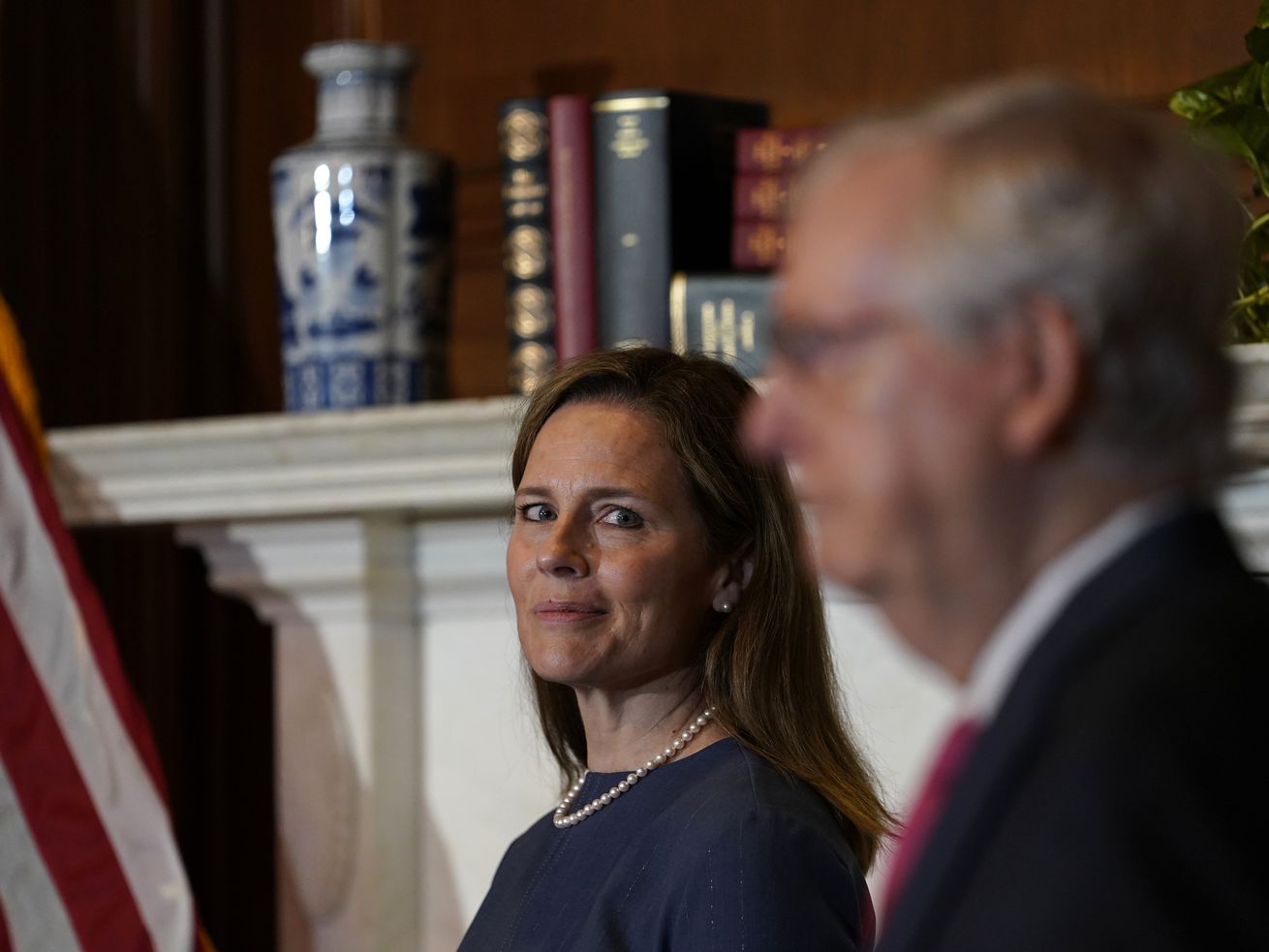 Judge Amy Coney Barrett, President Donald Trump’s nominee for the US Supreme Court, meets with Senate Majority Leader Mitch McConnell (R-KY). | Susan Walsh/Getty Images
The Republican Supreme Court was brought to you by a malapportioned Senate and the Electoral College.
In 2016, President Trump lost the national popular vote to Democratic nominee Hillary Clinton. He lost it by a lot — 2,865,075 votes, to be precise.
Meanwhile, the Senate just voted to confirm Trump’s third nominee to the Supreme Court. The vote was almost entirely along party lines, with Sen. Susan Collins (R-ME) crossing over to vote with all 47 members of the Senate Democratic caucus.
Yet, while pro-Barrett senators control a majority of the Senate, they represent nowhere near a majority of the entire nation. Indeed, the senators who voted against Barrett represent 13,524,906 more people than the senators who voted for her. (I derived this figure using 2019 census estimates of each state’s population. You can check my work using this spreadsheet.)
These two numbers — 2,865,075 and 13,524,906 — should inform how we view the actions Barrett will take now that she is one of the nine most powerful judges in the country. Barrett owes her new job to two of our Constitution’s anti-democratic pathologies.
If every American’s vote counted equally in a presidential election, Hillary Clinton would be president right now and Barrett would still be a law professor at Notre Dame. And if the Senate did not give Wyoming the same number of senators as California — despite the fact that California has more than 68 times as many people as Wyoming — Barrett would not have been confirmed.
And Barrett is not unique. The first justice in American history to be nominated by a president who lost the popular vote, and confirmed by a bloc of senators who represent less than half of the country, is Neil Gorsuch, Trump’s first nominee. The second is Brett Kavanaugh, Trump’s second nominee. The third is now Barrett. That’s half of the Supreme Court seats held by Republicans.
It is likely, moreover, that the Court’s newly enlarged Republican majority will make the United States even less democratic. Republican-appointed justices severely weakened the Voting Rights Act — the primary legal safeguard against racist voter discrimination — in Shelby County v. Holder (2013) and Abbott v. Perez (2018). Just last week, the Court divided 4-4 on whether to toss out an unknown number of ballots in the pivotal state of Pennsylvania.
The Pennsylvania Republican Party, which hopes to see these ballots tossed out, has already asked the Supreme Court to take up this case again. With Barrett on the Court, the GOP may now have five votes to prevail.
And that’s just the beginning. The Supreme Court plans to hear two related cases this term, Brnovich v. Democratic National Committee and Arizona Republican Party v. Democratic National Committee, which could potentially dismantle what remains of the Voting Rights Act. At the very least, these cases are likely to weaken the nation’s protections against racist voting laws, adding to the damage done by Shelby County and Perez.
Giving states broad leeway to target Black and brown voters will also likely hamper the ability of the Democratic Party, with its multi-racial coalition, to compete for the presidency or for control of Congress.
American democracy, in other words, has slipped into a death spiral. Anti-democratic features of our Constitution enabled a party that does not enjoy majority support to gain power. That party is now entrenching its power by appointing judges who tend to be hostile to voting rights. And, as the courts hand down more and more decisions undermining the right to vote, Democrats will find it harder and harder to compete in national elections.
Democrats, however, may have a brief opportunity to pull the nation out of this death spiral. Right now, polls show Democratic presidential nominee Joe Biden favored to win his upcoming election, and Democrats are favored to gain control over both houses of Congress.
If Democrats control Congress and the White House, they can add seats to the Supreme Court or enact other judicial reform measures that can dilute the influence of judges like Barrett and even reestablish a pro-democracy majority on the nation’s highest Court.
Even in the best-case scenario for Democrats, however, there is no guarantee that they will hold onto the Senate for more than two years. Indeed, because of Senate malapportionment, Republicans stand a decent chance of regaining control of the Senate in the 2022 midterm elections — especially if a Republican Supreme Court spends the two years between now and the midterms limiting the right to vote.
Democrats, in other words, will likely need to make a very difficult decision very quickly: add seats to, or drastically reform, the Supreme Court, or risk the further entrenchment of Republican power thanks to our anti-democratic Constitution.
Will you help keep Vox free for all?
The United States is in the middle of one of the most consequential presidential elections of our lifetimes. It’s essential that all Americans are able to access clear, concise information on what the outcome of the election could mean for their lives, and the lives of their families and communities. That is our mission at Vox. But our distinctive brand of explanatory journalism takes resources. Even when the economy and the news advertising market recovers, your support will be a critical part of sustaining our resource-intensive work. If you have already contributed, thank you. If you haven’t, please consider helping everyone understand this presidential election: Contribute today from as little as $3.
from Vox - All https://www.vox.com/2020/10/26/21534358/supreme-court-amy-coney-barrett-constitution-anti-democratic-electoral-college-senate
via HDMI Installers
Amy Coney Barrett has officially been confirmed as a Supreme Court justice
 Judge Amy Coney Barrett on Capitol Hill on October 1. | Anna Moneymaker/Getty Images
Barrett’s confirmation solidifies a 6-3 conservative majority on the high court.
In a narrow 52-48 vote, the Senate has officially confirmed Amy Coney Barrett for appointment to the Supreme Court, a huge win for Republicans who worked quickly — and ignored past precedent — to advance her nomination.
Barrett, who will now take the seat of the late Justice Ruth Bader Ginsburg, is a staunch conservative whose vote could be the deciding one on upcoming cases involving the Affordable Care Act, abortion rights, and voting rights. Her confirmation solidifies a 6-3 conservative majority on the high court, and is likely to affect its skew for decades.
Ultimately, every Republican senator except Susan Collins (R-ME) voted in favor of Barrett’s confirmation, while no Democrats did. Collins voted against Barrett because she disagreed with the process used for her nomination, something Democrats had objected to as well. Democrats had also expressed concerns about the conservative slant of Barrett’s past writings and opinions.
Overall, Barrett’s nomination has been controversial for many reasons including its timing: In 2016, Senate Republicans refused for months to consider a Supreme Court nominee until after the general election, because they argued that the American people — through their votes — should have a voice in the decision-making process. This year, however, with less than two months to go until the election, Republicans moved to expedite Barrett’s confirmation.
/cdn.vox-cdn.com/uploads/chorus_asset/file/21990596/GettyImages_1229033436t.jpg) Kevin Dietsch/Getty Images
Kevin Dietsch/Getty Images
To do so, Republicans made approving Barrett’s nomination their absolute priority, even as multiple lawmakers were diagnosed with coronavirus and as stimulus talks remained at an impasse. “Nothing about this is normal,” Sen. Cory Booker (D-NJ) emphasized at the start of Barrett’s confirmation hearing. “Instead of doing anything to help people who are struggling right now, we are here.”
Just eight days before the general election, Barrett now joins the high court. Her rushed confirmation further underscores how determined Republicans are to continue their work remaking the federal judiciary — and opens the door for a comparable Democratic response should they retake the Senate majority.
Amy Coney Barrett’s nomination, briefly explained
With her confirmation, Barrett, 48, becomes the Supreme Court’s youngest justice and the first justice to be a mother of school-aged children.
Previously a judge on the Seventh Circuit and a longtime Notre Dame law professor, Barrett has also clerked for former Supreme Court Justice Antonin Scalia — and emphasized that her focus on originalism is similar to his. “His judicial philosophy is mine, too,” she’s said.
Barrett is also a devout Catholic, and she has written in the past about how faith relates to judicial decisions about the death penalty. She will also be among six justices on the court who subscribe to the Catholic faith.
As Vox’s Ian Millhiser has written, Barrett has the potential to roll back the Affordable Care Act, undo Roe v. Wade, and expand the interpretation of the Second Amendment as a member of the court. While she’s only been a judge for a few years, she’s critiqued the Court’s decisions to uphold the ACA in the past, and contributed to opinions that signal an openness to limiting abortion access.
Among the first cases that Barrett will consider as a Supreme Court justice is one examining whether the Affordable Care Act should be overturned: Pending any decision to recuse herself, she’ll weigh in on whether a change to the individual mandate — the tax Americans had to pay for not getting health insurance — would affect the validity of the entire law.
Much like previous judicial nominees, Barrett did not comment on how she’d rule on particular cases like this one. She has been critical of Justice John Roberts’s past opinions preserving the ACA. After the 2012 NFIB v. Sebelius decision, which preserved the ACA, she published an argument noting that Roberts’s conclusion “pushed the Affordable Care Act beyond its plausible meaning to save the statute.” There is reason to believe that she may view the current case differently, however.
There are outstanding questions about how Barrett would handle a slew of issues — including possible recusal in a case involving the upcoming election outcome, if that comes before the Supreme Court. Multiple Democrats had asked if Barrett would recuse herself from a case like this, since it could pose a conflict of interest given her recent appointment by Trump — who’d likely have a stake in the lawsuit. During her hearing, she declined to say whether she’d recuse herself, but noted that she’d take the steps needed to see if that would be appropriate.
/cdn.vox-cdn.com/uploads/chorus_asset/file/21990606/GettyImages_1276849295t.jpg) Chip Somodevilla/Getty Images
Chip Somodevilla/Getty Images
Overall, Barrett — following in the tradition of other judicial nominees — did not offer much indication on how she’d evaluate contentious subjects. But Democrats have expressed frustration at her evasiveness in general. She dodged a number of straightforward questions, included ones asking whether she believed that climate change was real and if she felt a president had the unilateral authority to delay an election.
This nomination process has fired up voters in both parties ahead of the election
Members of both parties have said that they’re fired up by the Supreme Court confirmation process, and the energy it has created could have an impact on the upcoming presidential and Senate races.
And for Democrats, the rapid-fire nature of Barrett’s confirmation, specifically, stood out as problematic — particularly since McConnell even told the White House to hold off on a badly needed stimulus agreement, in part, out of concern that it would complicate the timing of Barrett’s nomination, per the New York Times.
According to an October survey by Data for Progress, 47 percent of Democratic likely voters, 32 percent of independents and 47 percent of Republicans said that Barrett’s Supreme Court nomination was a factor they were considering as they headed to the polls. Meanwhile, 75 percent of likely Democratic voters think the entire confirmation process has been rushed, while 38 percent of independents, and 30 percent of Republicans agree.
Certain lawmakers on the Senate Judiciary Committee like Sens. Lindsey Graham (R-SC) and Kamala Harris (D-CA) have also used this opportunity to energize their respective bases as they vie for reelection and the White House, respectively.
In the long term, Democrats have signaled that Republicans’ willingness to expedite Barrett’s nomination has opened the door to similar actions on their part if they retake power. Progressive groups and lawmakers have urged Senate Democrats to consider modifying how the Court operates — or even expanding the size of the Court — if they end up winning the seats needed to do so, for example.
“Don’t think when you have established the rule of ‘because we can,’ that should the shoe be on the other foot, you will have any credibility to come to us and say: ‘Yeah, I know you can do that, but you shouldn’t,’” Sen. Sheldon Whitehouse (D-RI) said earlier this month. “Your credibility to make that argument at any time in the future will die in this room and on the Senate floor if you continue.”
/cdn.vox-cdn.com/uploads/chorus_asset/file/21990660/GettyImages_1228786023t.jpg) Erin Schaff/Getty Images
Erin Schaff/Getty Images
Will you help keep Vox free for all?
The United States is in the middle of one of the most consequential presidential elections of our lifetimes. It’s essential that all Americans are able to access clear, concise information on what the outcome of the election could mean for their lives, and the lives of their families and communities. That is our mission at Vox. But our distinctive brand of explanatory journalism takes resources. Even when the economy and the news advertising market recovers, your support will be a critical part of sustaining our resource-intensive work. If you have already contributed, thank you. If you haven’t, please consider helping everyone understand this presidential election: Contribute today from as little as $3.
from Vox - All https://www.vox.com/2020/10/26/21529619/amy-coney-barrett-confirmed-supreme-court
via HDMI Installers
Not even prison can keep John McAfee from shilling shady crypto

John McAfee is in a Spanish prison awaiting possible extradition to the U.S. on charges of tax evasion, but that hasn't stopped the one-time cybersecurity expert from pumping some sketchy altcoin.
McAfee, known for his love of bath salts and allegedly being secretly paid to promote questionable cryptocurrencies to his unsuspecting acolytes, has long sung the praises of dubious investments. In a rambling Q&A-style statement tweeted Monday, the 75-year-old made clear that his fundamental nature remains unchanged.
That's right, even behind bars McAfee is trying to convince the world to invest in some random shitcoin. Read more...
More about Cryptocurrency, John Mcafee, Tech, and Cryptocurrency Blockchainfrom Mashable https://mashable.com/article/john-mcafee-pushes-cryptocurrency-from-spanish-jail/
via Middlesbrough
The new LELO Soraya Wave is better than the original, but is it worth $250?
Soraya Wave
$249
The Good
WaveMotion technology that mimics fingers for acute g-spot stimulation • Eight settings for different clit/g-spot stimulation combos • Sleek lookThe Bad
The manual doesn't detail exactly what the settings are • High price pointThe Bottom Line
The Soraya Wave is perfect for sex toy users who love simultaneous clit and g-spot stimulation — but its price may be a deterrent.⚡ Mashable Score 4.0
😎 Cool Factor 5.0
📘Learning Curve 3.5
💪Performance 5.0
💵Bang for the Buck 4.0
As archaic as it looks now, the rabbit episode of Sex and the City changed the game for the sex toy industry. Vibratex, the company behind the toy that was featured, told Forbes that average annual sales of the Rabbit jumped 700 percent in the years following the episode. Read more...
More about Reviews, Sex, Sex Toys, Vibrators, and Culturefrom Mashable https://mashable.com/review/lelo-soraya-wave-review/
via Middlesbrough
Goop Coronavirus Guide
What would Gwyneth do? If you want to be the belle of the plague, how about a Birkin lambskin face mask or a champagne bidet?
from Everything https://www.newyorker.com/magazine/2020/11/02/goop-coronavirus-guide
via Middlesbrough
from Everything https://www.newyorker.com/magazine/2020/11/02/goop-coronavirus-guide
via Middlesbrough
Grouptherapy Embodies a New Model of Cultural Versatility
Formed as a reaction to the commercialization of creative energy, the collective project is refreshingly effortful.
from Everything https://www.newyorker.com/magazine/2020/11/02/grouptherapy-embodies-a-new-model-of-cultural-versatility
via Middlesbrough
from Everything https://www.newyorker.com/magazine/2020/11/02/grouptherapy-embodies-a-new-model-of-cultural-versatility
via Middlesbrough
Goblincore's feral coziness will get you through the rest of the year

Like the seasons, Internet aesthetics come and go. As the days get colder and nights longer, the aspirational cottagecore of earlier months, with its sun-drenched wicker baskets and billowing dresses, is being rightly pushed aside for something grittier that we've all been feeling lately: goblincore.
Cottagecore dominated the first half of 2020, when states began mandating stay-at-home orders and the country was on hold. Unless they were essential workers, Americans found themselves newly confined to their homes with the expectation that life would return to normal sooner rather than later. Cottagecore is characterized by a deep desire to escape a metropolitan life for a slower, pastoral one. The cottagecore aesthetic has its faults, and has been criticized for romanticizing a colonialst mindset of homesteading, but the desire for a less frantic way of existing permeated American homes throughout quarantine. Read more...
More about Tumblr, Halloween, Tiktok, Culture, and Web Culturefrom Mashable https://mashable.com/article/goblincore-feral-aesthetic-tiktok-tumblr/
via Middlesbrough
New top story on Hacker News: Ask HN: Is there a website specialized in mathematics courses?
Ask HN: Is there a website specialized in mathematics courses?
6 by dalleh | 6 comments on Hacker News.
I have a BSc in computer engineering and part of the major was just a couple of calculus and discrete math courses. I want to expand my knowledge in mathematics through online courses. Is there a specialized website that offers courses in various mathematics fields?
Middlesbrough
6 by dalleh | 6 comments on Hacker News.
I have a BSc in computer engineering and part of the major was just a couple of calculus and discrete math courses. I want to expand my knowledge in mathematics through online courses. Is there a specialized website that offers courses in various mathematics fields?
Middlesbrough
Where we left off with 'The Mandalorian' Season 1

The Mandalorian returns to Disney+ for its second season on Friday, Oct. 30 — and while we couldn't be more excited to reunite with The Child, his father, and Carl Weathers, we're probably not alone in needing a little refresher on what last happened to them.
Here's where The Mandalorian left off — and what we can expect of Season 2.
This is the (name)
No Mandalorian is actually named Mando, no matter how jauntily Carl Weathers says it. His real name is Din Djarin, and he wasn't born on Mandalore, but raised by Mandalorians after his parents died.
He also has a face! We here in the Milky Way galaxy knew that Pedro Pascal was the face behind the helmet, but true to his credo, our hero didn't reveal himself to any living being in Season 1. He only removed the helmet in life-threatening circumstances, and that was in front of a droid — a neat little loophole courtesy of IG-11 (R.I.P.). Read more...
More about Star Wars, The Mandalorian, Entertainment, Star Wars, and Movies Tv Showsfrom Mashable https://mashable.com/article/mandalorian-season-1-recap/
via Middlesbrough
John Oliver unpacks the Trump administration's quiet, 'truly evil' war on asylum seekers

"The Trump administration's attack on asylum has been focused, dedicated and deeply resourceful," said John Oliver at the top of Sunday's episode of Last Week Tonight. "And I know that those aren't adjectives you're used to associating with this administration. But in this one area, they've been truly disciplined about being truly evil."
The process of applying for asylum in the U.S., Oliver notes, "has never been easy. But this administration has made it absolute hell. Their policy of family separation caused widespread outrage, but they have done so much more than that. And it's worth slowing down right now to look at three tactics that they've used in particular: migrant protection protocols, safe third country agreements, and Title 42. And I know that none of those have the harrowing ring of 'family separation', but each represents another cruel, calculated decision that has largely flown under the radar." Read more...
More about Donald Trump, John Oliver, Last Week Tonight, Asylum, and Family Separationfrom Mashable https://mashable.com/video/john-oliver-asylum-seekers/
via Middlesbrough
Sunday, 25 October 2020
This beginner-friendly course teaches you how to write a successful script

TL;DR: The Screenwriting Made Easy: 2020 Beginner Course is on sale for £22.22 as of Oct. 26, saving you 85% on list price.
Great works of art are often created during times of complete chaos. When people are forced to stop, reflect, and think of new ways to use their voices in the world, the results can be truly amazing. While you may not have thought of yourself as a screenwriter thus far in your lifetime, now may be your moment.
And if cinema is your medium of choice, this Screenwriting Made Easy: 2020 Beginner Course could be your ticket to (virtual) Sundance. You've binged enough Netflix to know what it takes, so now, it's your turn to write one. Read more...
More about Screenwriter, Mashable Shopping, Online Courses, Shopping Uk, and Uk Dealsfrom Mashable https://mashable.com/uk/shopping/oct-26-screenwriting-for-beginners-online-course-sale/
via Middlesbrough
Cartoon Caption Contest
Submit your caption.
from Everything https://www.newyorker.com/magazine/cartoon-caption-contest/this-weeks-contest-2020-11-02
via Middlesbrough
from Everything https://www.newyorker.com/magazine/cartoon-caption-contest/this-weeks-contest-2020-11-02
via Middlesbrough
One true thing Donald Trump said in that '60 Minutes' interview

In Sunday night's now infamous 60 Minutes interview, Donald Trump told at least 16 lies, according to CNN.
But he did get something right. Right before he made a number of menacing statements to Lesley Stahl, and then walked off in a huff in the middle of the interview, Trump reminded the world how he ended up in the White House in the first place.
“I think I wouldn’t be here if I didn’t have social media," said Trump.
Asked whether his tweets or name-calling turn people off, President Trump says: “I think I wouldn’t be here if I didn’t have social media.”
Moments later, he abruptly ended the interviewhttps://t.co/I6zv8qogcF pic.twitter.com/JYfPYOWGym— 60 Minutes (@60Minutes) October 26, 2020 Read more...
from Mashable https://mashable.com/article/trump-social-media-60-minutes/
via Middlesbrough
Subscribe to:
Posts (Atom)