Today's Trending Video in Middlesbrough

Middlesbrough News Featured post

Kim Jong-un: fragile and under pressure but he won’t give up

The Observer The North Korean leader’s surprise freeze of his nuclear programme is less a genuine move than a diplomatic manoeuvre,...

BBC News - Home

Best Video In Middlesbrough

The Guardian

Best Middlesbrough Videos

Showing posts with label Vox - All. Show all posts

Tuesday, 10 November 2020

The incredibly bizarre Dean Browning and “Dan Purdy” Twitter drama, explained

A politician was accused of using a fake burner account for a gay Black Trump supporter. That’s when things got weird. 

Dean Browning, a former commissioner in Lehigh County, Pennsylvania, confused Twitter users on Tuesday when he replied to his own tweet claiming to be a gay Black man who voted for Trump. In reality, Browning is a white man who describes himself as a “proud pro-life & pro-2A Christian conservative,” as his Twitter photo and bio clearly illustrate. None of this makes sense, but don’t worry, it will make even less sense soon.

Here is what happened: On November 8, Browning tweeted, “What Trump built in 4 years, Biden will destroy in 4 months” — a standard sentiment percolating on the MAGA internet right now. On Tuesday, November 10, when another user argued that, actually, it was Obama who built what Trump takes credit for, Browning came back with a retort.

“I’m a black gay guy and I can personally say that Obama did nothing for me, my life only changed a little bit and it was for the worse,” he wrote. “Everything is so much better under Trump though. I feel respected — which I never do when democrats are involved.”

To anyone who has spent enough time watching pro-Trump conservatives and #resistance liberals argue on the internet, it seemed extremely clear what had taken place. Browning was the owner of another Twitter account, one claiming to be a gay Black man who loved Trump, and he simply forgot to log in to it before posting the reply (this is often called “sock puppeting” online). Immediately, users began to flood into the discussion, calling out Browning’s accidental exposure of his fake burner account.

The situation seemed to remain a mystery to Browning, who left the tweet up for several hours. Later in the day, though, he said that it was actually all a misunderstanding. “Regarding the tweet that is going viral from my account — I was quoting a message that I received earlier this week from a follower,” he wrote. “Sorry if context was not clear. Trump received record minority votes & record LGBTQ votes. Many people won’t say it vocally, but do in private.”

Though Browning attempted to use the “silent majority” argument, most people didn’t buy it. Within the span of just a few minutes, Washington Post journalist Phillip Bump claimed to have found the smoking gun: the fake account in question. “You know who replies to Dean Browning a lot? ‘Dan Purdy,’ a gay black Trump supporter who joined Twitter in October,” wrote Bump, including screenshots of Purdy’s frequent replies to Browning.

@DanPurdy322 is an account with a cartoon of a Black man wearing a beanie as its avatar and a Trump 2020 logo as its header. As people on Twitter soon discovered, it also has a history of posting extremely racist and sexist remarks. Sample tweets include “Black ppl can’t count” and “black women will be the death of America,” among many others, in Purdy’s short time on the platform.

If Browning turns out to be the man behind the account, this is not a new phenomenon, particularly among conservatives. As far back as 2016, experts were identifying huge networks of pro-Trump bot accounts for people who didn’t actually exist. In October, Clemson University social media researcher Darren Linvill told the Washington Post that he’d identified more than two dozen Twitter accounts claiming to be Black Trump voters who’d gained hundreds of thousands of “likes” and retweets in the span of just a few days, sparking major doubts about their identities. Many used photos of Black men from news reports or stock images, including one in which the text “black man photo” was still watermarked on the image. White nationalists have also had a history of disguising as “antifa” online to sow fear toward leftists.

The Browning-Purdy plot thickened, however, when the account posted a video shortly thereafter of a Black man claiming to be Purdy himself. “I sent that message to Dean, Dean accidentally posted it somehow, that’s the end of the story,” he said. “No, he’s not a sock puppet. No, I’m not a bot.”

Many of the replies to the video asked questions like, “How much is he paying you?” and accusing him of being a hired actor. Internet sleuths like Jon Hendren (better known as @fart on Twitter) used Google to discover that “Dan Purdy” was also the name listed on a suspected account that had a history of several other aliases — including “Pat Riarchy” and “White Goodman.”

In yet another twist, people noticed similarities between the avatars — and faces — of the man in the video and William Holte, otherwise known as Byl Holte, otherwise known as the adopted son and nephew of music legend Patti LaBelle. Holte has indeed written several articles on Medium complaining about feminism and anti-racism in the media and proudly calls himself an “anti-feminist TV critic.”

However horrifying the tweets from “Dan Purdy” may be, the fiasco has offered, for some, a welcome distraction from the news. Much like the objectively hilarious Four Seasons Total Landscaping ordeal, the idea that a small-time Republican politician is posing as a gay Black man on Twitter — who may also be Patti LaBelle’s actual son — is too juicy to ignore. “Congratulations to Dean Browning, today’s main character,” tweeted Chris Geidner. “I really needed this … LMAO” added Yashar Ali.

Browning, meanwhile, continues to, as they say, “tweet through it,” while Purdy’s account has been suspended. Vox has reached out to Dan Purdy and Dean Browning (and Patti LaBelle) and will update with more info as it comes in.


from Vox - All https://www.vox.com/the-goods/2020/11/10/21559458/dean-browning-dan-purdy-byl-holte-patti-labelle-twitter-gay-black-man
via HDMI Installers

How the Navajo Nation helped push Democrats ahead in Arizona

Emerson Gorman, a Navajo elder, with his family in the Navajo Nation town of Steamboat in Arizona. There are roughly 67,000 eligible voters in the Navajo Nation. | Mark Ralston/AFP via Getty Images

Indigenous voters are often forgotten about. But they may have been key in turning swing states for Democrats.

Before the onset of the Covid-19 pandemic, grassroots organizers in the Navajo Nation were able to attend chapter meetings and perform door-to-door campaigns to encourage people to register to vote. But as the pandemic continued to overwhelm tribal communities, field organizers had to figure out other ways to reach out to Native American voters while limiting physical contact to prevent the spread of the virus. It was a challenge, considering many homes in Indian reservations do not have formal addresses and post offices tend to be miles away.

However, the pandemic didn’t stop organizations like the Rural Utah Project from doing the work. When the lockdown was lifted in May, field organizers in the Navajo Nation — whose territory stretches across New Mexico, Utah, and northern Arizona — returned to the ground and left flyers with voting information inside resealable plastic bags at people’s doors. The group had also partnered with Google to provide plus codes that serve as addresses based on longitudes and latitudes in parts of the Navajo Nation that can be hard to track and created hotlines to direct Indigenous voters to the right place, since voting precincts tend to be confusing. This robust voter outreach by grassroots advocates, many believe, impacted the results of the election in the state.

drive-thru voter registration Rural Utah Project
The Rural Utah Project organized drive-through voter registration events across the Navajo Nation ahead of the 2020 election.

Indigenous people make up nearly 6 percent of Arizona’s population, with eligible voters in the Navajo Nation reaching roughly 67,000. Although Indigenous populations are often overlooked by the Democratic Party and categorized as “something else” by the media, precinct-level data shows that 60 to 90 percent of Navajo Nation voters went for Democratic presidential candidate Joe Biden. And though the presidential race has already been called for Biden, it looks highly likely he’ll win Arizona, too. He is currently ahead by 15,000 votes in the state — a fraction of the votes given to him by the Navajo.

In Wisconsin, another key battleground state, Indigenous voters also may have aided Biden’s narrow win. Native Americans make up about 1.2 percent of the state’s population, or 70,000 people. While the exact percentage of the Native vote Biden received is still uncertain, some key facts point to voter turnout in tribal lands. Menominee County, dubbed a bellwether for the state, overlaps with the Menominee Reservation and has an Indigenous population of nearly 90 percent. Biden won the county with 1,303 votes, compared to President Donald Trump’s 278 votes.

“If it hadn’t been for the tribal nations, Biden truly wouldn’t be in office,” said Tara Benally, field director for the Rural Utah Project, a nonprofit organization that advocates and performs outreach to underrepresented voters. “Just seeing the turnout, that’s something Biden should be aware of and needs to truly understand that he has to work with these Indigenous nations — because if Biden doesn’t come through for these Indigenous nations, what does that mean for him? Where does Trump come into play again?”

The Navajo Nation turned out for Democrats after being ignored by Republican leaders in the pandemic

2020, in particular, has been a challenging year for tribal communities. Indigenous people were hit disproportionately hard by the pandemic, which compounded the underlying health and environmental injustices they already face. By May, the Navajo Nation quickly recorded the highest number of Covid-19 cases per capita in the country, exceeding numbers in New York and New Jersey. Yet despite the devastating health emergency, Republican state officials did little to keep the virus from spreading. Not only did the Trump administration slash funding for Indigenous communities, but policies for mask mandates, business lockdowns, and translations for Covid-19 resources were lacking. And when the federal stimulus package rolled out nationwide, finances were slow to arrive in tribal nations.

“There’s been a lot of distrust with the government, especially with treaties and funding. Anytime we get a budget, they tend to get cut,” Benally said. “When nations do expect funding from the federal government, it’s very minimal and it doesn’t go very far.”

Native Americans continue to reckon with a longstanding history of neglect and mistreatment. These unjust legacies have impacted their access to health care services, education, water affordability, and other critical resources. So when Biden and his running mate, Kamala Harris, released a comprehensive plan for tribal nations in October, which highlights strengthening nation-to-nation relationships and addressing health disparities, Indigenous communities caught a slight glimpse of hope.

Jade Begay, a member of the DinĂ© and Tesuque Pueblo tribes of New Mexico and the creative director of NDN Collective, an organization dedicated to building Indigenous power, says she was encouraged by the first two points in Biden’s plan, which reflect the current crises tribal nations are facing, including growing mistrust in the federal government as well as the pandemic that has strained health care services in Indigenous communities.

“But in years to come,” she added, “what would be great to see from elected officials and the Democratic Party, if they want to keep winning Indian Country, is investment to remove voter suppression barriers, to make voting more accessible to our communities, to invest in roads, and all of these things that just make traveling to cast a vote easier.”

As with most marginalized communities across the country, voter suppression and accessibility issues run rampant in tribal nations. For instance, unjust mail services make it difficult for Native Americans on tribal lands to vote. Scottsdale, Arizona, a city of roughly 184 square miles, has 12 post offices compared to 26 post offices in the entire Navajo Nation, which covers more than 27,000 square miles; the Salt River Pima-Maricopa Indian Community has zero.

In addition to Biden’s victory in Arizona, Begay said Indigenous communities played a pivotal role in helping Mark Kelly flip a Senate seat to Democrat. Kelly spent campaign dollars actively reaching out to the Navajo Nation, running ads in the DinĂ© language to bridge communication barriers. “That kind of outreach is really important and it shows the level of care and thoughtfulness in language gaps,” she said.

This year’s election also broke records in representation: Three of the 18 Native American women who ran for office won congressional seats — Democrats Deb Haaland, a Laguna Pueblo member in New Mexico, and Sharice Davids, a Ho-Chunk Nation member in Kansas, were both reelected to a second term, while Republican Yvette Herrell, member of the Cherokee Nation in New Mexico, beat the Democratic incumbent — the highest number in a single election cycle. Native American women represent about 1.1 percent of the US population yet have historically been underrepresented in Congress. Both Begay and Benally underscored the significance of this shift, especially in light of the longstanding patriarchal structure in Indigenous communities.

“At this time, the representation is really going to elevate women’s voices, as a woman, as a mother, and as a parent,” said Benally. “For many decades, it has just been the male leadership; it’s always been one-sided. In Navajo, men turn to their women on what needs to happen, what happens on a day-to-day basis, because the women took care of the house, the kids, and all the men did was go out to gather and hunt. For so long, that hasn’t happened here with the federal government, and now that it’s happening, Indigenous women will really make change happen for the people.”

But even with Indigenous people overwhelmingly throwing their support to a Biden-Harris administration, organizers say the work is not done. From stopping the Keystone XL pipeline to protecting Indigenous women and girls as well as demilitarizing the US-Mexico border that crosses tribal land, Begay said there is still a spate of issues that Native Americans want to see a new administration held accountable for.

“With women in office, they know what it means to take care of a family around the clock,” she said. “To have that kind of person in leadership in these offices makes a lot of sense for how we’re dealing with a pandemic, how we deal with climate change, all of these things that influence the livelihoods of our families — how we access food, how we access our basic needs — and so having that kind of leadership in place is going to be really important.”


from Vox - All https://www.vox.com/21559183/navajo-nation-arizona-biden-indigenous-voters
via HDMI Installers

Sunday, 8 November 2020

2020 House election live results

Amanda Northrop/Vox

Democrats have kept the House, but some races have yet to be called. Follow the vote count here.

Update, November 8, 8:50 pm: Democrats have held on to their majority, with races yet to be called that will determine the exact balance of power.


While Democrats aimed to retake the White House and the Senate on Election Day, they are also defending their US House majority in 435 congressional elections across the country.

But the vote count, as in several other races, is coming in slowly — and it could be days or weeks before we know the House’s exact makeup. Democrats appear to have maintained control of the chamber, but with a slimmer majority.

Democrats won the House in the 2018 midterm elections, netting more than 40 seats to regain a sliver of power after two years of complete Republican control. Their new majority set about passing a largely symbolic agenda meant to demonstrate how they would govern if they retook the presidency and the Senate (with voting rights bills and legislation to lower health care costs at the top of the list) while trying to stave off fights among party members (Medicare-for-all never got a House vote, but committee hearings were held).

The history books will most remember the Democratic House majority of the 116th Congress for impeaching President Donald Trump in December 2019, over his apparent attempts to use the power of his office to solicit politically damaging information about Joe Biden before the latter won the Democratic presidential nomination.

But now, Democrats are trying to hold on to their House majority with the hopes of winning a House-Senate-president trifecta — and getting a real chance to implement their agenda. Election forecasters considered Democrats to be heavy favorites to retain control and perhaps even gain seats. But as votes come in, Democrats appear headed toward a reduced House majority, and a Senate majority looks increasingly unlikely.

Here’s how Vox (and other media outlets) will be making calls throughout the night and following days. Vox is carrying live results, powered by our friends at Decision Desk. You can also follow live results for the presidential election here and Senate races here.

Three key states to watch in the 2020 US House elections

There are competitive House races across the country on Tuesday, from first-term Democrats trying to win reelection in Oklahoma and Utah with Trump on the ballot to vulnerable Republicans in Arkansas and Oklahoma hoping the president can help carry them to victory.

California and New York have a lot of House seats, and therefore a good number of close races. On the other end of that spectrum, Don Young, Alaska’s only at-large representative since 1973, is facing maybe his most serious reelection challenge to date.

But a handful of presidential swing states will also play an outsized role in the make-up of the House. Here is a sampling of some of the races we’re watching.

Texas: The Cook Political Report put seven House seats in Texas in their most competitive categories (Lean Democrat, toss-up, or Lean Republican). Democrats hoped to have a good shot to pick up at least a couple seats. One race in the 24th District is still close, but they are few other signs of a blue wave in the state.

North Carolina: A state court ruled last year that the Republican state legislature had unconstitutionally gerrymandered North Carolina’s congressional districts and ordered new, fairer maps to be drawn. That put five of the state’s 13 districts in play, according to Cook. Two of them were vacated by Republican incumbents after the districts were redrawn and are now considered likely Democratic pickups. But Democrats needed a substantial wave to gain more ground, and potential pick-ups in North Carolina’s Eighth, Ninth, and 11th Districts were ultimately called for Republicans.

Iowa: Three of Iowa’s four House races were expected to be competitive on election night, according to Cook, thanks to the state’s independent redistricting commission that aims to prevent partisan gerrymandering. Two have been called, but the Iowa Second District seat is still a tight race as votes come in.

Correction, 6:30 pm ET: This post has been updated to accurately reflect poll closing times in Alaska and Hawaii.


from Vox - All https://www.vox.com/21551621/house-congress-2020-live-results
via HDMI Installers

House Democrats will keep their majority for two more years

House Speaker Nancy Pelosi and Senate Minority Leader Chuck Schumer speak with members of Congress after honoring the late Supreme Court Justice Ruth Bader Ginsburg on September 25, 2020, at the Capitol building in Washington, DC. | Jonathan Ernst/Getty Images

Democrats will keep the House. But Republicans had a better showing than expected.

House Democrats did not have the election they expected.

Decision Desk HQ projected Democrats will keep their majority in the House after calling races for Democratic Reps. Abigail Spanberger in Virginia and Tom O’Halleran in Arizona, officially bringing their count to 219 seats. Many more races have yet to be called.

Democrats faced unexpectedly stiff competition from Republican candidates in multiple districts. Rather than expanding their majority as many Democrats — and nonpartisan forecasters — expected, the Democratic margin in the House appears to be shrinking after they first flipped the chamber in 2018.

The story of the night for House Republicans was the success of Republican women candidates. Republicans flipped back six seats as of Wednesday morning, with Democrats only flipping two open seats in North Carolina. More races have yet to be called.

Led by House Speaker Nancy Pelosi, Democrats were widely expected to retain control of the lower chamber of Congress after they gained the advantage in the 2018 midterms. Pelosi and Democratic Congressional Campaign Committee Chair Cheri Bustos (D-IL) were projecting confidence going into the night, yet Bustos herself wound up in a much closer battle for reelection.

Democrats controlling at least one chamber is still an important result. With Joe Biden formally becoming President-elect, Democrats will control the House of Representatives and the White House, but the party’s chances to take back the Senate come down to two uncertain runoffs in Georgia.

House Democrats saw early losses in Florida, where first-term Democratic Reps. Donna Shalala and Debbie Mucarsel-Powell lost to Republicans after Democrats underperformed with Cuban American voters in Miami-Dade County.

In Oklahoma’s Fifth Congressional District, Democratic Rep. Kendra Horn lost to Republican challenger Stephanie Bice. In New Mexico’s Second Congressional District, vulnerable incumbent Rep. Xochitl Torres Small lost to Republican Yvette Herrell. And in South Carolina’s First Congressional District, Democratic Rep. Joe Cunningham lost to Republican Nancy Mace.

And even though Democrats invested big in Texas, hoping to replicate early success in 2018, they didn’t manage to unseat a single Texas Republican member of the House in 2020. Democrats hung on to the two Texas seats they flipped in 2018, but failed to pick up any additional seats.

House Democrats’ bright spots of the night mirrored presidential trends. Democrats flipped Georgia’s Seventh Congressional District from red to blue, mirroring a trend at the presidential level of Biden appearing to perform better than expected in Georgia.

Why Democrats struggled in some House races

It’s too early to say exactly what went wrong for House Democrats, who broadly hoped to comfortably expand their majority. District-level internal party polling had shown Republicans with the potential to lose even more seats in 2020.

Many Republican strategists had resigned themselves to the possibility that their House ranks could decrease. Instead, Republicans were the ones making gains — albeit modest enough ones to stay the minority party in the House.

Cook Political Report’s House editor Dave Wasserman had some early thoughts on Wednesday: Just like Biden, Democratic congressional candidates suffered losses among Hispanic voters in key races. Democrats had bad nights particularly in Florida and Texas; they lost a couple of incumbents in Florida and didn’t defeat a single Republican incumbent in Texas, despite making a massive investment in the state to target 10 districts.

Republicans also learned from their losses in 2018 and recruited top-tier women candidates, who were on a winning streak.

“After last night, Republicans are on track to more than double their current count of 13 women,” Wasserman wrote.

The one bright spot for Democrats is that first-term women candidates, particularly those from national security backgrounds, largely held their own in competitive races. After sounding the alarm for months that the political environment was closer than the polls showed, Michigan Rep. Elissa Slotkin (D) won her race on Wednesday; races for Reps. Mikie Sherrill (D-NJ), and Elaine Luria (D-VA) haven’t been called by Decision Desk yet.

These outcomes all elude a clean narrative. It’s difficult to say early on how much is based on strategic error, and how much is owed to the bizarre nature of this election year — amid a pandemic that significantly hampered Democrats’ ability to do basic campaigning tasks like door-knocking.

“Prior to Tuesday, most Republican strategists were privately resigned to the prospect of a double-digit loss of seats,” Wasserman wrote. “At this writing, Republicans may be on track to pick up between five and ten seats in the House, ironically about where our expectations started this cycle — but certainly not where they ended.”

Progressive Rep. Alexandria Ocasio-Cortez (D-NY), who easily fended off her own well-funded challenger, said that many embattled House Democrats failed to invest enough in digital advertising.

Two years after sweeping races across the country, the party now has to figure out what went wrong for their congressional candidates in 2020.

House Democrats may well have to contend with a Republican Senate

House Democrats have spent the past two years passing bills at a rapid clip, on everything from sweeping anti-corruption reforms to lowering the cost of prescription drugs to a $1.5 trillion infrastructure bill. But the vast majority of these bills were dead on arrival in the US Senate. It seems likely this ambitious agenda could continue to be on ice, unless Democrats flip two Georgia Senate runoff races that will be decided in January.

One of the few bipartisan pieces of legislation Pelosi, Mitch McConnell, and President Trump were able to agree on was the $2.2 trillion CARES Act at the beginning of the pandemic; a second stimulus package has been held up by partisan bickering. McConnell recently signaled willingness to pass another stimulus package before the end of the year. He called it a “top priority” for the Senate’s lame-duck session but was vague on concrete details.

Even on infrastructure — one of the few places where there seemed to be bipartisan agreement — getting a bill through could be elusive. Should Democrats flip the Senate, Pelosi has provided them a road map.

But it’s too early to say if they will get to use it.


from Vox - All https://www.vox.com/2020/11/8/21539959/election-2020-house-democrats-control-majority
via HDMI Installers

Saturday, 7 November 2020

SNL’s cold open took some parting shots at Donald Trump

Alec Baldwin as Donald Trump on SNL, November 8, 2020 NBC

After four years of Trump spoofs, the show tackled Biden’s victory without much inspiration.

Saturday Night Live’s cold opens have not been great this season, but on November 7 — the day a number of news outlets finally declared that Joe Biden had defeated Donald Trump and won the presidential election — a mediocre opening sketch was at least a bit understandable. After all, vote-counting fatigue set in for everyone at least three days earlier, and the real-life victory speeches it referenced had only happened hours before.

The episode started late in most markets, thanks to a long-running football game, but when it finally began, Wolf Blitzer (played by Beck Bennett) and John King (Alex Moffat) announced that “Election Week in America” was coming to a close. They called the race for Biden (Jim Carrey), who strode onto stage with what has become Carrey’s signature Biden move: finger guns.

Biden had appeared to give his first public address as president-elect. “Whether you’re from a liberal state like California or a conservative state like Oklahoma, or a cracked-out, hot mess like Florida, I will be your president!” he said. Kamala Harris (Maya Rudolph) followed, wearing a white suit and white blouse with a pussy bow that echoed Harris’s real-life victory speech ensemble from earlier in the evening. Periodically stopping for applause, she said, “Like Joe, I am humbled and honored to be the first female, the first Black, the first Indian-American, and the first biracial vice president. And if any of that terrifies you, well, I don’t give a funt.”

But of course, few Trump-era SNL cold opens are complete without the appearance of a clearly-over-it Alec Baldwin as Donald Trump. This time he ostensibly showed up to give a “concession” speech — but after declaring victory, he stepped over to a piano. In an echo of SNL’s somber post-2016 election cold open in which Kate McKinnon, playing Hillary Clinton, sang Leonard Cohen’s “Hallelujah” from a grand piano, Baldwin sang a slow version of the Village People’s “Macho Man.”

Was it Baldwin-as-Trump’s last appearance on the show? That’s about as likely as Trump disappearing from public consciousness. SNL’s handling of the Trump administration has been alternately baffling and annoying, and whether it’s equipped for what comes next is far from clear. But if the cold open felt limp, it also signalled the end of an era that SNL seems happy to stop spoofing. Biden and Harris’s Ace Ventura-echoing parting taunt of Trump — “Loser!” — felt like it came from deep within the show’s psyche. And most of the SNL audience seemed just fine with that.


from Vox - All https://www.vox.com/culture/21554828/snl-cold-open-joe-biden-victory-donald-trump-loser-macho-man
via HDMI Installers

Joe Biden in victory speech: “Let this grim era of demonization in America begin to end”

President-elect Joe Biden address the country from Wilmington, Delaware. | Andrew Harnik/AFP via Getty Images

The president-elect’s acceptance speech was a call to unite America.

President-elect Joe Biden used his acceptance speech as the 2020 election winner to unite a divided nation and rally the country to solve problems at home and abroad.

“I will govern as an American president,” Biden said to the crowd assembled in Wilmington, Delaware. “I will work as hard for those who didn’t vote for me as those who did. Let this grim era of demonization in America begin to end here and now.”

He continued: “This is the United States of America. There has never been anything we have not been able to do when we have done it together.”

The address stood in stark contrast to the general message of President Donald Trump, who uses most of his speeches to try to drive a wedge between his base and the rest of the country while finding opportunities to congratulate himself.

 Andrew HarnikAFP via Getty Images
President-elect Joe Biden (right) and Vice President-elect Kamala Harris in Wilmington, Delaware, on November 7.

Biden’s victory speech made sure to thank his supporters, campaign staff, and family for his win, and to laud his running mate, Vice President-elect Kamala Harris, the first woman elected to the vice presidency.

“Don’t tell me it is not possible in the United States. It’s long overdue,” Biden said of Harris’s historic first. “And we are reminded tonight of those who fought so hard for so many years to make this happen. Once again, America has bent the arc of the moral universe more toward justice.”

Finally, Biden appealed to all Americans to help make his presidency a success.

It remains a big question whether Biden can deliver on his promise to unite the divided states of America. For the moment, though, it seems his intention is genuine.

Read a rush transcript of Biden’s victory speech below.


Folks, the people of this nation have spoken. They have delivered us a clear victory. A convincing victory. A victory for we, the people.

We won with the most votes ever cast on a presidential ticket in the history of the nation: 74 million. Well, I must admit it surprised me. Tonight, we are seeing all over this nation, all cities and all parts of the country, indeed across the world, an outpouring of joy, of hope, renewed faith in tomorrow to bring a better day.

And I’m humbled by the trust and confidence you have placed in me. I pledge to be a president who seeks not to divide, but unify. Who doesn’t see red states and blue states, only sees the United States.

I work with all my heart with the confidence of the whole people to win the confidence of all of you.

And for that is what I believe America is about. It is about people. And that is what our administration will be all about. I sought this office to restore the soul of America, to rebuild the backbone of this nation, the middle class, and to make America respected around the world again. And to unite us here at home.

It is the honor of my lifetime that so many millions of Americans have voted for that vision. Now the work of making that vision is real.

Folks, as I said many times before, I’m Jill’s husband. And I would not be here without her love and tireless support. And my son Hunter and my daughter and all our grandchildren and their spouses and all our family. They are my heart. Jill is a military mom, an educator. She dedicated her life to education. Teaching is not just what she does, it’s who she is.

For American educators, it is a great day for y’all. You’re going to have one of your own in the White House. And Jill is going to make a great First Lady. I am so proud of her.

I will have the honor — you just heard from Kamala Harris, who will make history as the first woman, the first black woman, the first woman from South Asian descent, the first immigrant ever elected to this country.

Don’t tell me it is not possible in the United States. It’s long overdue. And we are reminded tonight of those who fought so hard for so many years to make this happen. Once again, America has bent the arc of the moral universe more toward justice. Kamala, Doug, like it or not, you’re family. You have become an honorary Biden. There is no way out.

For all of you who volunteered and worked the polls in this pandemic, local elected officials, you deserve a special thanks from the entire nation. And to my campaign team and all the volunteers and all who gave so much of themselves to make this moment possible, I owe you everything — I owe you everything.

All those who supported us, I am proud of the campaign we built and ran. I am proud of the coalition we put together: Democrats, Republicans, independents, progressives, moderates, conservative, young, old, rural, suburban, gay, straight, transgender, Native American.

I mean it: Especially in those moments when the campaign was at its slowest, the African American community stood up again for me. You all had my back, and I will have yours.

I said at the outset I wanted to represent this campaign, to make it look like America. We have done that. For all those of you who voted for President Trump, I understand the disappointment tonight. I lost a couple times myself. Now, let’s give each other a chance.

It is time to put away the harsh rhetoric, lower the temperature, see each other again, listen to each other again, and to make progress, we have to stop treating our opponents as an enemy. They are not our enemies: They are Americans — they are Americans.

The Bible tells us to everything there is a season, a time to build, a time to reap and a time to sow and a time to heal. This is the time to heal in America.

Now this campaign is over, what is the will of the people? What is our mandate?

I believe it is this — America has called upon us to marshal the forces of decency, the forces of fairness, to marshal the forces of science and forces of hope in the great battles of our time. The battle to control the virus. The battle to build prosperity. The battle to secure your family’s health care. The battle to achieve racial justice and root out systemic racism in this country. And the battle to save our planet by getting climate under control.

The battle to restore decency, defend democracy, and give everyone in this country a fair shot. That is all they are asking for, a fair shot.

Folks, our work begins with getting Covid under control. We cannot repair the economy or relish life’s most precious moments hugging our grandchildren, birthdays, graduations, all the moments that matter most to us, until we get it under control.

On Monday, I will name a group of leading scientists and experts as transition advisers to help take the Biden-Harris plan and convert it into an action blueprint that will restore it on January 20, 2021. That plan will be constructed out of compassion, empathy, and concern. I will spare no effort, none, or any commitment to turn around this pandemic.

Folks, I am a proud Democrat. But I will govern as an American president. I will work as hard for those who didn’t vote for me as those who did. Let this grim era of demonization in America begin to end here and now. Refusal of Democrats and Republicans to cooperate with one another is not some mysterious force beyond our control; it is a decision, a choice we make.

If we decide not to cooperate, we can decide to cooperate. I believe this is part of the mandate given to us from the American people. They want us to cooperate in their interests. That is the choice I will make. I will call on Congress — Democrats and Republicans alike — to make that choice with me.

The American story is about a — about slow, yet widening the opportunities in America. Too many dreams have been deferred for too — deferred for too long. No matter their race, faith, identity, or disability.

Folks, America has always been shaped by inflection points, by moments in time where we made our decisions about who we are and what we want to be. Lincoln in 1860 coming to save the union. FDR in 1932 promising a beleaguered country a new deal. JFK in 1960 pledging a new frontier. And 12 years ago, when Barack Obama made history, he told us “Yes, we can.”

Folks, we stand at an inflection point. We have the opportunity to beat despair, to build prosperity and purpose. We can do it. I long talked about the battle for the soul of America. We must restore the soul of America. Our nation is shaped by the constant battle between our better angels and our darkest impulses. It’s time for our better angels to prevail.

Tonight, the whole world is watching America. And I believe at our best, America is a beacon for the globe. We will lead not only by the example of our power, but by the power of our example.

I have always believed, and many heard me — heard me say we can define America in one word: Possibility. That in America everyone should be given an opportunity to go as far as their dream and God-given ability will take them. You see, I believe in the possibility of this country.

We are always looking ahead, ahead to an America that is freer and more just, that treats jobs with dignity and respect, an America that cures diseases like cancer and Alzheimers, an America that never leaves anyone behind. Ahead to an America that never gives up, never gives in.

This is a great nation. It has always been a bad bet to bet against America. This is the United States of America. There has never been anything we have not been able to do when we have done it together.

Folks, in the last stages of the campaign, I began thinking about a hymn that means a lot to me and my family that captures the faith that sustains me and which I believe sustains America. And I hope it can provide comfort and solemn to the Americans who lost a loved one to this terrible virus this year. Our hearts go out to each and every one of you.

Hopefully this hymn gives you solemn. It goes like this: And he will raise you up on eagle’s wings, and make you a sign like the sun and hold you in the palm of his hand.

Together on eagle’s wings we embark on the work God called upon us to do with full hearts and steady hands, with faith in America and in each other, with love of country, a thirst for justice. Let it be the nation that we know we can be, a nation united, a nation strengthened, a nation healed.

The United States of America, ladies and gentlemen, there has never been anything we have tried and not been able to do. Remember, as our grandpop said when we walked out of our home, he said “Joe, keep the faith.” Our grandmother when she was alive said, “No, spread the faith.”

May God bless America, and may God protect our troops.

Thank you. Thank you. Thank you.


from Vox - All https://www.vox.com/2020/11/7/21554701/joe-biden-acceptance-speech-2020-election
via HDMI Installers

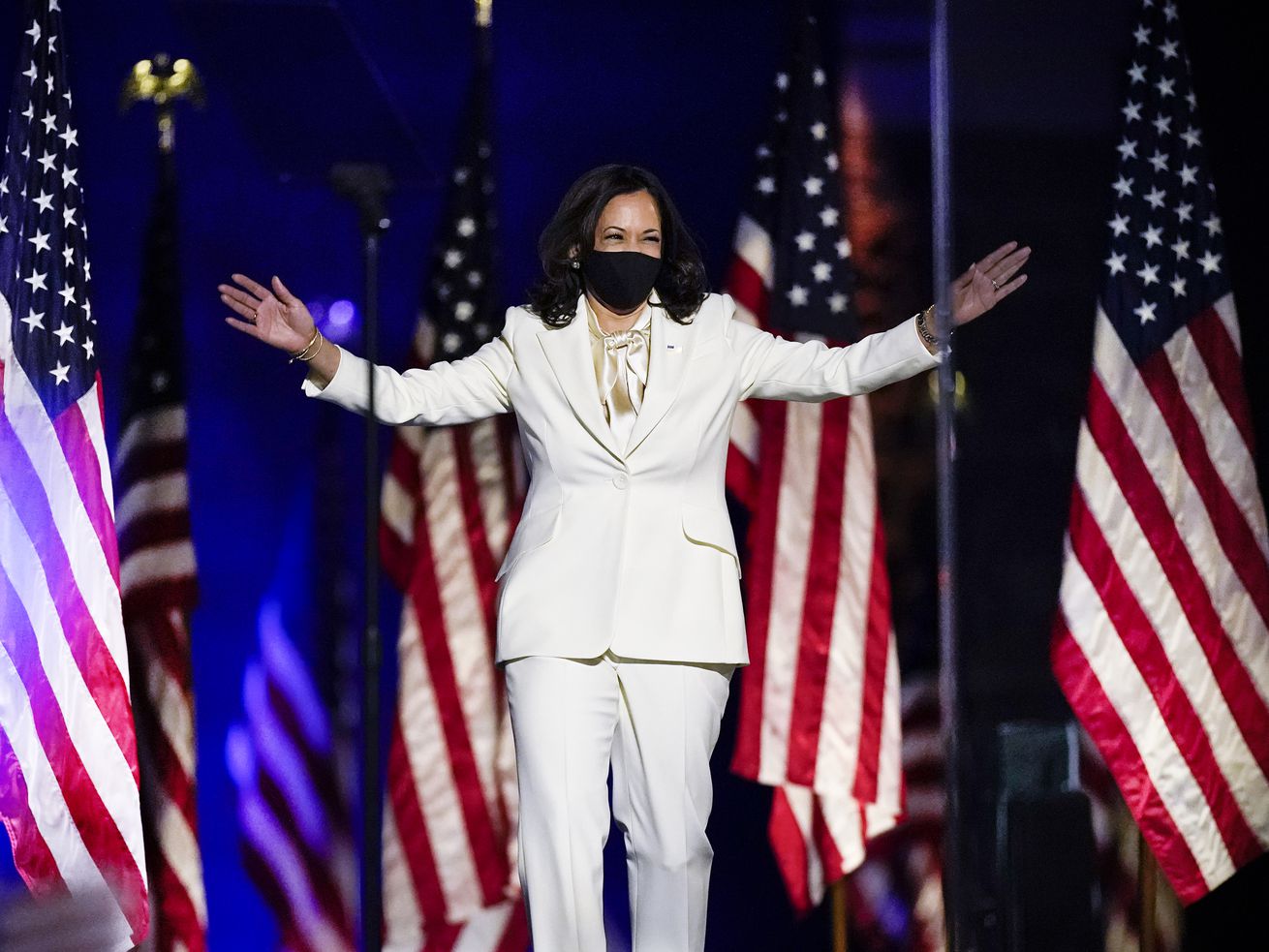
Vice President-elect Kamala Harris sent a strong message with her all-white suit

Harris spreads her arms as if hugging the crowd before her in a well tailored white suit, white silk pussy bow blouse, and black face mask. Behind her is a row of US flags, and she is illuminated by blue spotlights. Vice President-elect Kamala Harris arrives to speak in Wilmington, Delaware. | Andrew Harnik/AP

Harris wore all white for her victory speech, honoring suffragists.

Vice President-elect Kamala Harris began her acceptance speech with a strong statement: a white suit.

It was a striking message, sent before she said a word — the color was the one worn by suffragists as they fought for the right to vote.

Salutes to those women have been popularized by Democratic women in recent years — at this year’s State of the Union address, many lawmakers wore white in honor of the 100th anniversary of the 19th Amendment, which gave women the right to vote.

Many women lawmakers wore white during the 2017 and 2019 State of the Union speeches as well.

As Vox’s Anna North has explained, the suffragist movement was not an inclusive one; Harris herself likely would have been excluded from the famous Seneca Falls Convention of 1848 that helped pave the path to the vote for women. While it was founded on the work on nonwhite women, North notes, “in the drive to get states to ratify the 19th Amendment, white advocates wanted the support of Southern white women — and their husbands and fathers — and were willing to sacrifice Black Americans’ voting rights in order to get it.”

Those white suffragists made that sacrifice, and were ultimately successful in gaining the vote for themselves. Legally protected enfranchisement for Black women didn’t come until decades later — but to secure it, women of color created their own groups. And in those groups, they were able to, North writes, “work simultaneously against sexism and racism — pushing for federal anti-lynching legislation, for example.”

In many ways, Harris is the embodiment of the dreams and hard work of many of these women, white and nonwhite — not just because she is a woman, or a woman of color, but because she was able to take the stage thanks to the work of so many women, including modern women activists who have given their time and effort to register and motivate voters.

And while experts are still studying the electorate to understand who voted for whom, early exit polls suggest that women — particularly women of color — helped power Biden and Harris’s victory, whereas it appears Trump won among men.

Harris honored those women in her speech, thanking “all the women who have worked to secure and protect the right to vote for over a century.”

“One hundred years ago was the 19th Amendment,” Harris said. “Fifty-five years ago was the Voting Rights Act. And now in 2020, with a new generation of women in our country who cast their ballots and continue to fight for their fundamental right to vote and be heard.”

It was thanks to those women, Harris said, that the United States can now begin “to see what can be unburdened by what has been.” It was for them she wore white — and maybe even why she paired her suit with a pussy-bow blouse — to honor those who sacrificed and suffered to make her present possible.


from Vox - All https://www.vox.com/2020/11/7/21554695/vice-president-elect-kamala-harris-speech-white-suit
via HDMI Installers

Kamala Harris: “I may be the first woman to hold this office. But I won’t be the last.”

Vice President-elect Kamala Harris speaks in Wilmington, Delaware, on November 7. | Andrew Harnik/AP

Kamala Harris’s acceptance speech is historic.

Kamala Harris just made history in her speech as the first woman to be elected vice president of the United States.

“America’s democracy is not guaranteed. It is only as strong as our willingness to fight for it,” Harris declared. Dressed in a suffragette white suit and a (possibly pointed) pussy-bow blouse, Harris thanked all the poll workers and elected officials who worked on this week’s long election, saying, “You have protected the integrity of our democracy.”

Harris, who is also the first Black person and first South Asian elected vice president, spoke of the women who have “paved the way for this moment tonight,” sparing particular attention for “the Black women who are too often overlooked, but so often prove they are the backbone of our democracy.” She added that she wanted to prove to all children watching that America “is a country of possibilities.” For that reason, she declared, “I may be the first woman to hold this office. But I won’t be the last.”

Read a rough transcript of the full speech below.


Good evening. Thank you. Thank you. Good evening. [Cheers and applause]

So Congressman John Lewis, before his passing, wrote, “Democracy is not a state, it is an act.” What he meant was America’s democracy is not guaranteed. It is only as strong as our willingness to fight for it.

To guard it and never take it for granted. And protecting our democracy takes struggle. It takes sacrifice. But there is joy in it. And there is progress, because we the people have the power to build a better future.

And when our very democracy was on the ballot in this election, with the very soul of America at stake, and the world watching, you ushered in a new day for America.

Through — your campaign staff and volunteers, this extraordinary team, thank you for bringing more people than ever before into the democratic process.

And for making this victory possible, to the poll workers and election officials across our country who have worked tirelessly to make sure every vote is counted, our nation owes you a debt of gratitude.

You have protected the integrity of our democracy. And to the American people who make up our beautiful country, thank you for turning out in record numbers to make your voices heard.

And I know times have been challenging, especially the last several months. The grief, sorrow, and pain. The worries and the struggles. But we have also witnessed your courage, your resilience, and the generosity of your spirit. For four years, you marched and organized for equality and justice, for our lives, and for our planet. And then, you voted.

And you delivered a clear message. You chose hope and unity, decency, science, and yes, truth.

You chose Joe Biden as the next president of the United States of America. And Joe is a healer, a uniter, a tested and steady hand. A person whose own experience of loss gives him a sense of purpose that will help us as a nation reclaim our own sense of purpose. And a man with a big heart who loves with abandon. It is his love for Jill, who will be an incredible first lady —

It is his love for Hunter, Ashley, and his grandchildren and the entire Biden family. And while I first knew Joe as vice president, I really got to know him as the father who loved Beau. My dear friend, who we remember here today. And to my husband Doug — And our children and my sister and our whole family, I love y’all more than I can ever express.

We are so grateful to Joe and Jill for welcoming our family into theirs on this incredible journey.

And to the woman most responsible for my presence here today, my mother, who is always in our hearts. When she came here from India at the age of 19, she did not quite imagine this moment, but she believes so deeply in an America where a moment like this is possible. So I am thinking about her and the generations of women, black women — Asian, white, Latina, Native American women who surround our nation — who throughout our nation’s history have paved the way for this moment tonight. Women who fought and sacrificed so much for equality and liberty and justice for all.

Including the black women who are too often overlooked, but so often prove they are the backbone of our democracy. All the women who have worked to secure and protect the right to vote for over a century. 100 years ago was the 19th amendment. 55 years ago was the voting rights act. And now in 2020, with a new generation of women in our country who cast their ballots and continue to fight for their fundamental right to vote and be heard. Tonight I reflect on their struggle, their determination, and the strength of their vision to see what can be unburdened by what has been. And I stand on their shoulders.

And what a testament it is to Joe’s character that he has the audacity to break one of the most substantial barriers that exists in our country and select a woman as his vice president. While I may be the first woman in this office, I will not be the last.

Because every little girl watching tonight sees that this is a country of possibilities. And to the children of our country, regardless of your gender, our country has sent you a clear message, dream with ambition. Lead with conviction.

See yourselves in a way that others may not, simply because they have never seen it before. But know that we will applaud you every step of the way.

And to the American people, no matter who you voted for, I will strive to be a vice president, like Joe was to president Obama — loyal, honest, and prepared. Waking up every day thinking of you and your family. Because now is when the real work begins. The hard work. The necessary work. The good work. The essential work to save lives and beat this epidemic. To rebuild our economy so it works for working people. To root out systemic racism in our social justice system and society. To combat the climate crisis. To unite our country and heal the soul of our nation.

And the road ahead will not be easy, but America is ready. And so are Joe and I.

We have elected a president who represents the best in us. A leader the world will respect and our children will look up to. A commander-in-chief who will respect our troops and keep our country safe, as a president for all Americans.

And it is now my great honor to introduce the president-elect of the United States of America, Joe Biden!


from Vox - All https://www.vox.com/policy-and-politics/21554699/kamala-harris-victory-acceptance-speech
via HDMI Installers

Friday, 6 November 2020

Joe Biden didn’t claim victory on Friday — but he urged Americans to be patient

President-elect Joe Biden speaks from Wilmington, Delaware on November 6. | Carolyn Kaster/AP

The president-elect expressed confidence in the democratic process and that a consensus would emerge that he is the winner.

President-elect Joe Biden stopped short of declaring victory on Friday night, instead seeking to unify a divided nation and urge patience with the democratic process as the vote count continues in key states.

“I know watching these vote tallies on TV move slowly upward can be numbing,” Biden acknowledged in his speech in Wilmington, Delaware.

Vox in partnership with Decision Desk HQ has projected that the former vice president is the winner of the election, but other major news organizations have yet to call the race in his favor. Biden appears to be waiting until there is consensus that he is the president-elect to deliver a victory speech.

But then he quickly pivoted to a message of unity. “We may be opponents — but we are not enemies,” he said.

Biden has often said on the campaign trail that he would be a president both to people who did vote for him, and those who didn’t. He reiterated that message on Friday night, saying that he feels a “duty of care for all Americans” to deal with pressing issues including the Covid-19 pandemic, racial justice and climate change.

“The purpose of our politics is not total unrelenting warfare,” he said. “We have to put the anger and demonization behind us. It’s time for us to come together as a nation to heal.”

He said that, even though the votes are still being counted, he is not wasting any time in getting ready to assume the presidency just as the US reported the highest number of new Covid-19 cases in a single day and approaches 240,000 total deaths from the virus. He said that he and Vice President-elect Kamala Harris have been taking meetings with public health and economic experts to prepare to deal with the pandemic and an increasingly precarious economic recovery.

“We’re not waiting to get the work done,” he said.

Biden, who has earned a record 74 million votes and counting, also projected confidence that he has achieved a decisive victory, claiming that Americans have “given us a mandate.” He predicted that he would become the first Democratic presidential candidate to win Arizona in 24 years and to win Georgia in 28 years.

President Donald Trump has yet to concede the election and multiple news outlets have reported that he doesn’t intend to do so, but Biden assured Americans to nevertheless maintain faith in the democratic process.

“Look, we both know tensions are high,” he said. “But we need to remember — we have to remain calm. As we count all the votes, we’re proving again what we’ve proved for 244 years in this country: democracy works. Your vote will be counted. I don’t care how hard people try to stop it. I will not let it happen.”

“I hope to be talking to you tomorrow,” he added, suggesting that he anticipates that a consensus will emerge about the result in the next 24 hours.

Meanwhile, Trump has baselessly claimed that Democrats are “trying to steal an election” while filing a slew of lawsuits in Pennsylvania, Michigan and Georgia seeking better access for Republicans to monitor the ballot counting process and to prevent certain mail-in ballots from being counted.

Trump has invoked that litigation in calling into question the legitimacy of the vote counts and Biden’s victory. Republican officials have also alleged widespread voter fraud without presenting any evidence.

However, new reporting on Friday suggest that aides are quietly wondering how to approach the president about the fact that the election is unwinnable.

Races remain uncalled in several states, including in in Georgia, where a recount is expected due to the small margin. But Biden didn’t need Georgia to win, since he had already surpassed the 270 electoral vote threshold to become the next president and could still win more electoral votes.

Trump was not scheduled to address the American people on Friday night, but he said in a series of tweets that Biden should not yet claim victory while legal proceedings are ongoing and questioned how Biden had taken the lead in key states.


from Vox - All https://www.vox.com/policy-and-politics/2020/11/7/21553748/biden-president-address-counting-pennsylvania
via HDMI Installers

Why networks haven’t yet called Pennsylvania for Biden

MSNBC host Steve Kornacki on March 4. | Nathan Congleton/NBCU Photo Bank via Getty Images

Biden’s lead has been expanding. But only one election analyst group has called the race.

The major news outlets have not yet called Pennsylvania — the state that would give Joe Biden the 270 electoral votes he needs to win the presidency — as of 7:40 pm Eastern.

Biden took the lead from President Trump in the Pennsylvania count Friday morning, and soon afterward, Vox’s election-calling partner, Decision Desk, called the state for Biden. But the other major elections-calling outfits — NBC News, CBS News, NBC News, Fox News, CNN, the Associated Press, Reuters, and the New York Times — have not yet done the same.

As I wrote Friday morning, Decision Desk called Pennsylvania for Biden because their assessment of the votes that remain to be counted — how many there are, where they’re coming from, what type of votes they are, and how similar votes have broken down previously — is that the remaining votes will favor Biden strongly. They anticipate Biden’s current lead of about 19,400 votes, a 0.29 percent margin, will expand as the count continues. (Indeed, it has already expanded significantly through the day Friday — it was at about 6,500 votes when Decision Desk called the race.)

That expectation is shared by many election wonks. FiveThirtyEight’s Nate Silver tweeted that the outcome in Pennsylvania is “obvious,” the Cook Political Report’s Dave Wasserman tweeted Friday that there’s “little reason” to think Biden’s Pennsylvania lead won’t hold up, and the New York Times’s Nate Cohn wrote that “it seems just a matter of time before the race in Pennsylvania is put out of reach” for Trump. However, none of the news outlets these analysts are working with — ABC for Silver, NBC for Wasserman, and the New York Times for Cohn — have called Pennsylvania yet.

Why not?

The Kornacki case

It’s possible that most or all of these outlets are close to calling Pennsylvania, but Biden’s lead is just a bit too small at this point for them to feel comfortable doing so. They may be waiting for Biden’s margin of 0.29 percent of the vote to rise above 0.5 percent — the threshold that would no longer mean a mandatory recount — before calling the race. The Pennsylvania vote count has been agonizingly slow, so it may just be taking a while to get there.

A broader issue here is that it would be extra-embarrassing to incorrectly call the state that decides the presidential race, so even small levels of remaining uncertainty may make the networks gun-shy.

But MSNBC host Steve Kornacki laid out a more extensive case that there’s some real uncertainty remaining Friday afternoon:

Kornacki’s argument is as follows:

  • Biden’s lead is currently small — when he spoke it sat at 14,000 votes, a mere 0.21 percent margin, though it has since expanded — and the count is not done.
  • The remaining tens of thousands of mail ballots to be counted will heavily favor Biden. But there’s some uncertainty about exactly how many of them will end up being counted — some could be rejected. So it may not pad his lead by as much as some expect.
  • Most importantly, Kornacki said, there are reportedly around 100,000 provisional ballots out there in Pennsylvania that add uncertainty to this whole situation.

Provisional ballots are ballots cast when there’s some question about whether someone is truly eligible to vote, or some problem with the ballot itself. Most of them have not yet been counted, and elections officials will eventually have to decide whether to accept or reject them.

The traditional assumption has been that provisional ballots tend to favor Democrats. But, Kornacki asked, what if this time they don’t, due to various technicalities associated with the partisan polarization of mail balloting? Kornacki pointed out that a few Republican-friendly places have counted their provisional ballots already, and that they favored Trump.

Note that Kornacki did not say he thinks the larger universe of 100,000 provisional ballots will favor Trump. He is just saying that he would prefer to see more of them counted to feel totally confident about what’s going on with them.

So what is up with those provisional ballots?

But other analysts do not think it’s at all likely that the Pennsylvania provisional ballots will give Trump back his lead, and that’s for a few reasons.

First off, provisional ballots are provisional — some of them will be counted and some won’t. Only the ones that actually count will matter, and that will be less than the overall number that were cast.

Second, Kornacki emphasized that Trump was doing well in provisional ballots in Trump-friendly counties. But as Wasserman points out, Trump’s performance in these provisional ballots was not really much different from his overall performance in these counties.

This matters because there were also many provisional ballots cast in Democratic-friendly areas — we don’t have an exact tally from every county yet, but Philadelphia, Allegheny County, and other areas where Biden has performed very well will make up a large share of the overall total. If the provisional ballot vote largely resembles the rest of the vote in these areas, then it’s Biden who will pick up votes here — a lot of them.

To even make up his current 19,000-vote deficit, Trump would need to win the overall universe of approved provisional ballots across the state handily. And remember, Biden’s lead is expected to grow as tens of thousands more mail votes in Democratic areas are counted. The more Biden’s lead grows, the better Trump would have to do in approved provisional ballots to make up the gap.

Those pushing for a quicker call think the scenario of Trump utterly dominating provisional ballots statewide is fanciful. But Kornacki is essentially saying, it’s a weird year, it’s a small margin, and with so many potential ballots outstanding, it can’t hurt to wait a bit longer and get a bit more information. And we will see how much longer that wait will take.


from Vox - All https://www.vox.com/2020/11/6/21553115/pennsylvania-call-biden-kornacki-provisionals
via HDMI Installers

Thursday, 5 November 2020

Claire McCaskill’s MSNBC comments revive a tired argument over the Democratic Party’s future

The Common Good Forum & American Spirit Awards 2019 Claire McCaskill attends the Common Good Forum & American Spirit Awards 2019. | Photo by Sylvain Gaboury/Patrick McMullan via Getty Images

We’re going to argue about “pocketbook issues” versus “social issues” again, it would seem.

So Claire McCaskill, a former senator from Missouri, said some bullshit on MSNBC last night.

I probably shouldn’t start this article that way. I should probably start with something like: “In the wake of a better-than-expected election performance by Republicans and President Donald Trump, Democrats are wondering just what path to take to ensure better performance for their candidates in the future, even as former Vice President Joe Biden looks likely to win the presidency. Republicans’ built-in advantage in the Electoral College continues to be a massive headache for the Democratic Party (which has now won the popular vote in seven of the past eight elections). But a schism the party perpetually faces in the eyes of pundits who informally advise the party is whether it needs to refocus on so-called pocketbook issues over social issues like LGBTQ rights and abortion rights.”

Then I should say something like, “On MSNBC Wednesday night, after anchor Brian Williams asked former Democratic Sen. Claire McCaskill what her party could do to appeal more to blue-collar voters, she offered an answer that played exactly into this line of punditry”:

Around cultural issues, the Republican Party, I think, very adroitly adopted cultural issues as part of their main theme. Whether you’re talking guns or issues surrounding the right to abortion in this country or things like gay marriage and the right for transsexuals and other people who we as a party have tried to look after and make sure that they’re treated fairly.

As we circle those issues, we’ve left some voters behind, and Republicans dove in with a vengeance and grabbed those voters. You’ve seen this shift. You see it in the South. I see it in the rural areas of my state. So we’ve gotta get back to the meat-and-potatoes issues. We’ve gotta get back to the issues where we are taking care of their families, and we’ve gotta stop acting like we’re smarter than everybody else. Because we’re not.

Then I should embed the video clip, which I would do anyway, so here it is:

But, as mentioned in my actual lead paragraphs, this framing of the choice the Democratic Party faces as being between economic issues and social issues is some bullshit, and it keeps coming up. (See here and here and here and here and here. And that’s just for LGBTQ issues. You could find even more if you went looking for similar articles on, say, abortion rights.)

Here I should note that McCaskill apologized on Twitter this morning, particularly for using the term “transsexuals,” which should be replaced by “trans people” or “transgender people” in statements that seek to turn us into a monolith for one reason or another.

Briefly: Transsexual is an outdated term that is still used by some trans people to describe themselves on an individual basis but that should be replaced with “trans people” in almost all instances when referring to us as a group. And regardless, it should be used with great care by a cisgender person, unless it’s referring to a specific person who you know prefers to use the term. McCaskill’s use of the term, apology notwithstanding, suggests to me she’s very detached from this conversation.

What’s more, the ways Democratic pundits and candidates too often stumble over trans nomenclature plays into a larger fear many in the trans community have that the Democratic Party wouldn’t hesitate to cut us out of its policies if it meant passing, say, the Employment Nondiscrimination Act, because that literally happened. Even Kamala Harris, the current vice presidential nominee, has a problematic past when it comes to trans issues.

From her apology, it seems clear McCaskill genuinely believes the Democratic Party can make room for trans people and rural voters, and that her larger point was that the Democratic Party should combat Republican demagoguery on social issues by pointing to its economic positions. That she seemed to play into a framing that harms trans people was likely an accident. She was on cable TV. It was late. She just glossed over her larger points.

But the fact that she jumped to this particular framing in answering Williams’s question underlines how ubiquitous that framing has been for the party throughout the 21st century. (Remember Howard Dean getting in trouble for saying he wanted to be the candidate of “guys with Confederate flags on their pickup trucks” in 2003?) And even though the party increasingly seems to include LGBTQ rights as a fairly mainstream part of its platform, pundits continue to advise reconsidering this in the hopes of reaching some mythical blue-collar voter who could be persuaded to vote Democratic by the party’s economic policies if the party just sacrificed the “right” social issues.

But as the National Women’s Law Center’s Gillian Branstetter points out, the only people who’ve clearly lost elections for being particularly interested in trans people are Republicans:

Any framing that presents choices on social issues as either-or is a false choice, I think. So-called bathroom bills — which seek to ban trans people from using bathrooms congruent with their genders — were largely a Republican Party invention to attempt to paint Democrats as being “for” trans people in bathrooms. (Yes, we use bathrooms.) Yet bathroom bills haven’t been particularly popular, and indeed, North Carolina’s bill ended up backfiring massively for the state.

That framing also creates a false conclusion that there are, say, no working-class people who are trans or who require an abortion. I don’t even need to link to data to prove to you that there are working-class trans people and working-class people who have had abortions, because those statements are obviously true on their face.

So who, exactly, is supposed to be appeased by the idea of, say, the Democratic Party performatively tossing trans people out of the coalition? And how will doing that not suggest that Democrats will cave on a whole bunch of other social issues in the name of chasing some mythical white guy in a pickup truck who would vote for Democrats if they just stopped reminding him LGBTQ people exist? Considering the rates at which Republicans backed Donald Trump in this election, I’m not holding my breath.

The Democratic Party has been the “big tent” party for decades now, and the problem with having a big tent is that you have a whole bunch of people underneath it who often have different ideas they hold as particularly important. But that’s also what makes the Democratic Party so big that it has, again, won the popular vote in seven of the past eight elections.

When the party boasts increased energy on its leftward flank, particularly from younger voters, who tend to be more supportive of LGBTQ rights, it feels very silly to revisit the “Well, if you just did this and this and this, it would appease this extremely narrow slice of voters in Pennsylvania.” But why is that the assumption so many pundits (especially those associated with the Democratic establishment) leap to, instead of the assumption that pushing people out of the big tent would make the tent smaller?

So anyway, Claire McCaskill, probably accidentally, said some bullshit that played into a very old schism the Democratic Party itself seems to have moved past. I hope the argument over “pocketbook issues” versus “social issues” doesn’t consume Democratic punditry or even the Democratic Party itself, particularly if — as seems increasingly likely — Joe Biden were to win the election.


from Vox - All https://www.vox.com/2020/11/5/21551329/claire-mccaskill-msnbc-transsexuals
via HDMI Installers