Today's Trending Video in Middlesbrough

Middlesbrough News Featured post

Kim Jong-un: fragile and under pressure but he won’t give up

The Observer The North Korean leader’s surprise freeze of his nuclear programme is less a genuine move than a diplomatic manoeuvre,...

BBC News - Home

Best Video In Middlesbrough

The Guardian

Best Middlesbrough Videos

Showing posts with label DuckDuckGo Blog. Show all posts

Monday, 28 September 2020

As Predicted, Google’s Search Preference Menu Eliminates DuckDuckGo

As Predicted, Google’s Search Preference Menu Eliminates DuckDuckGo

This is the sixth in our series of posts about search preference menus.

  • The Q4 2020 results of Google’s search preference menu auction have been released and, as we predicted, DuckDuckGo has been eliminated in most countries.
  • This EU antitrust remedy is only serving to further strengthen Google’s dominance in mobile search by boxing out alternative search engines that consumers want to use and, for those search engines that remain, taking most of their profits from the preference menu.
  • The auction model is fundamentally flawed and must be replaced.

An Antitrust Remedy that Hurts Competition

As explained in this series, we believe search preference menus — ones that change all search defaults and include the most common Google alternatives — can enable consumers to easily express their search preferences and significantly increase competition in the search market. Our most recent large-sample user testing shows that when a search preference menu is designed properly, then Google’s search mobile market share could immediately drop by around 20% (with potentially greater market change shift over time).

However, Google’s current search preference menu in the EU is not properly designed, evidenced by the just released Q4 2020 auction results, listing which search engines will appear on the menu. DuckDuckGo, despite being the Google alternative that consumers most want to select, will no longer appear.  As a result, many EU residents buying a new Android device will no longer have an easy way to adopt a private search engine.

The central problem with Google’s search preference menu is that it is a pay-to-play auction in which only the highest bidders are on the menu. This auction format incentivizes bidders to bid what they can expect to profit per user selection. The long-term result is that the participating Google alternatives must give most of their preference menu profits to Google! Google’s auction further incentivizes search engines to be worse on privacy, to increase ads, and to not donate to good causes, because, if they do those things, then they could afford to bid higher.

Why Was DuckDuckGo Eliminated?

Despite DuckDuckGo being robustly profitable since 2014, we have been priced out of this auction because we choose to not maximize our profits by exploiting our users. In practical terms, this means our commitment to privacy and a cleaner search experience translates into less money per search. This means we must bid less relative to other, profit-maximizing companies.

We predicted this outcome but chose to participate as long as we could since offering consumers an easy way to get simple privacy protection is more important than a boycott. We weren’t eliminated sooner for two reasons. First, prices were temporarily depressed due to less bidders because we believe not all eligible companies submitted the initial paperwork on time to participate in early rounds. Second, we didn't have adequate data on auction outcomes and how it impacted our business until this round. With this information, we bid what is long-term sustainable, and we were eliminated.

How to Make a Preference Menu that Works

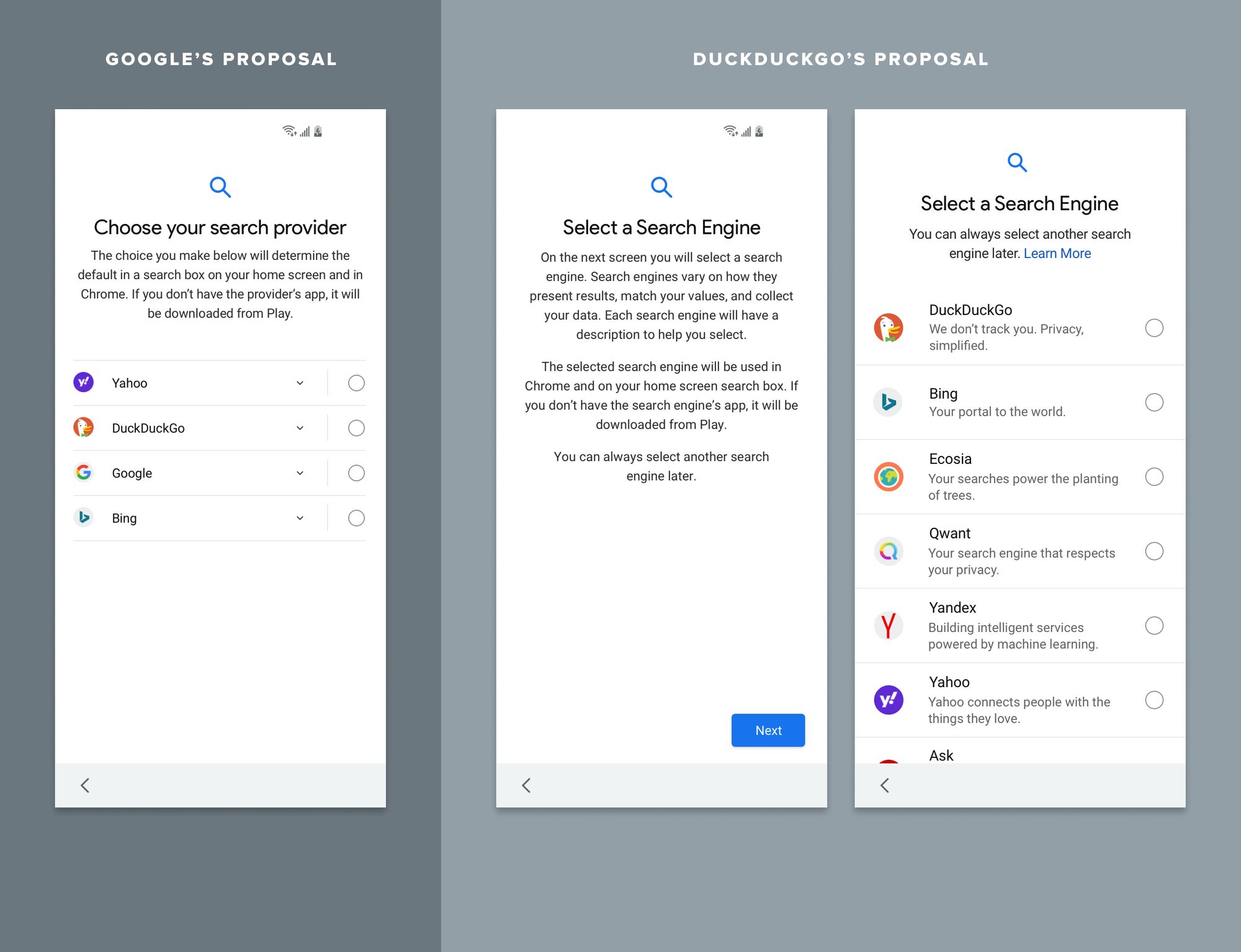
There is a better way. Our series of posts on search preference menus explains in detail how to design one that actually empowers consumers and increases search competition. In our proposal, there is no auction. Alternative search engines with the most market share in each market are shown on the first screen, randomly ordered. The remaining alternative search engines are available by scrolling, also randomly ordered.

Our research shows that such a preference menu can be a great remedy. The European Commission should take action now and require Google to overhaul its preference menu design. The current remedy is not a remedy at all – it is fundamentally rigged by Google to benefit Google. The Commission has said they have been waiting on data to act: such data is now available. To expedite this process, we are sending the Commission our data that demonstrates exactly how the current process inevitably eliminates DuckDuckGo.


For more privacy advice follow us on Twitter, and stay protected and informed with our privacy newsletters.


from DuckDuckGo Blog https://spreadprivacy.com/search-preference-menu-duckduckgo-elimination/
via Middlesbrough

Tuesday, 19 May 2020

Search Preference Menus: Google Auction Ignores Screen Size and Scrolling

Search Preference Menus: Google Auction Ignores Screen Size and Scrolling

This is the fourth in our series of posts about search preference menus.

  • DuckDuckGo has researched market conditions and user behavior on search preference menus for submission to the UK Competition and Markets Authority and European Commission.
  • User testing shows that over 60% of people scroll past a first screen to see more search alternatives, and that increases to 80% if Google is not on the first screen.
  • Using our proposed design, 24% of Europeans choose a Google alternative, which is 8 times higher than the 3% today.
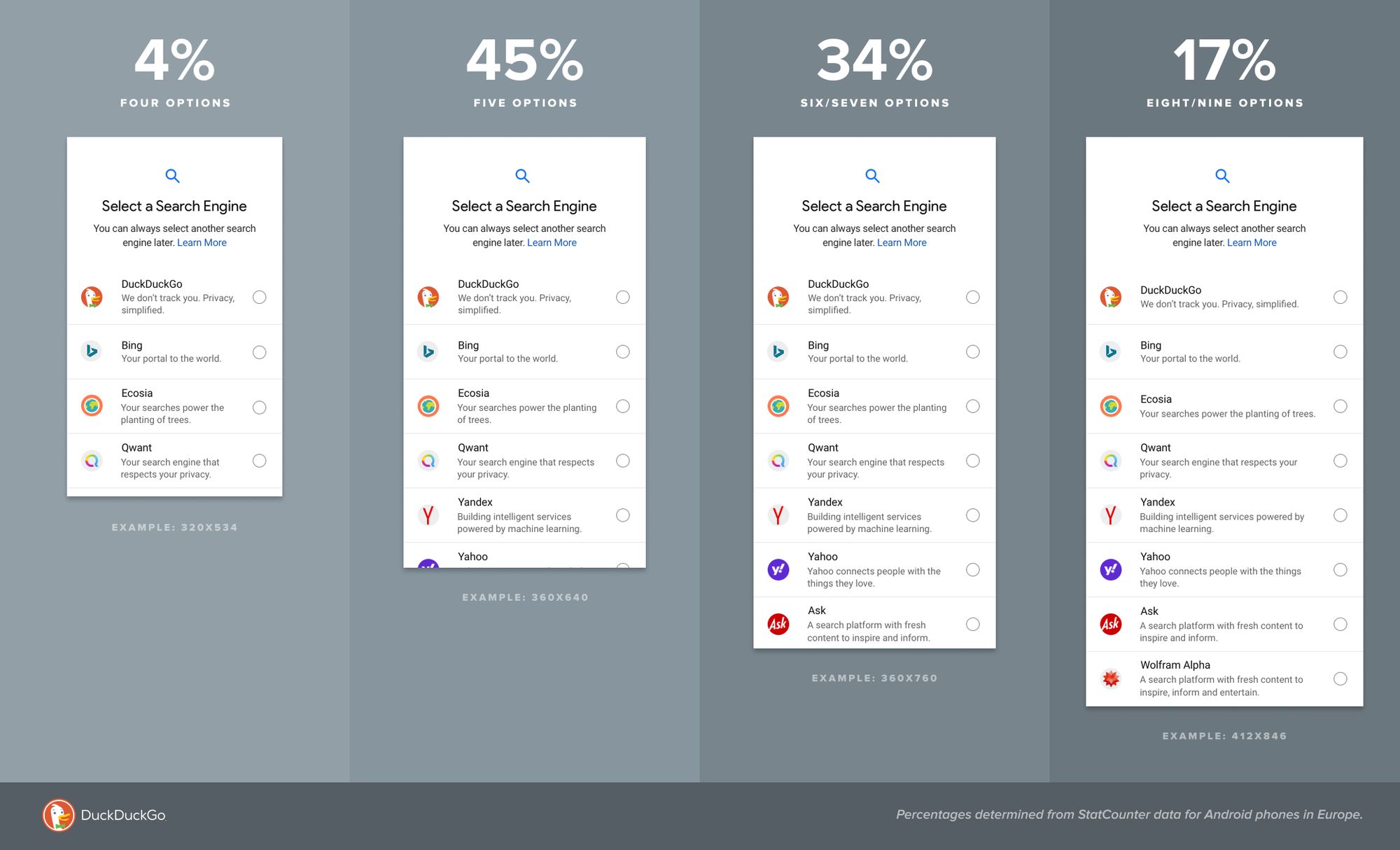
  • 96% of Android phones in Europe can display 5 search engines on the first screen, and 51% can display 6 or more, while still showing descriptions for all. Just 4% can only display 4 options.

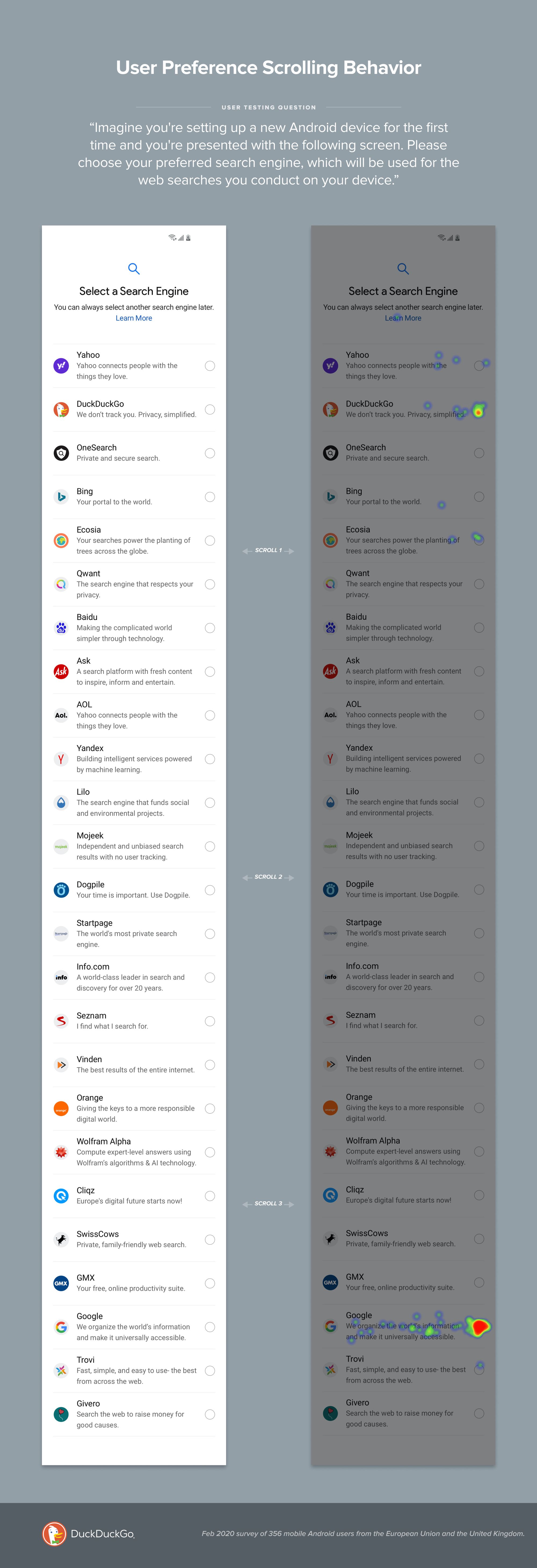
As part of ongoing discussions about search preference menus with the UK Competition and Markets Authority (CMA) and European Commission (EC), today we are providing data that answers two questions about our proposal (depicted below):

  1. How many search engines can fit on typical Android phone screens for devices sold in Europe?
  2. Will people scroll to see search engines beyond the first screen?
Search Preference Menus: Google Auction Ignores Screen Size and Scrolling

As explained in the first post of this series, we believe search preference menus — ones that change all search defaults and include the most common Google alternatives — can deliver meaningful search engine choice to consumers and significantly increase competition in the search market. In short, it's a great tool when done right.

However, Google’s search preference menu for the European Union is designed in a way that undercuts the very reason it was created, making it harder than necessary for people to choose an alternative. As a result, in the second post of this series we proposed a number of design improvements to Google's search preference menu.

Central to our suggested design improvements is significantly increasing the number of search engines options from just four, which Google has made artificially low because they are extracting money from the preference menu via an auction format (alternative search engines must bid for placement). We strongly believe it is in the best interest of consumers to throw out this auction format and replace it with a non-pay-to-play model that includes way more than four options, as explained in the third post of this series.

However, some people have questioned how many search engines can fit on the first screen, and whether people would scroll beyond the first screen. So, we decided to provide objective data.

First, almost all (96%) of Android phones in Europe can display five or more search engines, and over half (51%) can display six or more, even when showing larger logos and search engine descriptions by default. The average phone displays just over six (6.1). Just 4% of phones fit only four options.

Search Preference Menus: Google Auction Ignores Screen Size and Scrolling

The data that underlies these numbers comes from StatCounter via their screen resolution stats report for mobile phones in Europe. To ensure the highest accuracy in our conclusions, StatCounter produced for us a more detailed report with more screen sizes. We also removed iPhone screen resolutions, so that only Android screen resolutions remained in the report.

These results reflect a global trend of larger phones becoming more common. According to Statista, annual shipments of phones with a screen size smaller than 5" are expected to shrink from 150M in 2018 to just 25M in 2022.

Second, we ran live click tests to see if people will scroll, and the answer is a resounding yes. We conducted an experiment with 334 mobile Android users in Europe. In a first test users saw Google and the most common search engine alternatives on the first screen. Yet, 64.4% (± 5.1) still scrolled beyond the first screen to consider other search engines before actually selecting their search engine. (All of these results are statistically significant using a confidence level of 95%.)

In a second test of 356 mobile Android users in Europe (depicted below), when Google was moved to the last screen, 79.8% (±4.2) scrolled beyond the first screen, and 75.8% (±4.4) selected Google as their search engine. (In the first test, 80.8% (±4.2) selected Google.)

Search Preference Menus: Google Auction Ignores Screen Size and Scrolling

This user testing shows that the best way to increase competition in a search preference menu is to display Google on the last screen. Our second test (using this format) resulted in 24.2% (±4.4) of users selecting Google alternatives, a full 8x higher than the 3% current market share of Google alternatives on mobile in EU countries.

For any design, showing Google near the bottom of a scrollable list allows one more alternative search engine to be displayed on the first screen. Wherever Google is displayed, however, our study shows the majority of people will still scroll to check out alternatives.

In our earlier study, we proved that more choice means more diverse market share. A scrollable list maximizes the number of choices. In our proposal, the alternative search engines with the most market share in a given market are shown on the first screen, randomly ordered. The remaining alternative search engines are available by scrolling, randomly ordered. Google is placed on the last screen.

Methodology

Click (heat map) results are based on the polling of random samples of European Android users via the Helio platform. Respondents were paid. All reported results above are statistically significant at a confidence level of 95%.


For more privacy advice follow us on Twitter, and stay protected and informed with our privacy newsletters.


from DuckDuckGo Blog https://spreadprivacy.com/search-preference-menus-scrolling/
via Middlesbrough

Thursday, 2 May 2019

The Do-Not-Track Act of 2019

The Do-Not-Track Act of 2019

When you turn on the setting in your browser that says “Do Not Track”, you probably expect to no longer be tracked on most websites you visit. Right? Well, you would be wrong. But don’t worry, you’re not alone.

Our recent study on the Do Not Track (DNT) browser setting indicated that about a quarter of people have turned on this setting, and most were unaware big sites do not respect it. That means approximately 75 million Americans, 115 million citizens of the European Union, and many more people worldwide are, right now, broadcasting a DNT signal.

All of these people are actively asking the sites they visit to not track them. Unfortunately, no law requires websites to respect your Do Not Track signals, and the vast majority of sites, including most all of the big tech companies, sadly choose to simply ignore them.

Let’s change that now. Let’s put teeth behind this widely used browser setting by making a law that would align with current consumer expectations and empower people to more easily regain control of their online privacy.

While DuckDuckGo actively supports the passing of strong, comprehensive privacy laws, we also recognize that it will take time for them to take effect worldwide. In the meantime, governments can provide immediate relief by enacting separate, simpler Do Not Track legislation.

It is extremely rare to have such an exciting legislative opportunity like this, where the hardest work — coordinated mainstream technical implementation and widespread consumer adoption — is already done.

That’s why we're announcing draft legislation that can serve as a starting point for legislators in America and beyond. It’s entitled the "Do-Not-Track Act of 2019" and, if it were to be enacted, would require sites to respect the Do Not Track browser setting in this manner:

  1. No third-party tracking by default. Data brokers would no longer be legally able to use hidden trackers to slurp up your personal information from the sites you visit. And the companies that deploy the most trackers across the web — led by Google, Facebook, and Twitter — would no longer be able to collect and use your browsing history without your permission.
  2. No first-party tracking outside what the user expects. For example, if you use Whatsapp, its parent company (Facebook) wouldn't be able to use your data from Whatsapp in unrelated situations (like for advertising on Instagram, also owned by Facebook). As another example, if you go to a weather site, it could give you the local forecast, but not share or sell your location history.

Under this proposed law, these restrictions would only come into play if a consumer has turned on the Do Not Track setting in their browser settings. To keep the Internet flowing without hiccups, these restrictions would have exceptions for debugging, auditing, security, non-commercial research, and journalism.

However, each of these exceptions would only apply if a site adopts strict data-minimization practices, such as using the least amount of personal information needed, and anonymizing it when possible. Importantly, this draft legislation takes a more realistic view of what constitutes anonymous data vs. de-identified data. Legislators need to appreciate that users can be re-identified unless companies implement extra measures of protection.

We hope the Do-Not-Track Act of 2019 serves as a useful guide to start thinking seriously about this amazing legislative opportunity. We further hope that it can close the loophole of Do Not Track and immediately help hundreds of millions of people already using this widely deployed browser setting.

Download the proposed Do-Not-Track Act of 2019


For more privacy advice, follow us on Twitter & get our privacy crash course.


from DuckDuckGo Blog https://spreadprivacy.com/do-not-track-act-2019/
via Middlesbrough

Wednesday, 17 April 2019

24 Tech Companies Back CCPA Amendment to Make It Stronger: Privacy for All Act of 2019

24 Tech Companies Back CCPA Amendment to Make It Stronger: Privacy for All Act of 2019

Last year California passed the California Consumer Privacy Act (CCPA), giving residents more rights over their personal information. The pro-privacy law sets a new standard of trust online in the U.S., requiring companies doing business in California with revenues over $25 million or who process information from over 50,000 residents a year to comply with a new set of personal information rights. These rights include the right to know what info is collected, shared, or sold, the right to opt-out of having information sold, and more.

CCPA is set to take effect in 2020 and is without a doubt a major advancement in individual privacy rights for Americans. As an Internet privacy company that empowers users to take control of personal information, we support the law. And we want to see it become even better.

That’s why today we’re sending a letter to the California Assembly’s Privacy Committee backing an amendment to CCPA, proposed by Assemblymember Buffy Wicks in conjunction with privacy groups (including EFF, ACLU of California, Common Sense Kids Action, Consumer Reports, and Privacy Rights Clearinghouse). The amendment, entitled the Privacy for All Act of 2019, extends CCPA personal information rights further, including allowing consumers to opt-out of having information shared (and not just sold), giving them the ability to sue companies for violations, and more.

True to our belief that raising the standard of trust online requires a collective effort, 23 other tech companies have co-signed the letter with us. Together, we’re demonstrating that the industry supports this amendment, that privacy is good for business, and that the Assembly should adopt this amendment.


April 16, 2019

Dear Assemblymember Chau,

We are pleased to support A.B. 1760, sponsored by Assemblymember Buffy Wicks, as a vital addition to privacy protections in the state of California. We thank you for your commitment to the essential area of privacy, and your crucial role in the passage of the California Consumer Privacy Act (CCPA) last year.

We are a broad coalition of for-profit companies that share that privacy commitment and support the CCPA. All of us have California customers and we are currently subject to CCPA’s requirements or may be subject to them in the foreseeable future. As companies that put user privacy at the core of our products and services, we also support legislation that builds on CCPA’s foundation. Our relationship with our users is built on trust—trust that the data they provide to us and other companies will be used only in the ways they understand and expect.

A.B. 1760 holds all covered companies to that standard and makes sure that Californians’ information is protected by default. It will give all Californians the knowledge and power to truly control their personal information, as well as the ability to practically exercise and legally enforce their privacy rights, all without being punished with higher prices or degraded service.

We appreciate and support your committee’s important efforts to provide all Californians with the privacy rights they want and deserve. Thank you again for your leadership on this important issue.

Sincerely,

Duck Duck Go, Inc.
Gabriel Weinberg, Founder and CEO

Brave Software Inc.
Dr. Johnny Ryan, Chief Policy & Industry Relations Officer

Proton Technologies AG
Dr. Andy Yen, CEO

Ghostery, Inc.
Jeremy Tillman, President

Disconnect, Inc.
Casey Oppenheim, CEO

Vivaldi Technologies LLC
Tatsuki Tomita, Chief Operating Officer

Tresorit AG
Istvan Lam, Co-Founder & CEO

Lavabit LLC
Richard Delgado, COO

Fastmail Pty Ltd
Bron Gondwana, CEO

Fastmail US LLC
Helen Horstmann-Allen, COO

Ecosia GmbH
Christian Kroll, CEO & Founder

Mycroft AI Inc.
Eric Jurgeson, Vice-President

Purism, SPC
Todd Weaver, CEO

Discourse, aka Civilized Discourse Construction Kit, Inc.
Jeff Atwood, CEO

Shiny Frog Limited, aka Bear
Matteo Rattotti, Founder

Sgrouples, Inc. dba "MeWe"
Mark Weinstein, Founder & CEO

Nextcloud GmbH
Frank Karlitschek, CEO

Whaller SAS
Thomas Fauré, CEO

Virtru Corp.
Andrea Little Limbago, PhD
Chief Social Scientist

Tutao GmbH, aka Tutanota
Matthias Pfau, Co-Founder

Snips SAS
Dr. Rand Hindi, PhD
Co-Founder & CEO

Bit Chute Limited
Ray Vahey, Founder & CEO

Mailr Tech LLP, aka Canary Mail
Sohel Sanghani, CEO

Conva Ventures Inc., aka Fathom Analytics
Jack Ellis & Paul Jarvis, Directors


from DuckDuckGo Blog https://spreadprivacy.com/ccpa-privacy-for-all-act/
via Middlesbrough

Friday, 29 March 2019

Improved Weather Results on DuckDuckGo

Improved Weather Results on DuckDuckGo

You'd think that weather forecasts and online privacy are two separate subjects with little in common. Sadly, with privacy breaches by popular weather apps hitting the headlines, that's not the case. Weather websites often also track you unnecessarily, unless you're using something like the DuckDuckGo mobile app or browser extension for protection.

Improved Weather Results on DuckDuckGo

In other words, even something as commonplace as wanting to know if it'll rain tomorrow risks leaking personal data on your phone to third parties, such as where you are at any time of the day or night. This data can then be used to target you with ads and manipulate your behavior, and even passed on to hedge funds for their investment analysis!

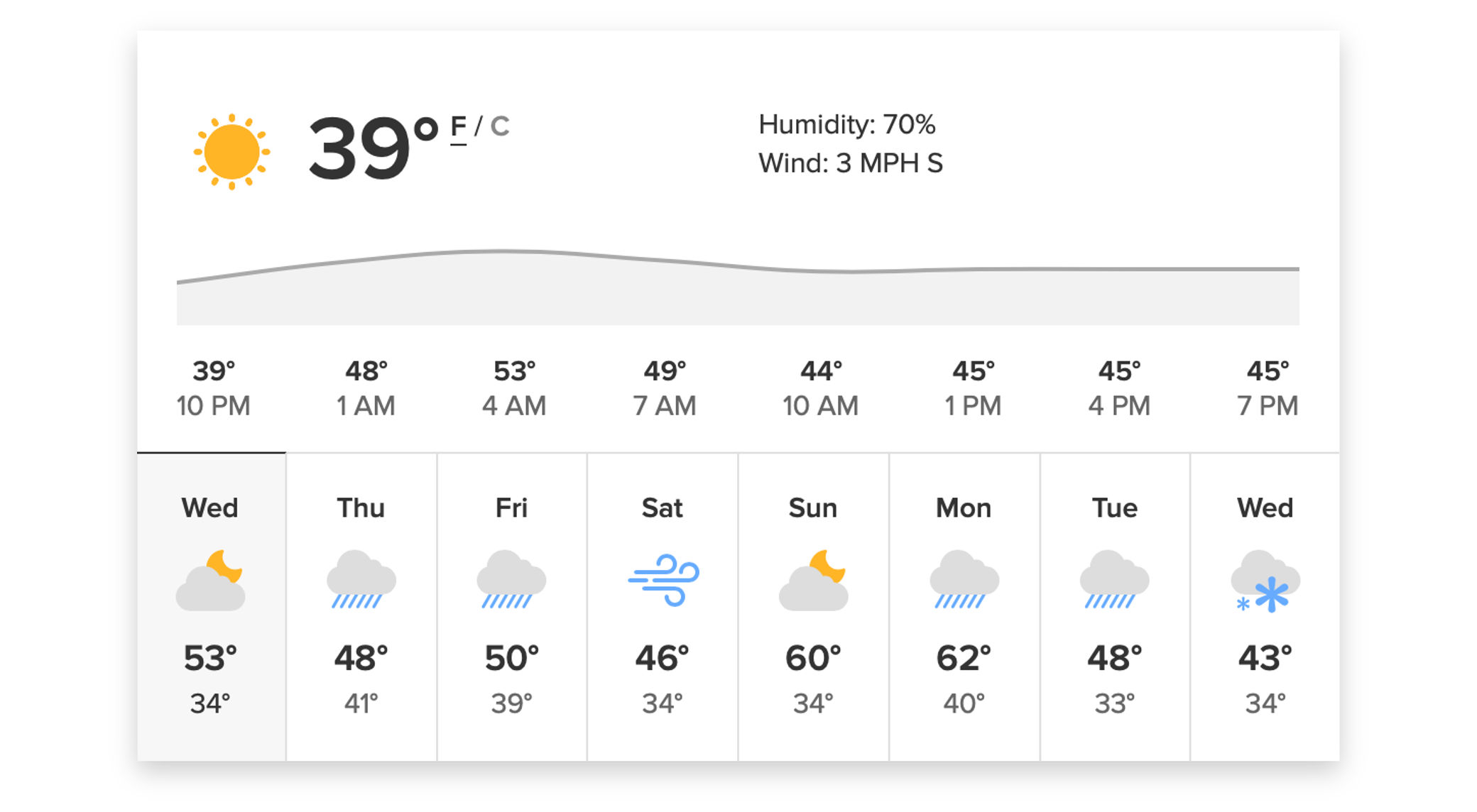
It's therefore not surprising that people want a reliable alternative that respects your right to privacy. Fortunately, DuckDuckGo search results include weather forecasts (just search for "weather"), and we're pleased to announce we've given them a revamp, making them more powerful but still just as private!

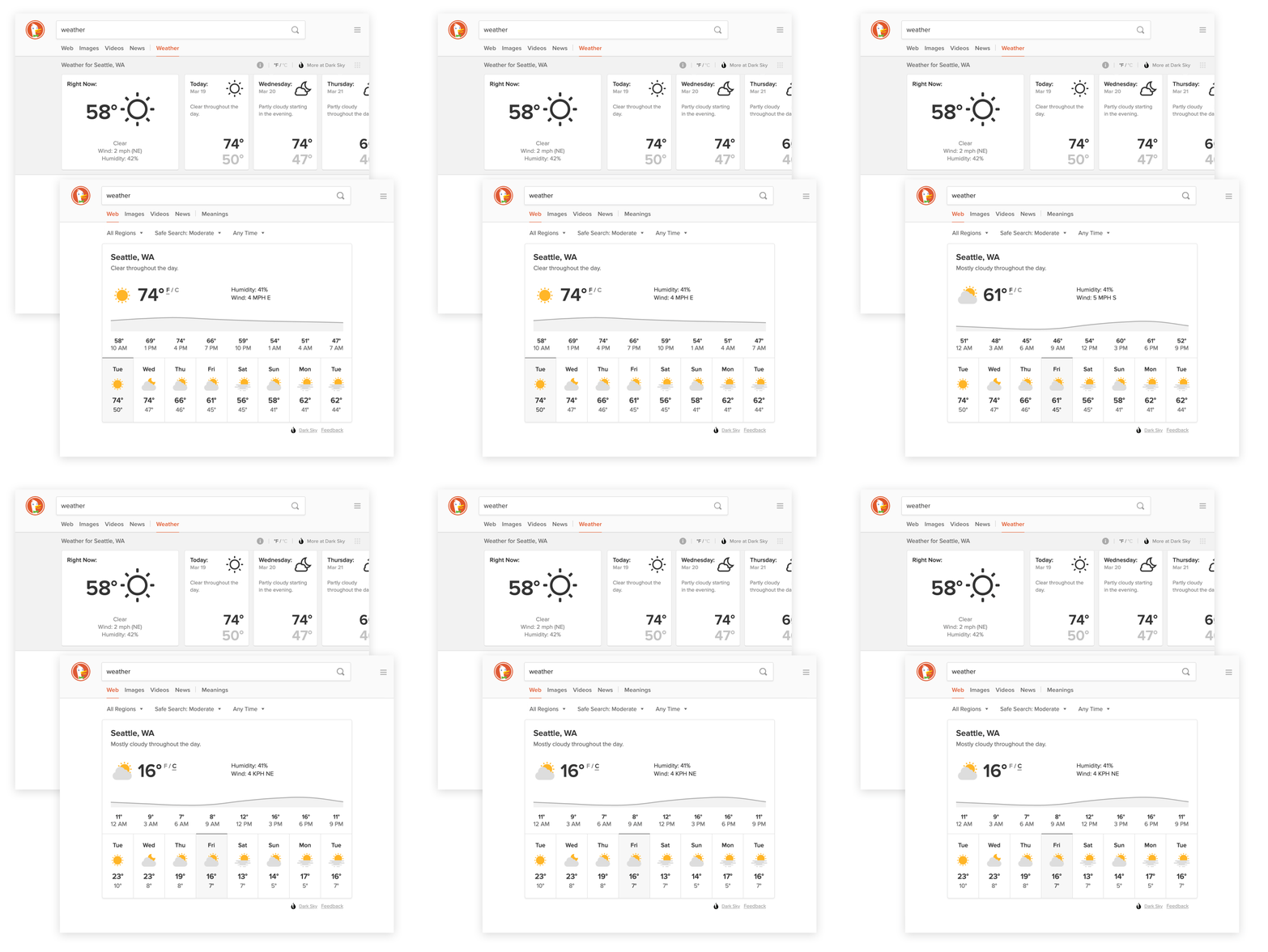
To see the difference for yourself, here's a before and after comparison:

Improved Weather Results on DuckDuckGo

Our new weather format gives you more detailed information and clearer images, in a nice compact format. It's also interactive, showing you hourly data by clicking on each day of the week, and instant toggling of fahrenheit and celsius. These weather instant answers are still powered by Dark Sky, who are notably outspoken about respecting user privacy. Nevertheless we don’t send them your IP address or other personal information, as with any of our partners.

With our strict privacy policy of not collecting or sharing personal information, all your weather searches, and in fact all searches on DuckDuckGo no matter the subject, are private. For weather searches in particular (like just searching "weather"), we can infer an approximate location from the information automatically sent by your browser to us with the search request, and then immediately discard this approximate location without storing it. You can read more about our private localized results here.

At DuckDuckGo, we believe getting the privacy you deserve online should be as simple as closing the blinds. This enhancement to our search results is one more way that we're setting a new standard of trust online, without sacrificing convenience for the right to stay private.


For more privacy advice, follow us on Twitter & get our privacy crash course.


from DuckDuckGo Blog https://spreadprivacy.com/duckduckgo-weather-results/
via Middlesbrough

Wednesday, 13 March 2019

DuckDuckGo Testimony Before the United States Senate

DuckDuckGo Testimony Before the United States Senate

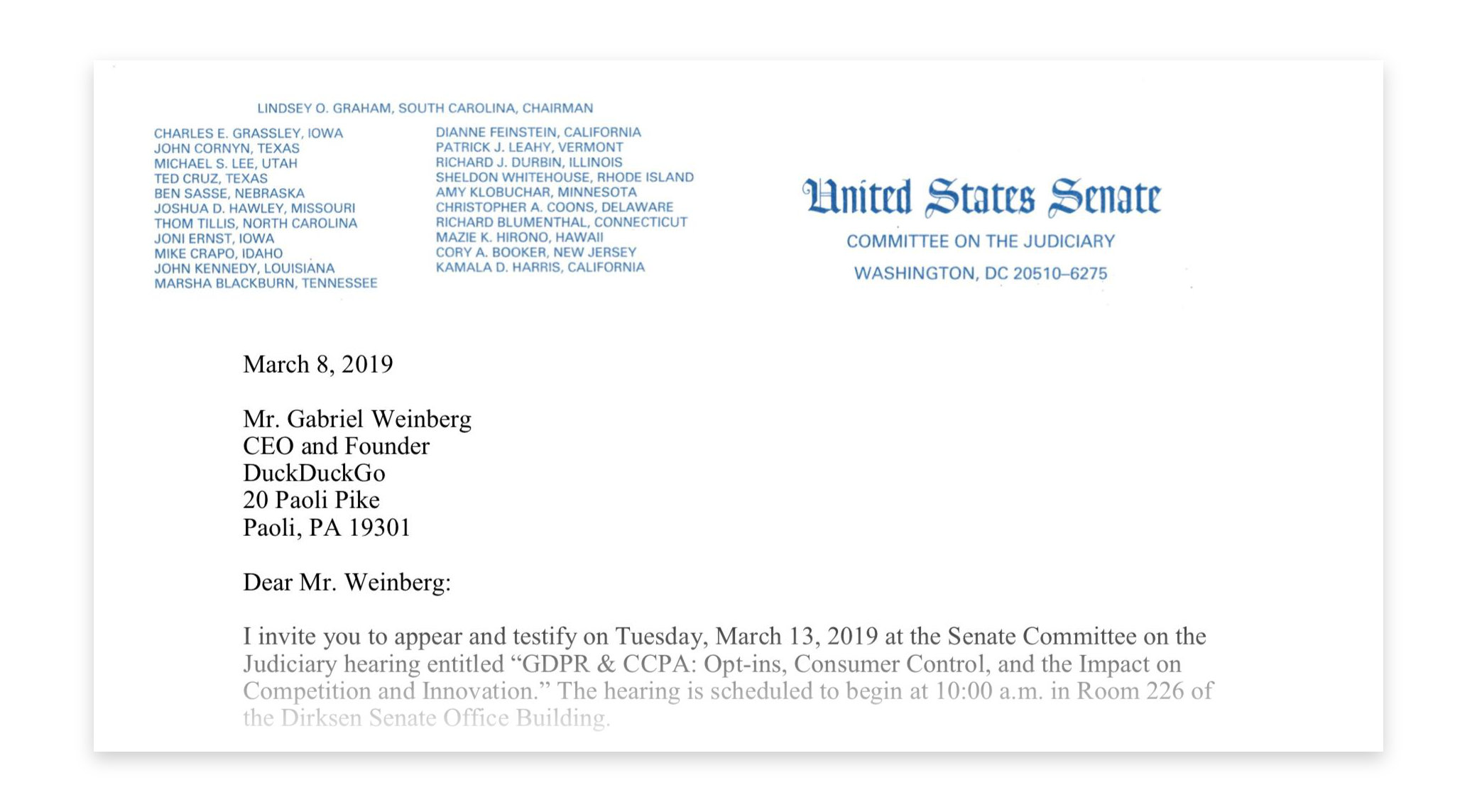
Below is the prepared testimony of Gabriel Weinberg, CEO & Founder of DuckDuckGo, before the United States Senate Judiciary Committee Hearing on GDPR & CCPA: Opt-ins, Consumer Control, and the Impact on Competition and Innovation.


March 12, 2019

Chairman Graham, Ranking Member Feinstein and Members of the Committee, thank you for holding this important hearing and inviting me to testify. I am here to explain that privacy legislation, like the GDPR and CCPA, is not only pro-consumer, but also pro-business, and pro-advertising.

DuckDuckGo's primary service is a search engine alternative to Google that allows you to search the web without being tracked. We are the fourth largest search engine in the US, serving over one billion searches a month globally. We also offer a mobile privacy browser that serves as an alternative to Google Chrome.

We regularly conduct rigorous consumer research on privacy issues, which we post at SpreadPrivacy.com. We also help educate consumers about online privacy from our Twitter account, @duckduckgo.

I founded DuckDuckGo in 2008, far outside of Silicon Valley, in Valley Forge, Pennsylvania. We now have a distributed workforce spread across the nation in twelve states, the District of Columbia, and in ten other countries.

As you know, people are tired of being watched everywhere they go online. They are fed up with all the intended and unintended consequences this online tracking creates, including invasive ads, identity theft, discrimination, and manipulation. Have you ever searched for something only to see an ad for that very thing pop up in a mobile app or on a different website? DuckDuckGo helps you avoid these types of scenarios by seamlessly reducing your online digital footprint.

Every time you search on DuckDuckGo, it's like you are searching on our site for the first time. We do not even have the concept of a search history.

And we also offer privacy protection beyond the search box. Many companies run sophisticated tracker networks that lurk on the websites you visit. DuckDuckGo’s browser technology blocks such hidden trackers.

In many ways I come to you from the future: I run a business that is already GDPR and CCPA-compliant. Our privacy policy is straightforward and doesn’t require a law degree to decipher: We simply do not collect or share any personal information at all. That’s it — no confusing settings to fiddle with, no jargon-filled pages to read. Yet, even with this simple privacy policy, we nonetheless are able to make money through advertising.

This brings me to my first point: Privacy legislation is not anti-advertising. Take our business for example: When you type in a search on DuckDuckGo, we simply show you ads related to that search. If you search for ‘car’, we show you car ads. But those ads won’t follow you around, because we don’t know who you are, where you’ve been, or where you go. It's contextual advertising versus behavioral advertising.

As a privately held company, our finances are private, though I’m proud to say we’ve been profitable using contextual advertising since 2014, and last year we earned substantially more than the $25 million revenue floor that subjects a company to CCPA.

And we are not alone. For example, in response to GDPR, when the New York Times in Europe switched from behavioral advertising to contextual advertising, it reported an increase in revenue. And just last week, Business Insider reported the Washington Post was looking into making a similar change. If Congress forced the digital advertising industry to return to its roots in contextual advertising, that would allow companies to remain profitable, or even become more profitable — all without the unintended consequences of behavioral advertising.

My second point is that privacy is becoming increasingly good for business. Consumers flock to brands they trust and respect, and according to Harris Poll, data privacy is the most pressing issue on Americans' minds, now for two years in a row. And again, we serve as a great case study, having grown exponentially during this period.

DuckDuckGo Testimony Before the United States Senate

My third point is that well-drafted privacy legislation can spur more competition and innovation in one of the most foundational markets of the Internet: digital advertising. This market is currently a duopoly, and this reality is hurting everyone from small businesses to venture-backed startups to media companies. To restore competition and innovation in this market, the data monopolies at its core need to be addressed.

Fixing this digital-ad-market duopoly can take any number of forms. Here are three suggestions. First, consumers could be given a robust mechanism to opt-out of online tracking. Second, monopoly platforms could be prohibited from combining data across their different business lines. Third, acquisitions that strengthen existing data monopolies could be blocked.

Our mission at DuckDuckGo is to raise the standard of trust online. We support strong privacy legislation that does exactly that. We believe the Internet shouldn’t feel so creepy, and getting the privacy you deserve online should be as easy as closing the blinds.

I am pleased to answer your questions today and make myself available to Members in the future for more in-depth discussions. Thank you.

You can download the PDF version of this testimony here.


from DuckDuckGo Blog https://spreadprivacy.com/us-senate-testimony/
via Middlesbrough

Wednesday, 6 February 2019

The "Do Not Track" Setting Doesn't Stop You from Being Tracked

The

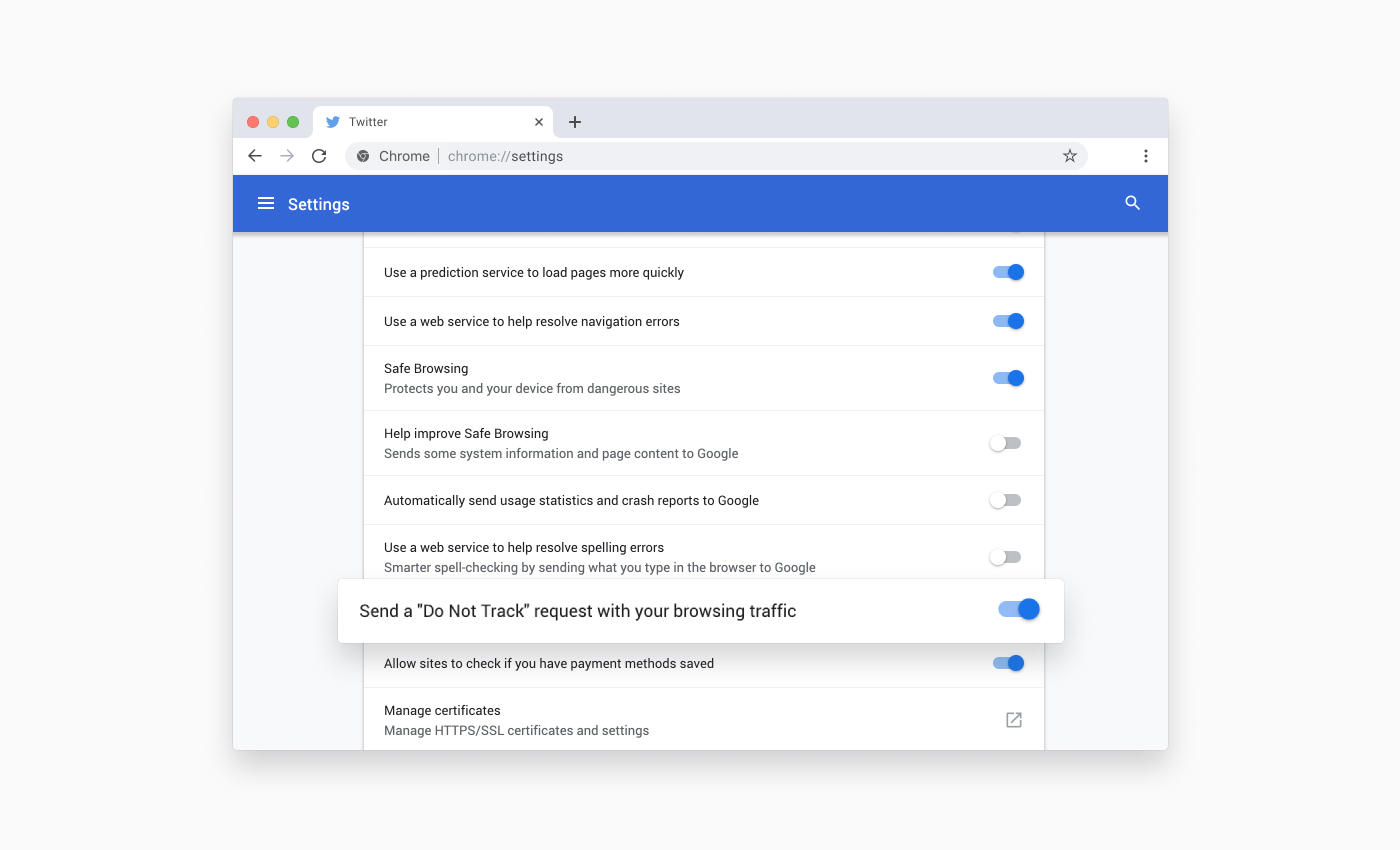
Most browsers have a "Do Not Track" (DNT) setting that sends "a special signal to websites, analytics companies, ad networks, plug in providers, and other web services you encounter while browsing, to stop tracking your activity." Sounds good, right? Sadly, it’s not effective. That's because this Do Not Track setting is only a voluntary signal sent to websites, which websites don’t have to respect 😧.

The

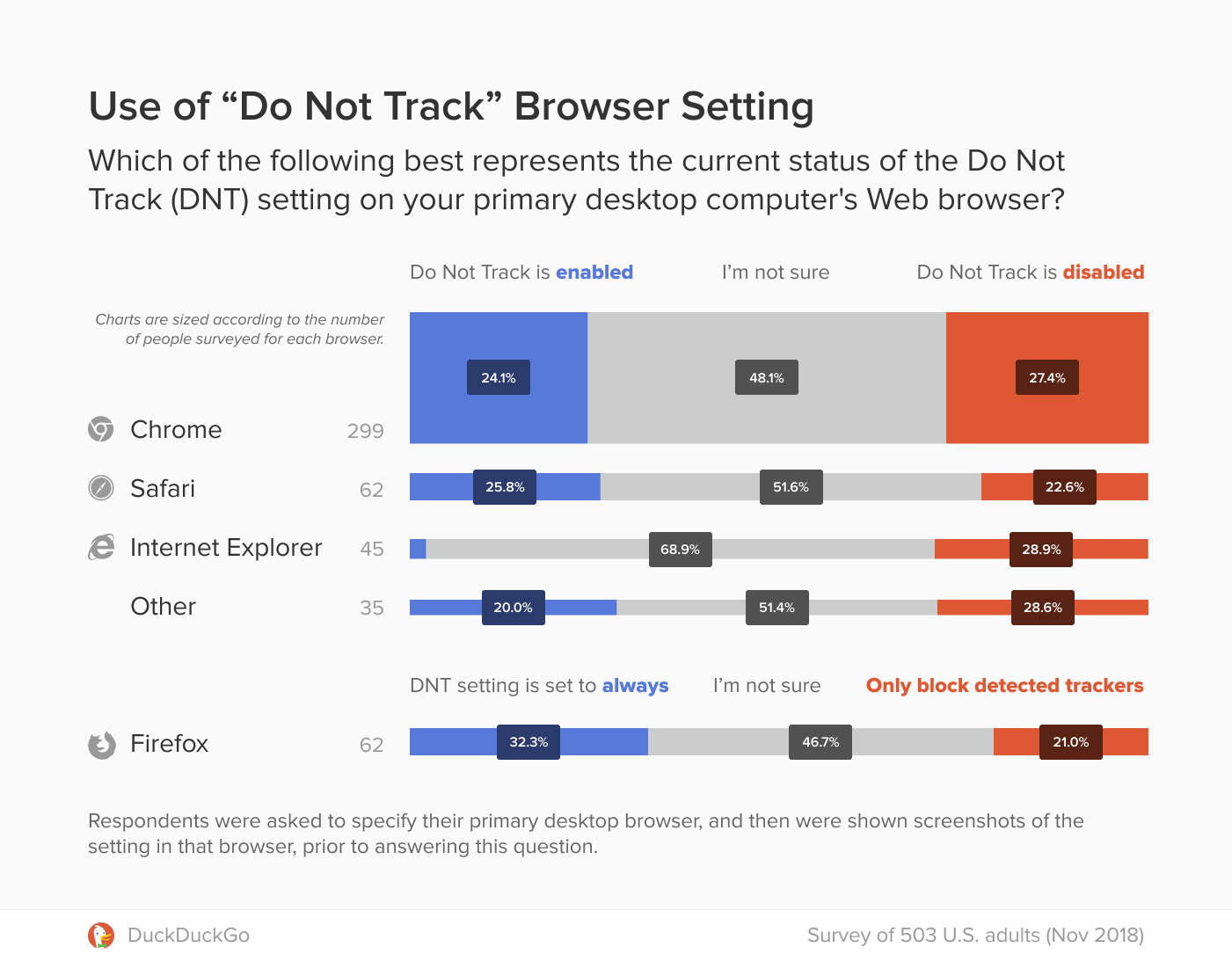
Nevertheless, a hefty portion of users across many browsers use the Do Not Track setting. While DNT is disabled by default in most major web browsers, in a survey we conducted of 503 U.S. adults in Nov 2018, 23.1% (±3.7) of respondents have consciously enabled the DNT setting on their desktop browsers. (Note: Apple is in the process of removing the DNT setting from Safari.)

The

We also looked at DNT usage on DuckDuckGo (across desktop and mobile browsers), finding that 24.4% of DuckDuckGo requests during a one day period came from browsers with the Do Not Track setting enabled. This is within the margin of error from the survey, thus lending more credibility to its results.

Unfortunately, tens of millions of Americans (and many more worldwide) who enable DNT don’t know that it's only sending a voluntary signal. Of the respondents who heard of and were at least "slightly familiar" with the Do Not Track setting, 44.4% (±7.3) of them were not aware of its true voluntary nature. Even among those who have consciously enabled DNT in their browser, 41.4% (±8.9) didn't know that it only sends a voluntary signal.

It can be alarming to realize that Do Not Track is about as foolproof as putting a sign on your front lawn that says “Please, don’t look into my house” while all of your blinds remain open. In fact, most major tech companies, including Google, Facebook, and Twitter, do not respect the Do Not Track setting when you visit and use their sites – a fact of which 77.3% (±3.6) of U.S. adults overall weren’t aware.

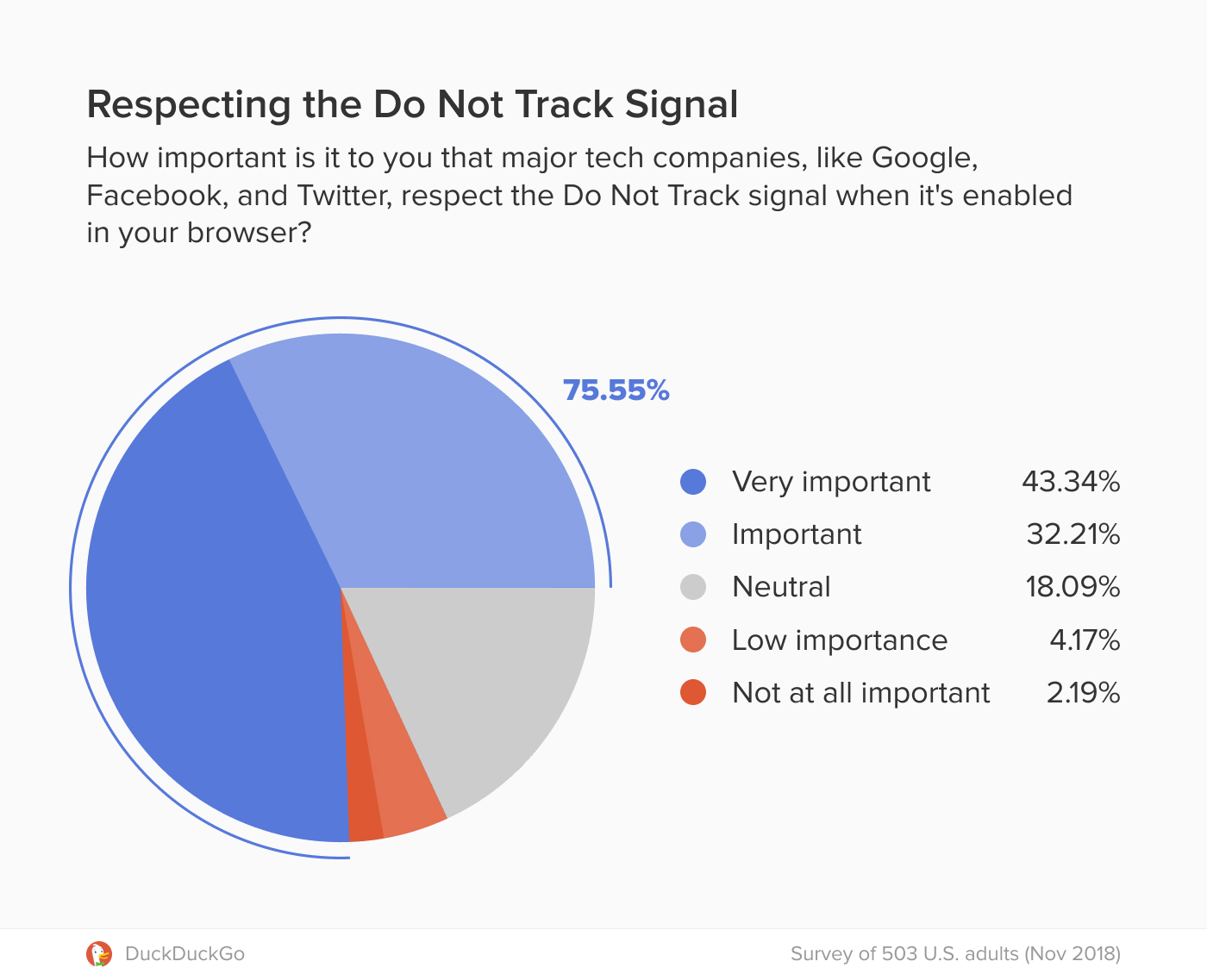
There is simply a huge discrepancy between the name of the setting and what it actually does. It’s inherently misleading. When educated about the true function and limitation of the DNT setting, 75.5% (±3.8) of U.S. adults say it’s "important" or "very important" that these companies "respect the Do Not Track signal when it is enabled." So, in shocking news, when people say they don’t want to be tracked, they really don’t want to be tracked.

The

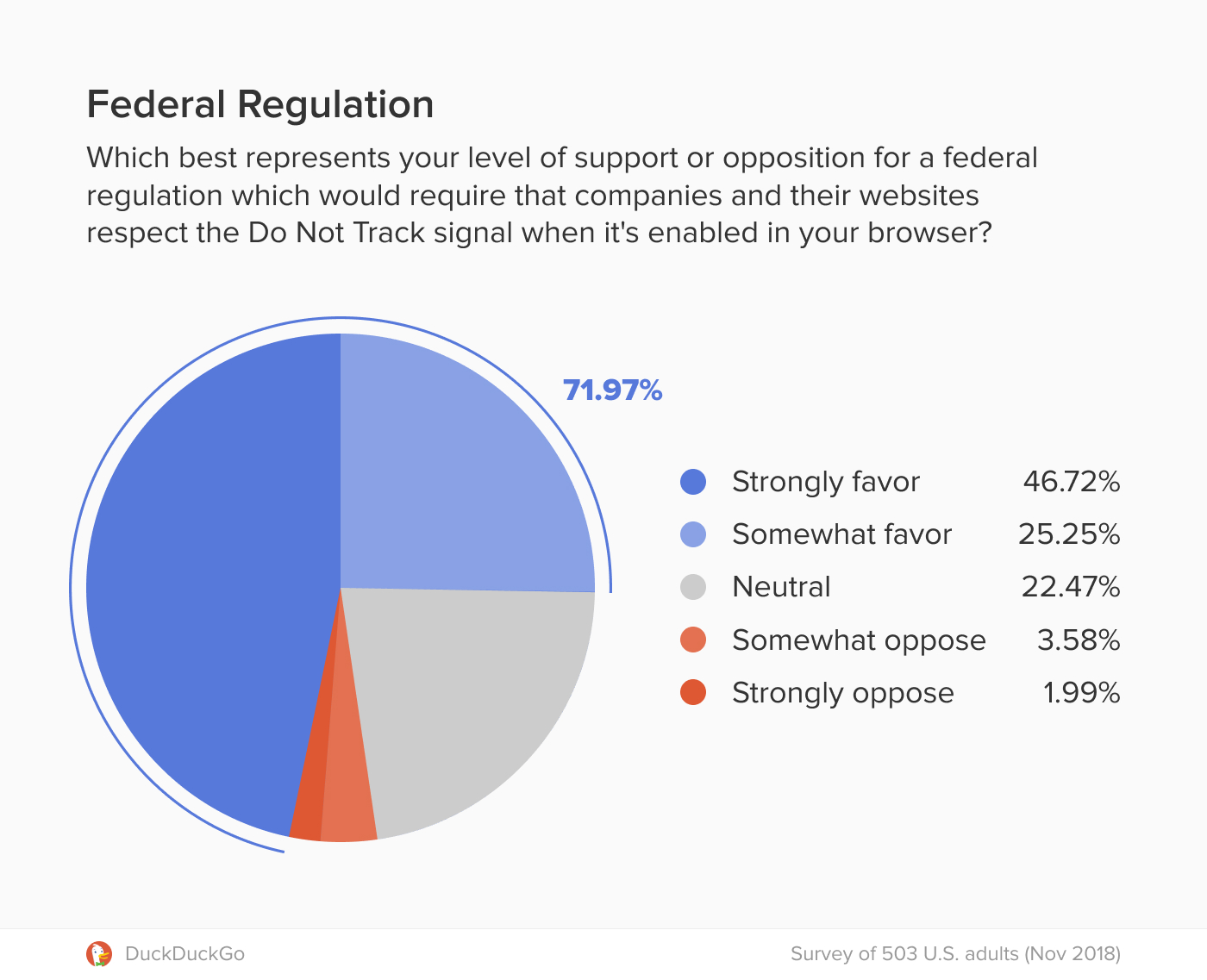
As a matter of fact, 71.9% (±3.9) of U.S. adults "somewhat favor" or "strongly favor" a federal regulation requiring companies to respect the Do Not Track signal.

The

We agree and hope that governments will focus this year on efforts to enforce adherence to the Do Not Track setting when users enable it. As we've seen here and in our private browsing research, many people seek the most readily available (though often, unfortunately, ineffective) methods to protect their privacy.

Just like Private Browsing (a.k.a. "Incognito") Mode, the "Do Not Track" setting is an easily-discoverable option in most browsers, but it fails to effectively educate users on what exactly it does (or doesn't do), and falls well short of the privacy benefit users expect from it. Until such time that the Do Not Track setting lives up to its name, you can reclaim your privacy and block trackers right now by using the DuckDuckGo browser extension and mobile app.

Methodology

These results are based on the polling of a random sample of 503 American adults (18+) on November 29th, 2018 via SurveyMonkey's Audience platform, which ensures the demographic make-up of respondents is representative of the U.S. population. Survey respondents were paid and a confidence level of 95% was used for calculating the values above.

For more privacy advice, follow us on Twitter & get our privacy crash course.


from DuckDuckGo Blog https://spreadprivacy.com/do-not-track/
via Middlesbrough

Wednesday, 16 January 2019

DuckDuckGo Taps Apple Maps to Power Private Search Results

DuckDuckGo Taps Apple Maps to Power Private Search Results

We're excited to announce that map and address-related searches on DuckDuckGo for mobile and desktop are now powered by Apple's MapKit JS framework, giving you a valuable combination of mapping and privacy. As one of the first global companies using Apple MapKit JS, we can now offer users improved address searches, additional visual features, enhanced satellite imagery, and continually updated maps already in use on billions of Apple devices worldwide.

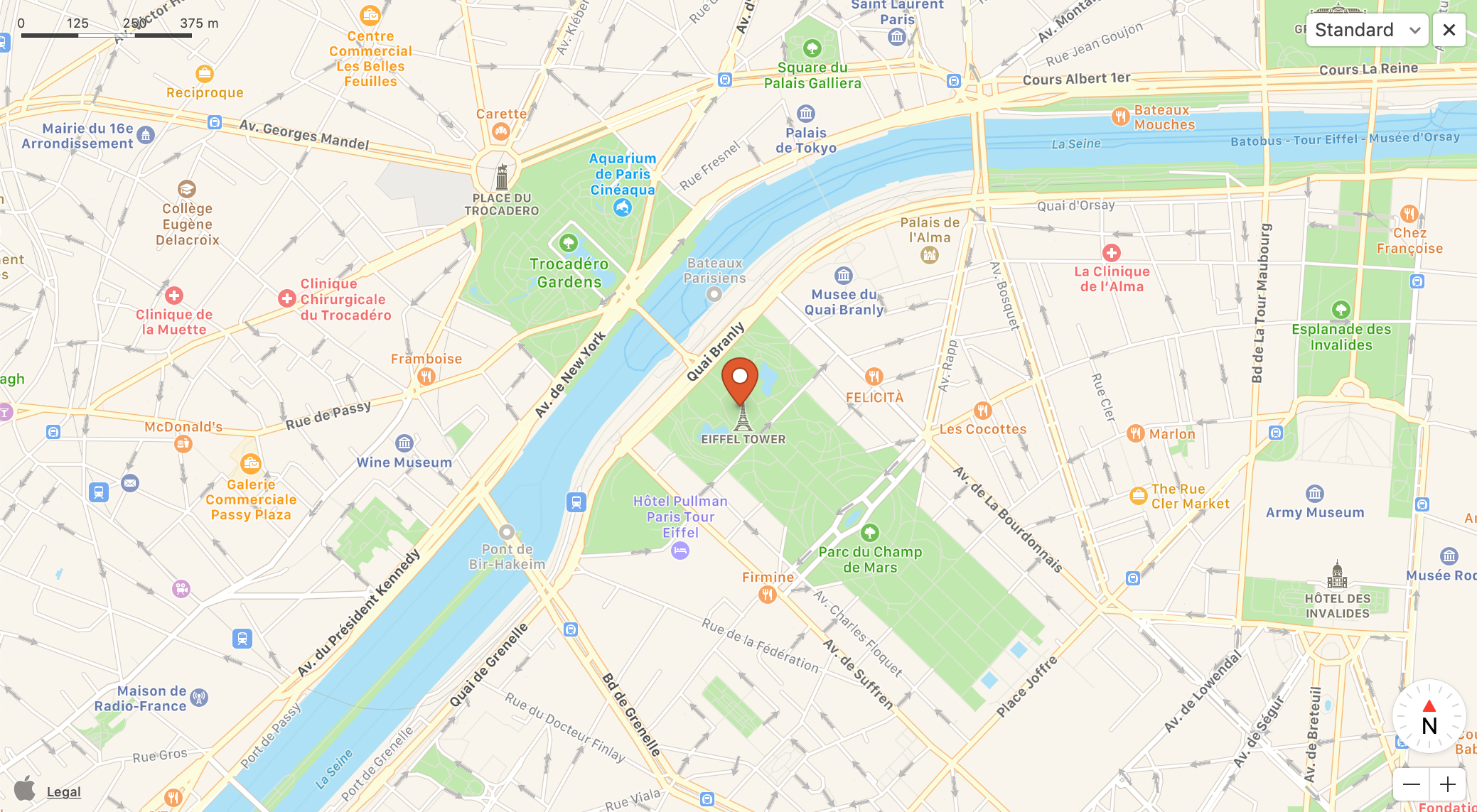
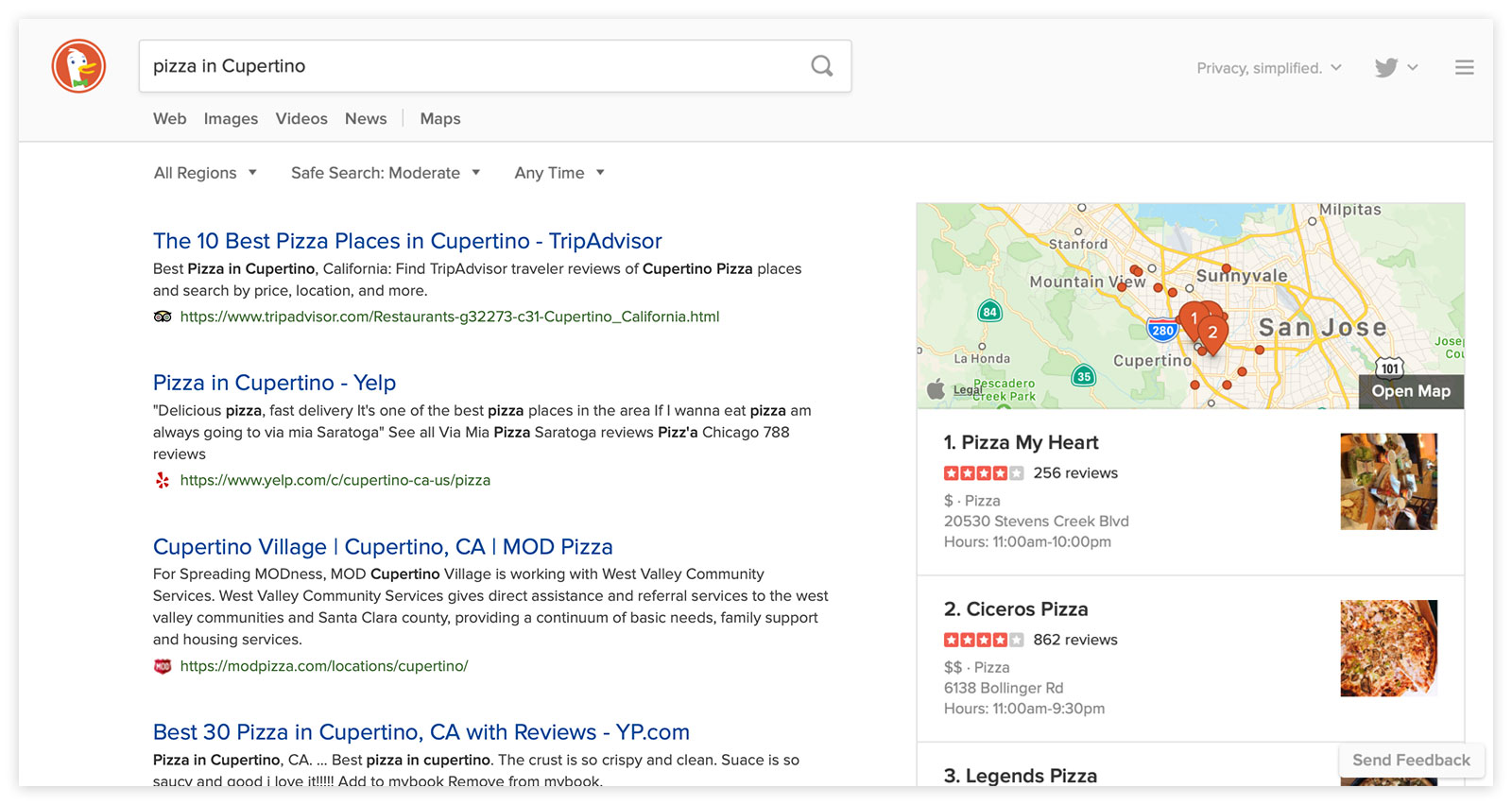
With this updated integration, Apple Maps are now available both embedded within our private search results for relevant queries, as well as available from the "Maps" tab on any search result page. Let's see it in action…

  1. With the example query pizza in Cupertino, the map appears as a module within the search results.
DuckDuckGo Taps Apple Maps to Power Private Search Results
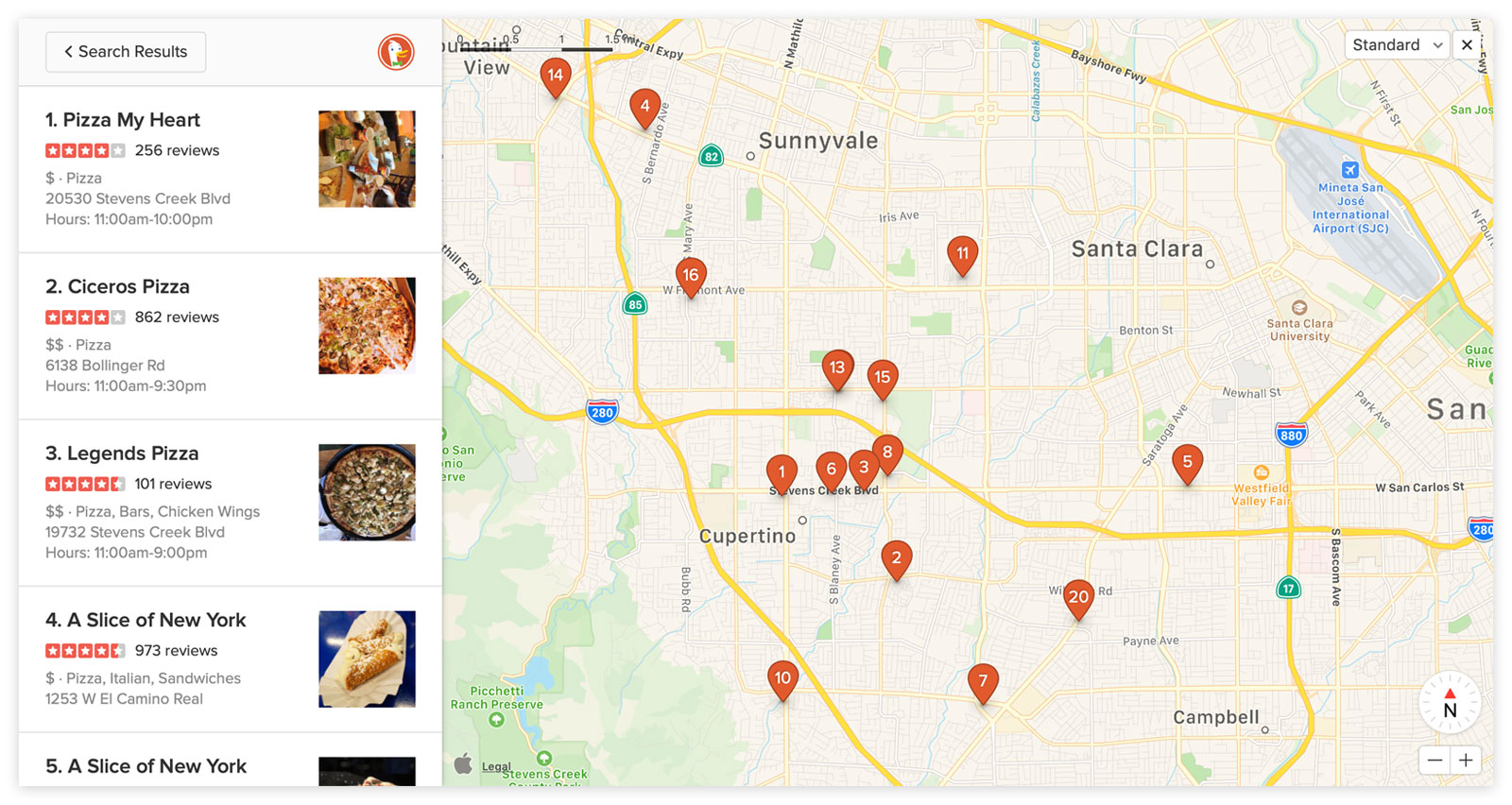
  1. Clicking on the map image opens an expanded map.
DuckDuckGo Taps Apple Maps to Power Private Search Results
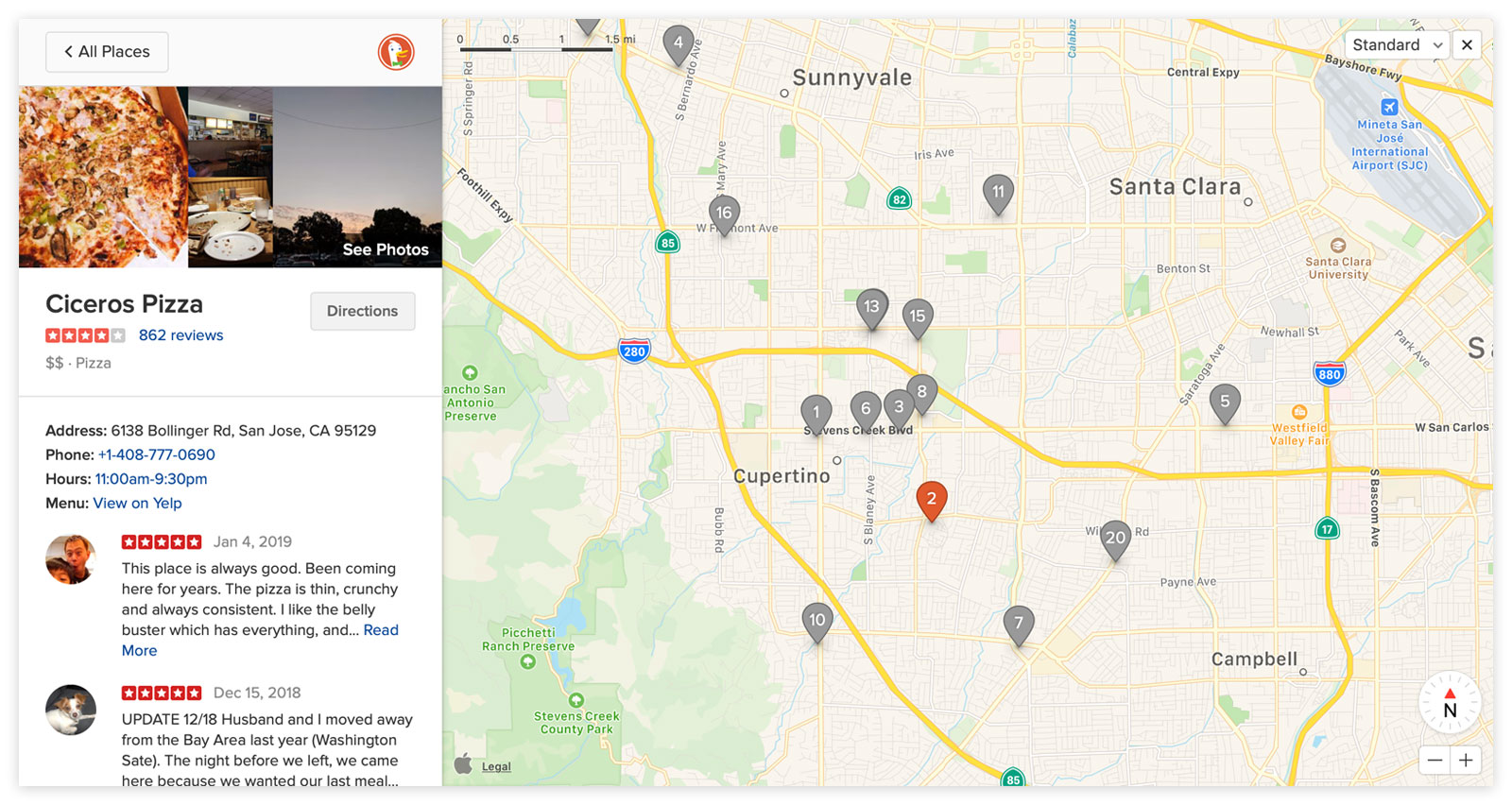
  1. Clicking an item on the sidebar highlights that location, for you to zoom into.
DuckDuckGo Taps Apple Maps to Power Private Search Results

Try it out with one of the many different ways you can search for places on DuckDuckGo:

At DuckDuckGo, we believe getting the privacy you deserve online should be as simple as closing the blinds. Naturally, our strict privacy policy of not collecting or sharing any personal information extends to this integration. We do not send any personally identifiable information such as IP address to Apple or other third parties. For local searches, where your approximate location information is sent by your browser to us, we discard it immediately after use. You are still anonymous when you perform map and address-related searches on DuckDuckGo. You can read more about our anonymous localized results here.

We’re excited to work closely with Apple to set a new standard of trust online, and we hope you'll enjoy this update. We also welcome your feedback, which can be sent via the "Send feedback" button at the bottom of search results.


For more privacy advice, follow us on Twitter & get our privacy crash course.


from DuckDuckGo Blog https://spreadprivacy.com/duckduckgo-apple-mapkit-js/
via Middlesbrough

Saturday, 8 December 2018

Measuring the "Filter Bubble": How Google is influencing what you click

Measuring the

Over the years, there has been considerable discussion of Google's "filter bubble" problem. Put simply, it's the manipulation of your search results based on your personal data. In practice this means links are moved up or down or added to your Google search results, necessitating the filtering of other search results altogether. These editorialized results are informed by the personal information Google has on you (like your search, browsing, and purchase history), and puts you in a bubble based on what Google's algorithms think you're most likely to click on.

The filter bubble is particularly pernicious when searching for political topics. That's because undecided and inquisitive voters turn to search engines to conduct basic research on candidates and issues in the critical time when they are forming their opinions on them. If they’re getting information that is swayed to one side because of their personal filter bubbles, then this can have a significant effect on political outcomes in aggregate.

Back in 2012 we ran a study showing Google's filter bubble may have significantly influenced the 2012 U.S. Presidential election by inserting tens of millions of more links for Obama than for Romney in the run-up to that election. Our research inspired an independent study by the Wall Street Journal (paywall):

A Wall Street Journal examination found that the search engine often customizes the results of people who have recently searched for "Obama"—but not those who have recently searched for "Romney."

Now, after the 2016 U.S. Presidential election and other recent elections, there is justified new interest in examining the ways people can be influenced politically online. In that context, we conducted another study to examine the state of Google's filter bubble problem in 2018.

Summary of Findings

Google has claimed to have taken steps to reduce its filter bubble problem, but our latest research reveals a very different story. Based on a study of individuals entering identical search terms at the same time, we found that:

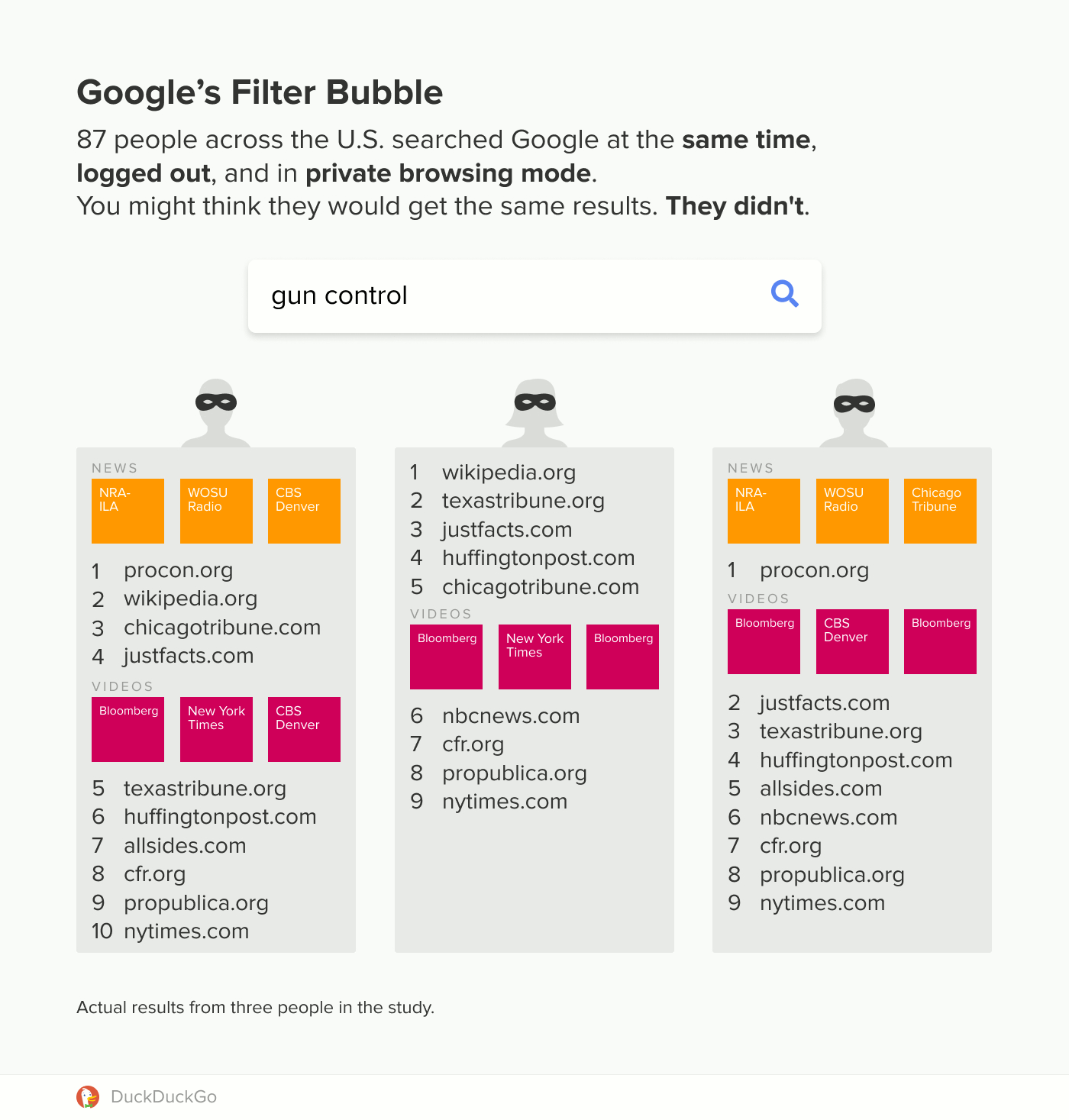
  1. Most participants saw results unique to them. These discrepancies could not be explained by changes in location, time, by being logged in to Google, or by Google testing algorithm changes to a small subset of users.
  2. On the first page of search results, Google included links for some participants that it did not include for others, even when logged out and in private browsing mode.
  3. Results within the news and videos infoboxes also varied significantly. Even though people searched at the same time, people were shown different sources, even after accounting for location.
  4. Private browsing mode and being logged out of Google offered very little filter bubble protection. These tactics simply do not provide the anonymity most people expect. In fact, it's simply not possible to use Google search and avoid its filter bubble.
Measuring the

For those interested in more details, we've written out everything below, as well as provided the underlying data and code. We hope this work encourages further study of this important issue.

Methodology

We asked volunteers in the U.S. to search for "gun control", "immigration", and "vaccinations" (in that order) at 9pm ET on Sunday, June 24, 2018. Volunteers performed searches first in private browsing mode and logged out of Google, and then again not in private mode (i.e., in "normal" mode). We compiled 87 complete result sets — 76 on desktop and 11 on mobile. Note that we restricted the study to the U.S. because different countries have different search indexes.

During analysis of the search results, we only looked at websites' top-level domains, for example www.cdc.gov/features/vaccines-travel and www.cdc.gov/vaccines/adults would both be treated as just cdc.gov.

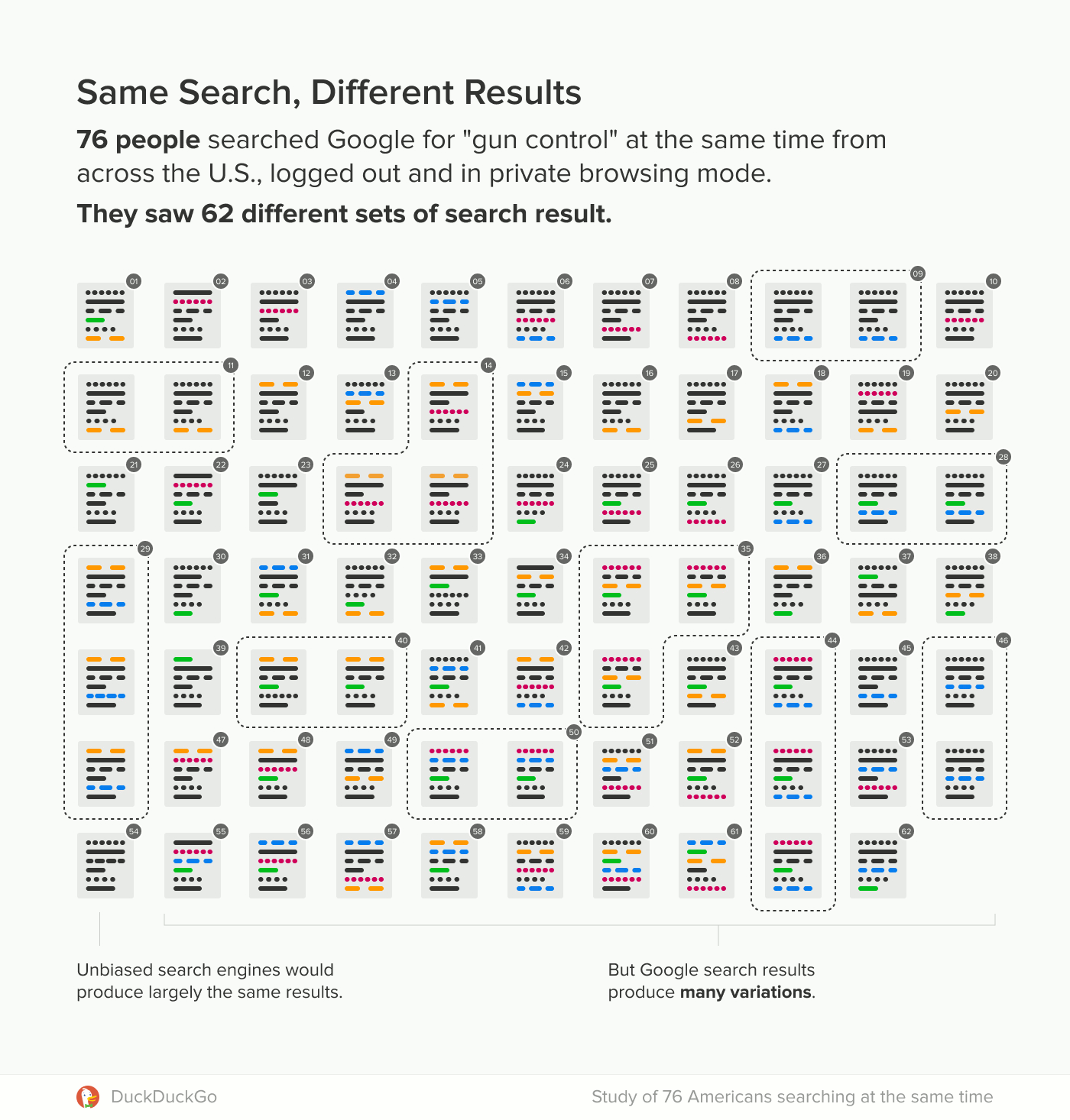
Finding #1: Most people saw results unique to them, even when logged out and in private browsing mode.

To count variants of results, we noted the order of the major elements: the organic (regular) links, the news (Top Stories) infobox, and the videos infobox. We ignored ads, sections containing related searches, and other infoboxes. There were variations in these too, but we didn't consider them.

A quick note on ordering of links: You might think that as long as the same links are shown to users, the ordering of them is relatively unimportant, but that's not the case. A given link gets only about half as many clicks as the link before it and twice as many clicks as the link after it. In other words, link ordering matters a lot because people click on the first link much more than the second, and so on.

The amount of variations we saw for each search term is listed below. For this part of the study, we excluded mobile results because the number of infoboxes displayed can vary significantly between mobile and desktop. That's why it says 76 participants instead of the overall total of 87. We also controlled for location (more on that below).

Private browsing mode (and logged out):

  • "gun control": 62 variations with 52/76 participants (68%) seeing unique results.
  • "immigration": 57 variations with 43/76 participants (57%) seeing unique results.
  • "vaccinations": 73 variations with 70/76 participants (92%) seeing unique results.
Normal mode:

  • "gun control": 58 variations with 45/76 participants (59%) seeing unique results.
  • "immigration": 59 variations with 48/76 participants (63%) seeing unique results.
  • "vaccinations": 73 variations with 70/76 participants (92%) seeing unique results.
Measuring the

With no filter bubble, one would expect to see very little variation of search result pages — nearly everyone would see the same single set of results. That's not what we found.

Instead, most people saw results unique to them. We also found about the same variation in private browsing mode and logged out of Google vs. in normal mode.

Now, some search result variation is expected due to two factors that we controlled for. First, search results can change over time, such as the inclusion of time-sensitive links. We controlled for this factor by having everyone search at the same time.

Second, search results can change by location, such as the inclusion of local news articles. We controlled for this factor by checking all links by hand for this possibility, comparing them to the city and state of the volunteer. We saw very few local links for gun control (1 organic link, 1 news infobox link) and immigration (0), though more for vaccinations (15 organic links, 4 news infobox links).

To control for these local links, we replaced all of them with the same placeholder — localdomain.com for organic links and "Local Source" for infoboxes — in all of our analysis. This adjustment means two users whose results only differed by a different local domain in the same slot would not count as different. Interestingly, this adjustment didn't affect overall variation significantly.

Another reason you might expect some variation is testing of the search algorithm, where you show slightly different results to different people. In that case, you'd expect to see most people seeing the same results, with a few people seeing slight differences. What we saw, by contrast, was most people seeing different results.

Finding #2: Google included links for some participants that it did not include for others.

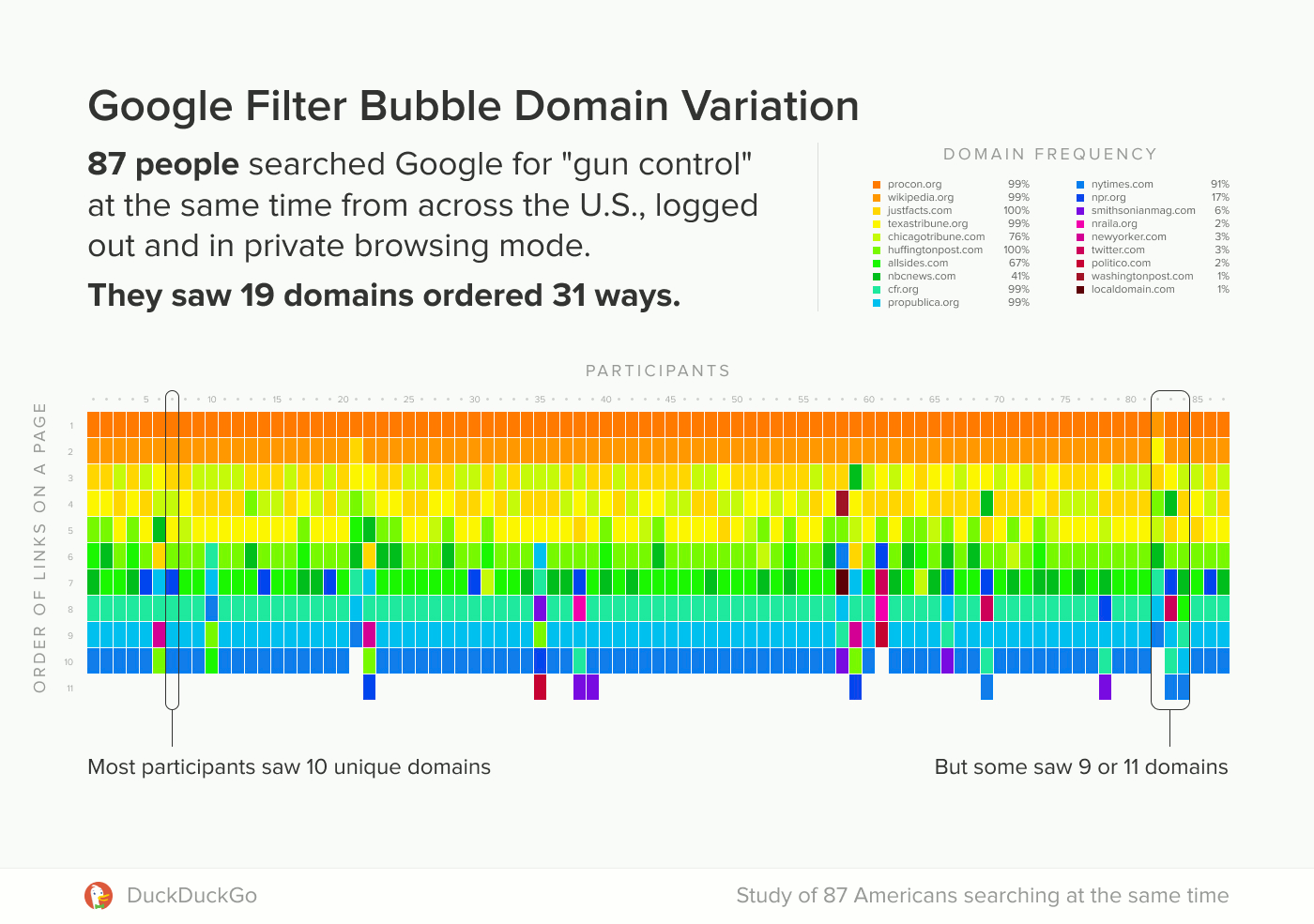
Google search results typically have ten organic links. While the ordering of those links really matters (i.e. link #1 gets ~40% of clicks, link #2 ~20%, link #3 ~10% and so on), we also wanted to know how many different domains were being displayed.

With no filter bubble, one would expect to see this total to be around ten. We saw significantly more. In private browsing mode, logged out of Google, and with local domains replaced with localdomain.com, here are the totals:

  • "gun control": 19 different domains
  • "immigration": 15 different domains
  • "vaccinations": 22 different domains
Measuring the

As you can see this clearly in the visualization above, some people were shown a very unusual set of results relative to the other participants, offered some domains seen by no-one else. If you were one of these people, you would have no way of knowing what you're missing.

Finding #3: We saw significant variation within the News and Videos infoboxes.

We also wanted to look at variation within the news (Top Stories) and videos infoboxes. We also saw significant variation within those, even though there are only three slots available. Again, these are for private browsing mode, logged out of Google, and with local domains replaced with "Local Source".

News infobox:

  • "gun control": 3 variations from 5 sources, appearing for 75/76 people. The most common variation was seen by 69 people (90%).
  • "immigration": 6 variations from 7 sources, appearing for 76/76 people. The most common variation was seen by 35 people (46%).
  • "vaccinations": 2 variations from 3 sources, appearing for 2/76 people. Each variation was seen by one person (1%).

Videos infobox:

  • "gun control": 12 variations from 7 sources, appearing for 75/76 people. The most common variation was seen by 24 people (32%).
  • "immigration": 6 variations from 6 sources, appearing for 75/76 people. The most common variation was seen by 42 people (55%).
  • "vaccinations": Not shown in the search results.

As an example, the Videos infobox for the "immigration" query showed the following six variations. As with organic search results, the ordering matters here because the second and third slots get far fewer clicks.

  • Today, MSNBC, NBC News (shown to 42 participants)
  • MSNBC, Today, NBC News (shown to 26 participants)
  • Today, MSNBC, MSNBC (shown to 4 participants)
  • MSNBC, Today, Today (shown to 1 participant)
  • New York Times, CNN, MSNBC (shown to 1 participant)
  • Today, MSNBC, RealClearPolitics (shown to 1 participant)

Remember, we had people search at the same time, and we changed all local-links to the be same, so this variation is not explained by time or location. And again, some people were real outliers; in fact, some didn't see the infoboxes at all.

Finding #4: Private browsing mode and being logged out of Google offered almost zero filter bubble protection.

Finally, we saw the variation in private browsing mode (also known as incognito mode) and logged out of Google as about the same as in normal mode. Most people expect both being logged out and going "incognito" to provide some anonymity. Unfortunately, this is a common misconception as websites use IP addresses and browser fingerprinting to identify people that are logged out or in private browsing mode.

If search results were more anonymous in these states, then we would expect everyone's private browsing mode results to be similar. That's not what we saw.

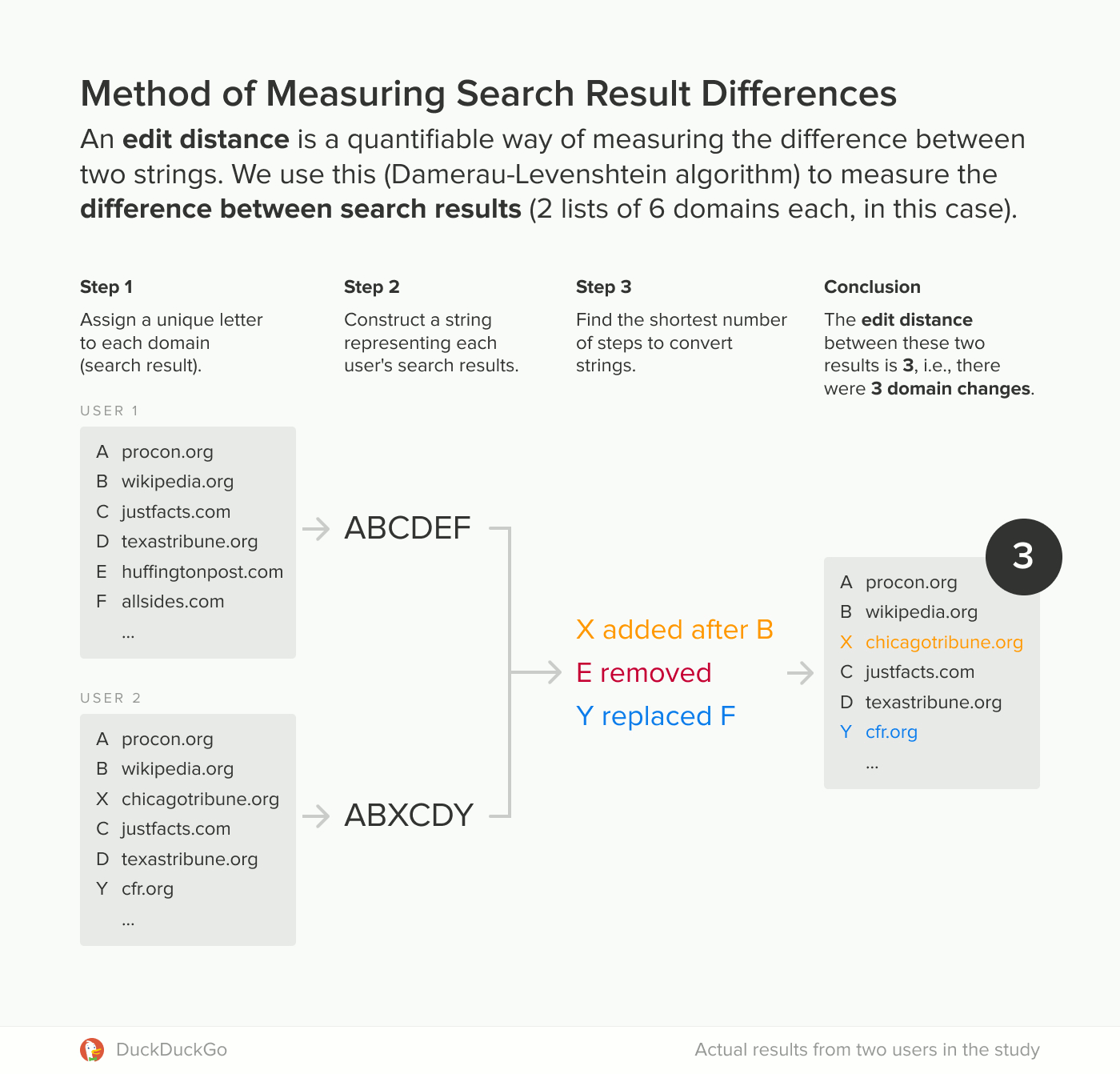
To test this more rigorously, we took the organic results, excluding ads and infoboxes, and:

  1. Assigned each domain a letter (e.g. A for nytimes.com, B for wsj.com, etc.).
  2. Made a string of letters for each person's results, e.g. ABDFJKMSL.
  3. Compared these strings to see how similar they were to each other.

To do this comparison we counted domain changes between different sets of search results, reducing the differences to a number. For example, ABC -> ACB is one change. (Technically, we used a letter to represent each domain within each search result and calculated the Damerau-Levenshtein edit distance between them.)
Measuring the

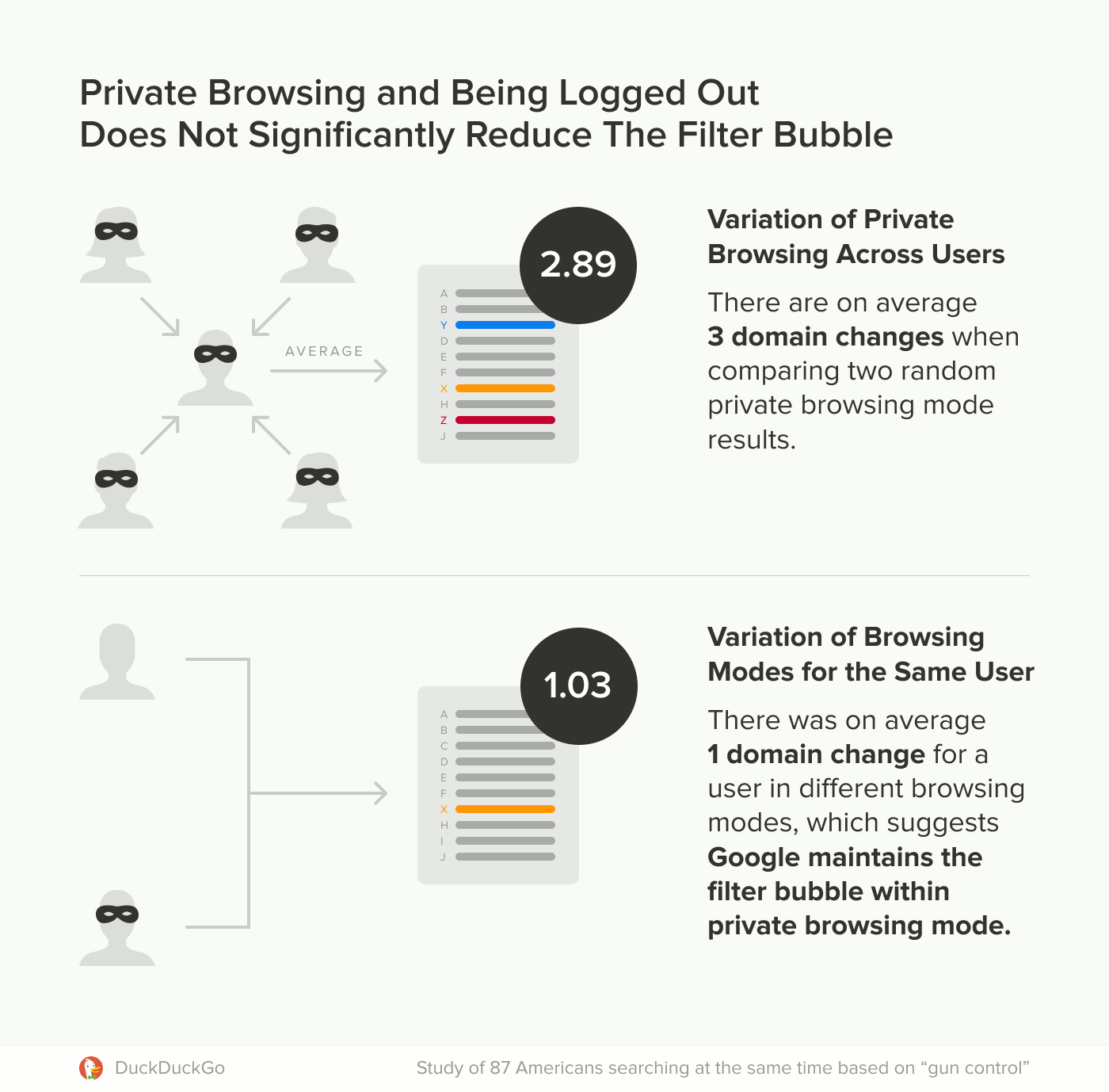
We saw that when randomly comparing people's private modes to each other, there was more than double the variation than when comparing someone's private mode to their normal mode:

gun control:

  • Average of normal and private browsing mode (same user): 1.03
  • Average of private browsing mode (random user): 2.89
  • Average of private browsing mode (five closest users): 2.65

immigration:

  • Average of normal and private browsing mode (same user): 1.38
  • Average of private browsing mode (random user): 3.28
  • Average of private browsing mode (five closest users): 2.80

vaccinations:

  • Average of normal and private browsing mode (same user): 2.23
  • Average of private browsing mode (random user): 4.97
  • Average of private browsing mode (five closest users): 4.25
Measuring the

We often hear of confusion that private browsing mode enables anonymity on the web, but this finding demonstrates that Google tailors search results regardless of browsing mode. People should not be lulled into a false sense of security that so-called "incognito" mode makes them anonymous.

Study Data and Code

The data is available for download in two parts: Basic non-identifiable participant data, and raw data from the search results.

The code that we wrote to analyze the data is open source and available on our GitHub repository.


For more privacy advice, follow us on Twitter & get our privacy crash course.


from DuckDuckGo Blog https://spreadprivacy.com/google-filter-bubble-study/
via Middlesbrough

Wednesday, 17 October 2018

Most Americans aren't aware that Facebook owns WhatsApp, or that Google owns Waze

That's a problem as more and more Americans look to take control of their privacy online.

Most Americans aren't aware that Facebook owns WhatsApp, or that Google owns Waze

In the past six months, many have been rudely awakened by the lack of privacy within the behemoth data platforms of Facebook and Google. A recent report by Pew Research Center found that a majority of Americans are significantly changing their relationship with Facebook, with about half taking breaks from the platform in one way or another.

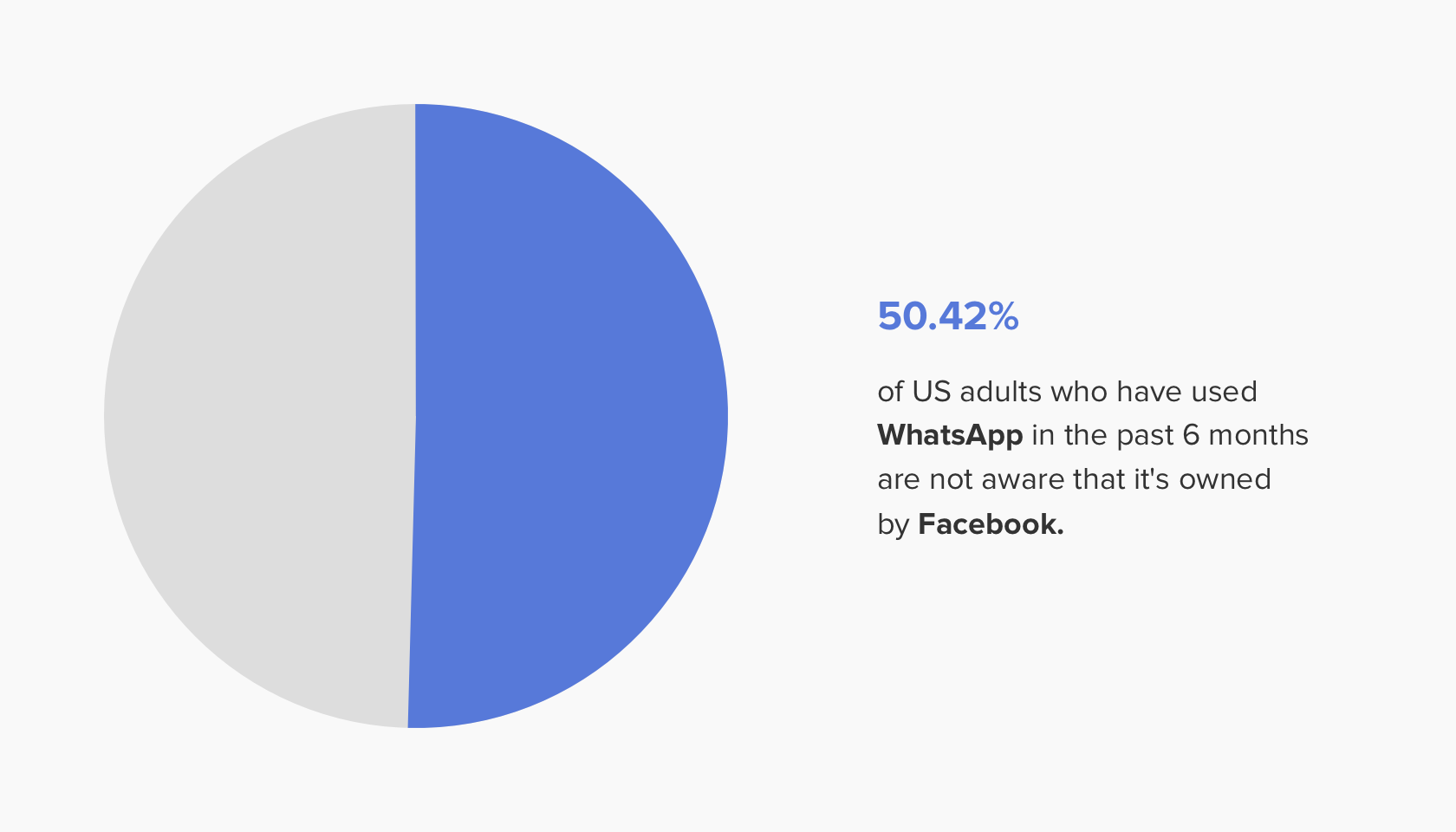
But as Facebook usage wanes, messaging apps like WhatsApp are growing in popularity as a "more private (and less confrontational) space to communicate." That shift didn't make much sense to us because both services are owned by the same company, so we tried to find an explanation. It turns out that a striking percentage of American adults actually don't know that Facebook owns WhatsApp. 😱

We randomly selected 1,297 random U.S. adults (not just DuckDuckGo users) who are collectively demographically similar to the general population of U.S. adults (see methodology below) and surveyed them on August 16th, 2018. Half of those who used WhatsApp in the past six months weren't aware that Facebook owns WhatsApp.

Most Americans aren't aware that Facebook owns WhatsApp, or that Google owns Waze

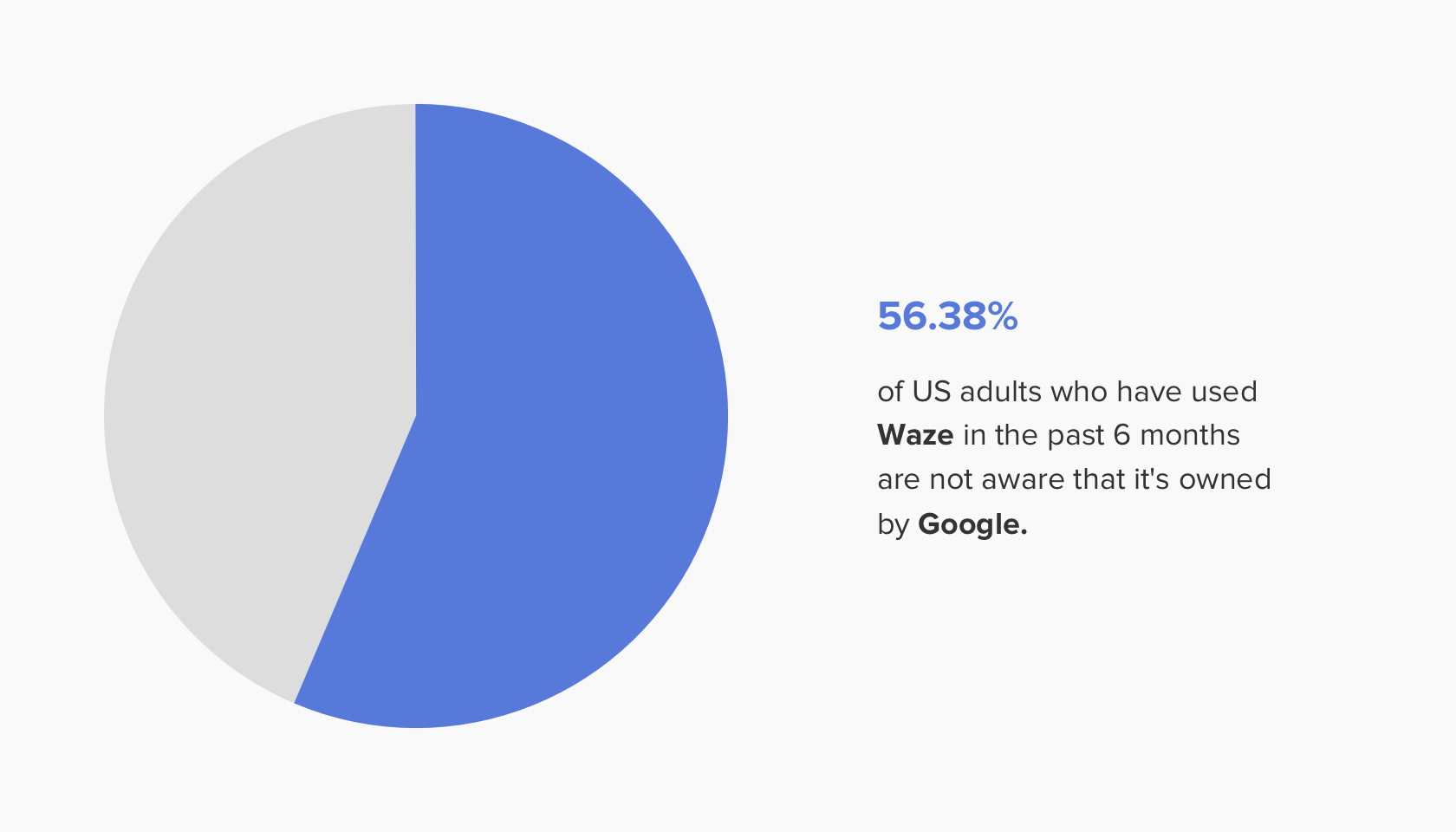
And it doesn't stop there. We also found that nearly 60 percent of those who used Waze in the past six months didn't know that Google owns Waze. 🚨

Most Americans aren't aware that Facebook owns WhatsApp, or that Google owns Waze

This means that a majority of Americans who are using WhatsApp and/or Waze are doing so without realizing that all of their information, whether it be routes, travel time, messages, photos, or location data, is privy to Facebook (for WhatsApp) and Google (for Waze).

As Waze states in its privacy policy:

Waze may also share personal information with companies or organizations connected or affiliated with Waze, such as subsidiaries, sister-companies and parent companies (i.e. entities that belong to the Google group of companies).

If that's not creepy enough, the social component of the Waze app means that the app is also able to collect information like your voice recordings, chats you have with friends within the app, and contacts within your cell phone.

And as was recently made clear when WhatsApp's original co-founder left the company this past April, the threat Facebook poses to WhatsApp user privacy is significant.

The lack of awareness over Facebook and Google's reach is even more alarming as more and more Americans are looking to take control of their privacy online, but don't have the information to make conscientious choices. It misleads people into believing they can avoid the treacherous waters of Google and Facebook privacy practices by standing in a smaller stream like Waze or WhatsApp, without knowing each directly flows into the very same oceans they attempted to escape.

This new survey is similar to our April 2018 findings that found that 56.90% (± 2.86%) of American adults were unaware that Facebook owns Instagram and 44.67% (± 2.87%) did not know that Google owns YouTube.

Methodology

These results are based on the polling of a random sample of 1,297 American adults (18+) on August 16th, 2018 via SurveyMonkey's Audience platform, which ensures the demographic make-up of respondents is representative of the U.S. population. Survey respondents were paid and a confidence level of 95% was used for calculating the values above.

For more privacy advice, follow us on Twitter & get our privacy crash course.


from DuckDuckGo Blog https://spreadprivacy.com/facebook-whatsapp/
via Middlesbrough
Wednesday, 22 August 2018

DuckDuckGo Partners with OMERS Ventures to Expand Canadian Presence and Global Impact

DuckDuckGo Partners with OMERS Ventures to Expand Canadian Presence and Global Impact

Consumers are increasingly facing privacy invasions wherever they turn: hyper-targeted ads and massive data breaches are now daily occurrences, along with their unfortunate consequences (ad discrimination, identity theft, spreading misinformation, filter bubbles, etc.). As a result, the demand for online privacy is growing - and it's growing fast. As an internet privacy company, we've felt the effects of this demand firsthand at DuckDuckGo.

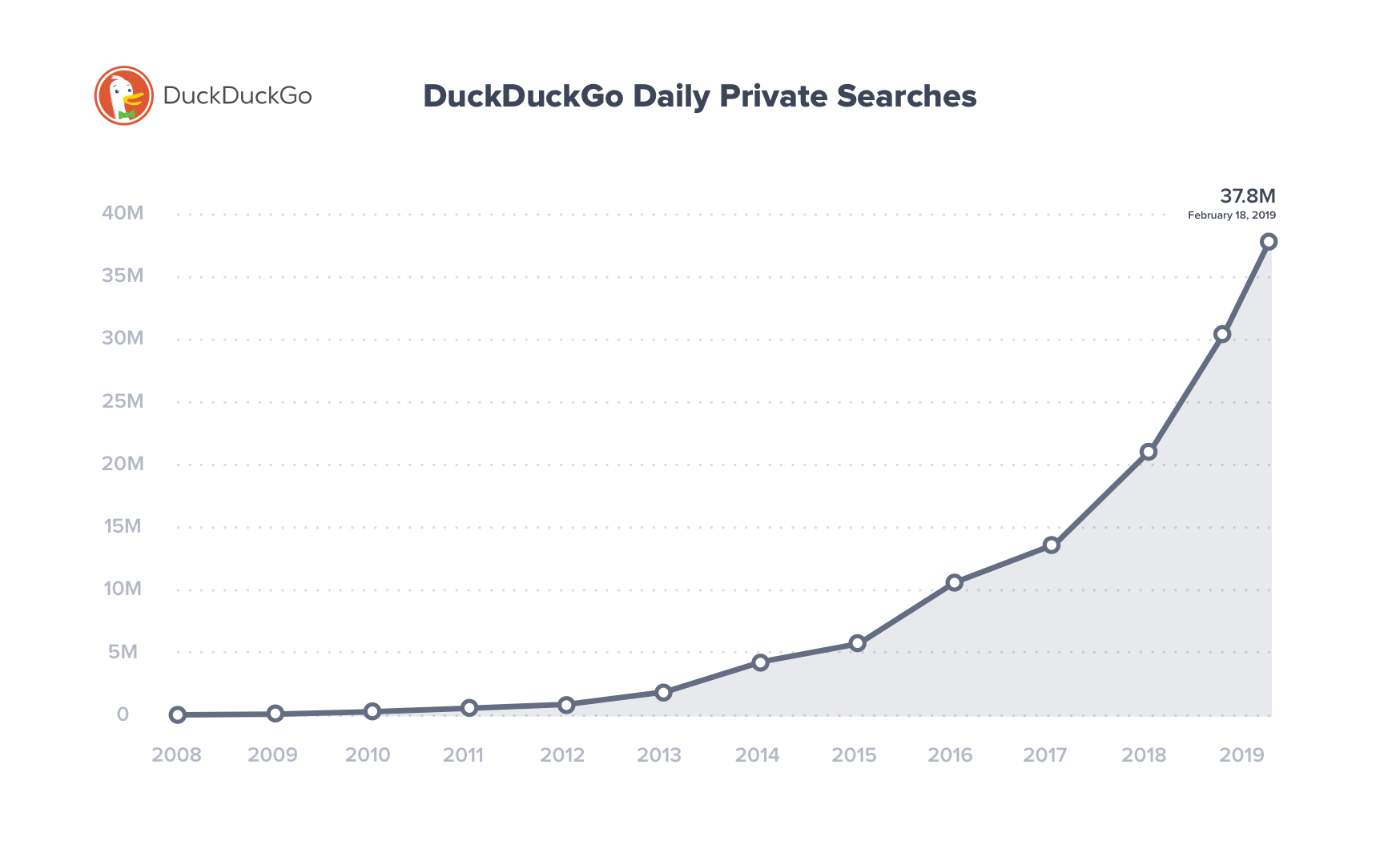
In the wake of Facebook's Cambridge Analytica scandal, we hit our all-time high daily direct search record - a whopping 25,568,558 private searches. And since this year, we're proud to report that our apps and browser extensions - DuckDuckGo Privacy Essentials - now do more than just private searching. They also come packaged with best-in-class tracker blocking, smarter encryption, and website privacy grades - all the privacy essentials you need on any device with just one download.

Despite our progress this year, we've still got more to do to advance our vision of raising the standard of trust online. Today, we're announcing a partnership with OMERS Ventures (OV), part of the $95 Billion global OMERS pension fund, based in Canada. Their expertise, shared interest in privacy, and investment in DuckDuckGo will help us continue expanding our privacy protections across the globe.

DuckDuckGo has been a profitable company since 2014 without storing or sharing any personal information of our users. By partnering with OMERS, we hope to bring our profitable privacy-centric business model to more places.

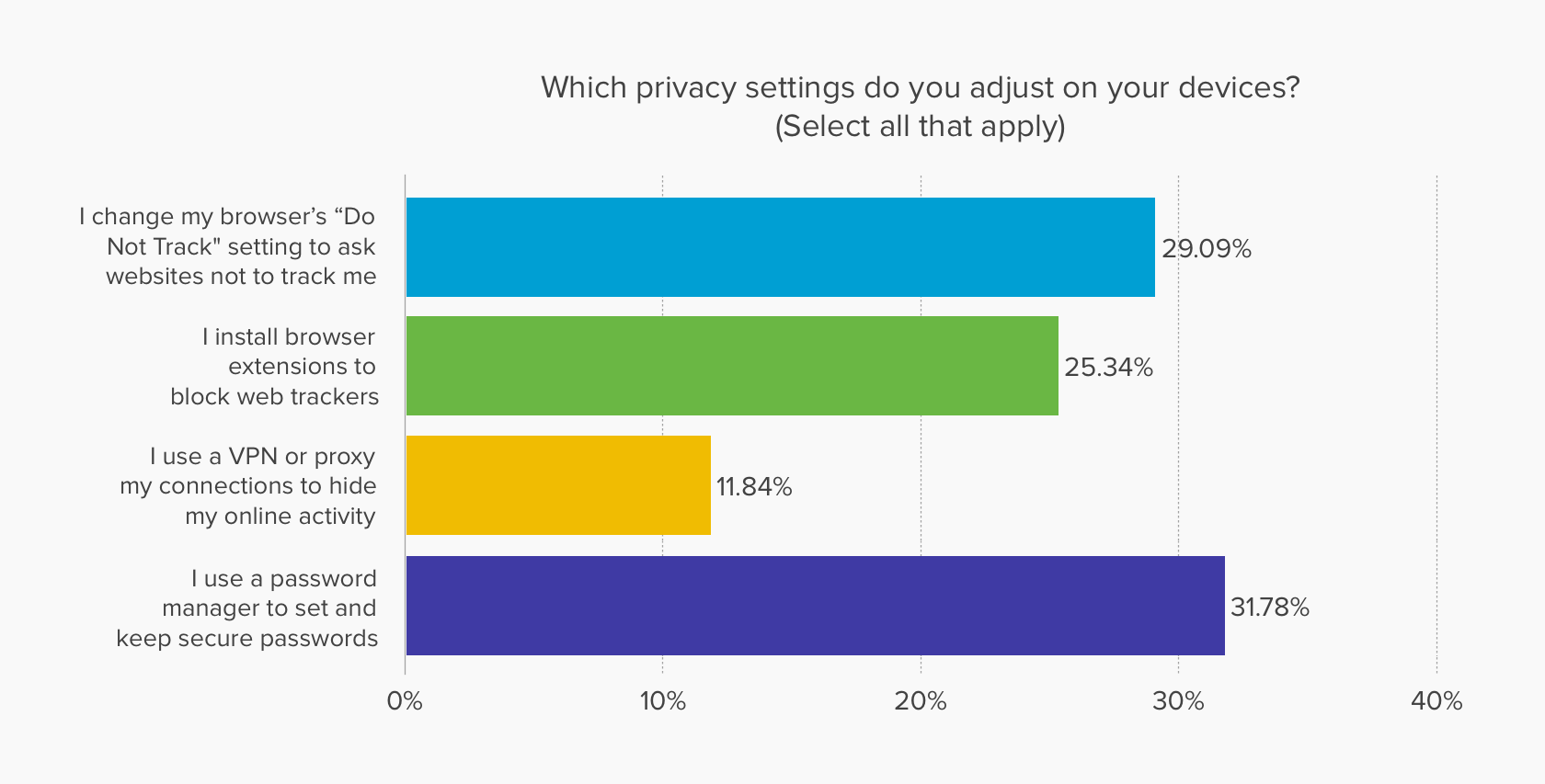
This partnership comes at just the right time as the need for privacy continues to grow globally. In a July 2018 survey of 667 Canadian adults, we found that 43% have taken a significant online privacy action, such as installing "browser extensions to block web trackers."

DuckDuckGo Partners with OMERS Ventures to Expand Canadian Presence and Global Impact

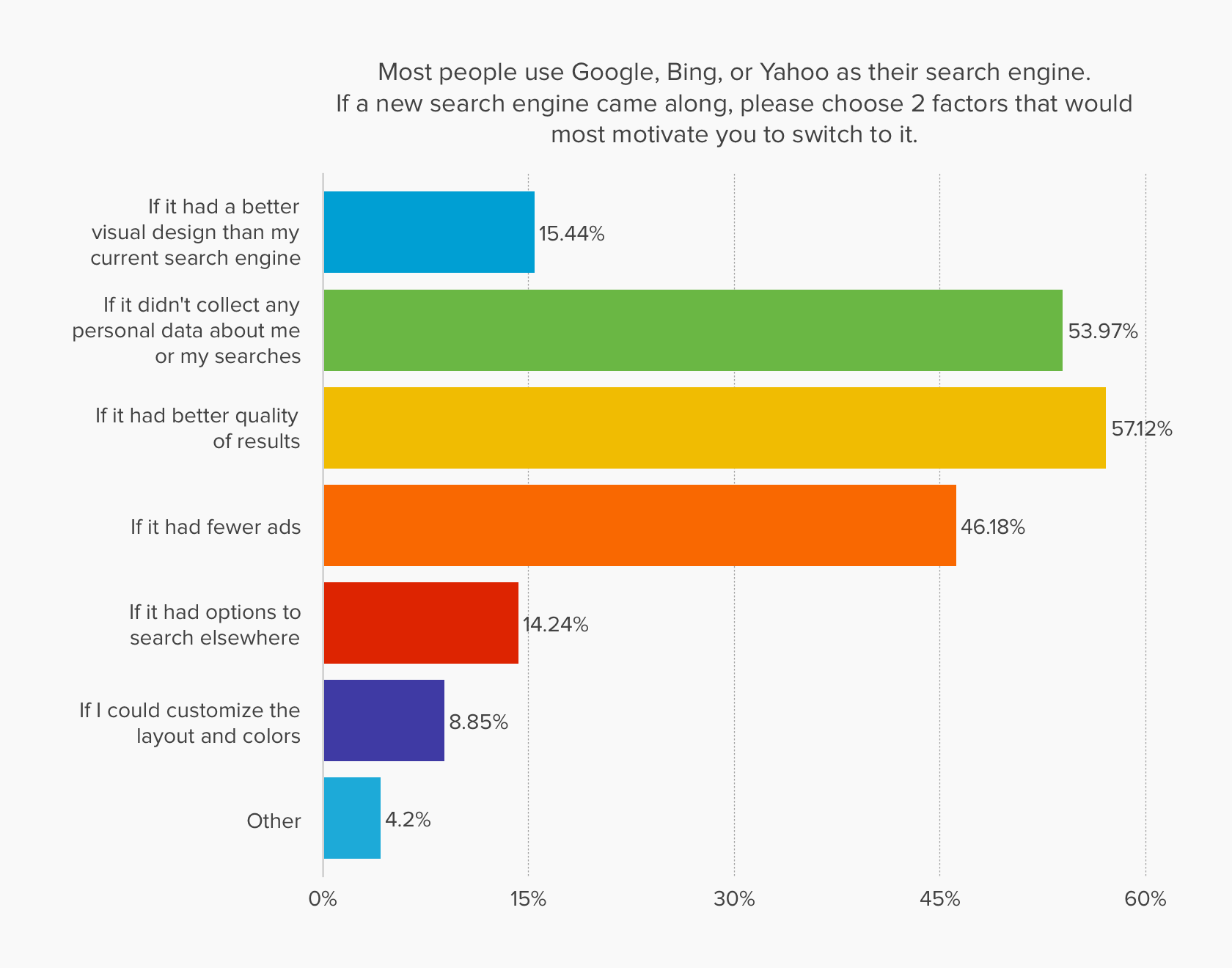
Additionally, 53% of Canadians say that having a search engine that "didn't collect any personal data about me or my searches" would be among the top two motivations to switch search engines. Privacy is alive and mainstream in Canada, just like in many other parts of the globe.

DuckDuckGo Partners with OMERS Ventures to Expand Canadian Presence and Global Impact

We hope to be able to report continued progress in helping Internet users across the globe protect their privacy. We believe the internet shouldn't feel so creepy (right?) and it's our mission to empower people with seamless tools to take control of their personal information online, without any tradeoffs.

For privacy advice, follow us on Twitter & get our privacy crash course.


from DuckDuckGo Blog https://spreadprivacy.com/duckduckgo-partners-with-omers-ventures-to-expand-canadian-presence-and-global-impact/
via Middlesbrough
Thursday, 28 June 2018

Three Reasons Why the "Nothing to Hide" Argument is Flawed

Three Reasons Why the

Over the years, we at DuckDuckGo have often heard a flawed counter-argument to online privacy: “Why should I care? I have nothing to hide.”

As Internet privacy has become more mainstream, this argument is rightfully fading away. However, it’s still floating around and so we wanted to take a moment to explain three key reasons why it's flawed.

1) Privacy isn’t about hiding information; privacy is about protecting information, and surely you have information that you’d like to protect.

Do you close the door when you go to the bathroom? Would you give your bank account information to anyone? Do you want all your search and browsing history made public? Of course not.

Simply put, everyone wants to keep certain things private and you can easily illustrate that by asking people to let you make all their emails, texts, searches, financial information, medical information, etc. public. Very few people will say yes.

2) Privacy is a fundamental right and you don't need to prove the necessity of fundamental rights to anyone.

You should have the right to free speech even if you feel you have nothing important to say right now. You should have the right to assemble even if you feel you have nothing to protest right now. These should be fundamental rights just like the right to privacy.

And for good reason. Think of commonplace scenarios in which privacy is crucial and desirable like intimate conversations, medical procedures, and voting. We change our behavior when we're being watched, which is made obvious when voting; hence, an argument can be made that privacy in voting underpins democracy.

3) Lack of privacy creates significant harms that everyone wants to avoid.

You need privacy to avoid unfortunately common threats like identity theft, manipulation through ads, discrimination based on your personal information, harassment, the filter bubble, and many other real harms that arise from invasions of privacy.

In addition, what many people don’t realize is that several small pieces of your personal data can be put together to reveal much more about you than you would think is possible. For example, an analysis conducted by MIT researchers found that “just four fairly vague pieces of information — the dates and locations of four purchases — are enough to identify 90 percent of the people in a data set recording three months of credit-card transactions by 1.1 million users.”

It’s critical to remember that privacy isn't just about protecting a single and seemingly insignificant piece of personal data, which is often what people think about when they say, “I have nothing to hide.” For example, some may say they don't mind if a company knows their email address while others might say they don't care if a company knows where they shop online.

However, these small pieces of personal data are increasingly aggregated by advertising platforms like Google and Facebook to form a more complete picture of who you are, what you do, where you go, and with whom you spend time. And those large data profiles can then lead much more easily to significant privacy harms. If that feels creepy, it’s because it is.

We can't stress enough that your privacy shouldn’t be taken for granted. The ‘I have nothing to hide’ response does just that, implying that government and corporate surveillance should be acceptable as the default.

Privacy should be the default. We are setting a new standard of trust online and believe getting the privacy you want online should be as easy as closing the blinds.

For more privacy advice, follow us on Twitter & get our privacy crash course.


from DuckDuckGo Blog https://spreadprivacy.com/three-reasons-why-the-nothing-to-hide-argument-is-flawed/
via Middlesbrough
Thursday, 7 June 2018

2018 DuckDuckGo Privacy Donations: $500,000 + $142,000 From You!

2018 DuckDuckGo Privacy Donations: $500,000 + $142,000 From You!

We are proud to share that we've just donated $500,000 to 21 privacy organizations that share our vision of raising the standard of trust online. Each year, we donate to privacy-focused organizations, though this year we're exceptionally excited because an additional $142,482 was donated by 2,113 individuals like you as a part of the DuckDuckGo Privacy Challenge Crowdfunding Campaign, meaning a grand total of $642,482 was raised to help advance privacy rights and tools.

In the wake of the Cambridge Analytica Facebook incident, people are actively seeking out ways to protect their online privacy.

2018 DuckDuckGo Privacy Donations: $500,000 + $142,000 From You!

In this context, we're proud that many of you took the additional step to directly support the organizations that tirelessly protect your online privacy. And just as importantly, through your efforts on social media and beyond, we were also able to increase awareness of these important projects:

For more privacy advice, follow us on Twitter & get our privacy crash course.


from DuckDuckGo Blog https://spreadprivacy.com/2018-duckduckgo-privacy-donations-results/
via Middlesbrough

Saturday, 14 April 2018

A Majority of Americans Don't Know That Facebook Owns Instagram

And 45% Don't Know That Google Owns YouTube

A Majority of Americans Don't Know That Facebook Owns Instagram

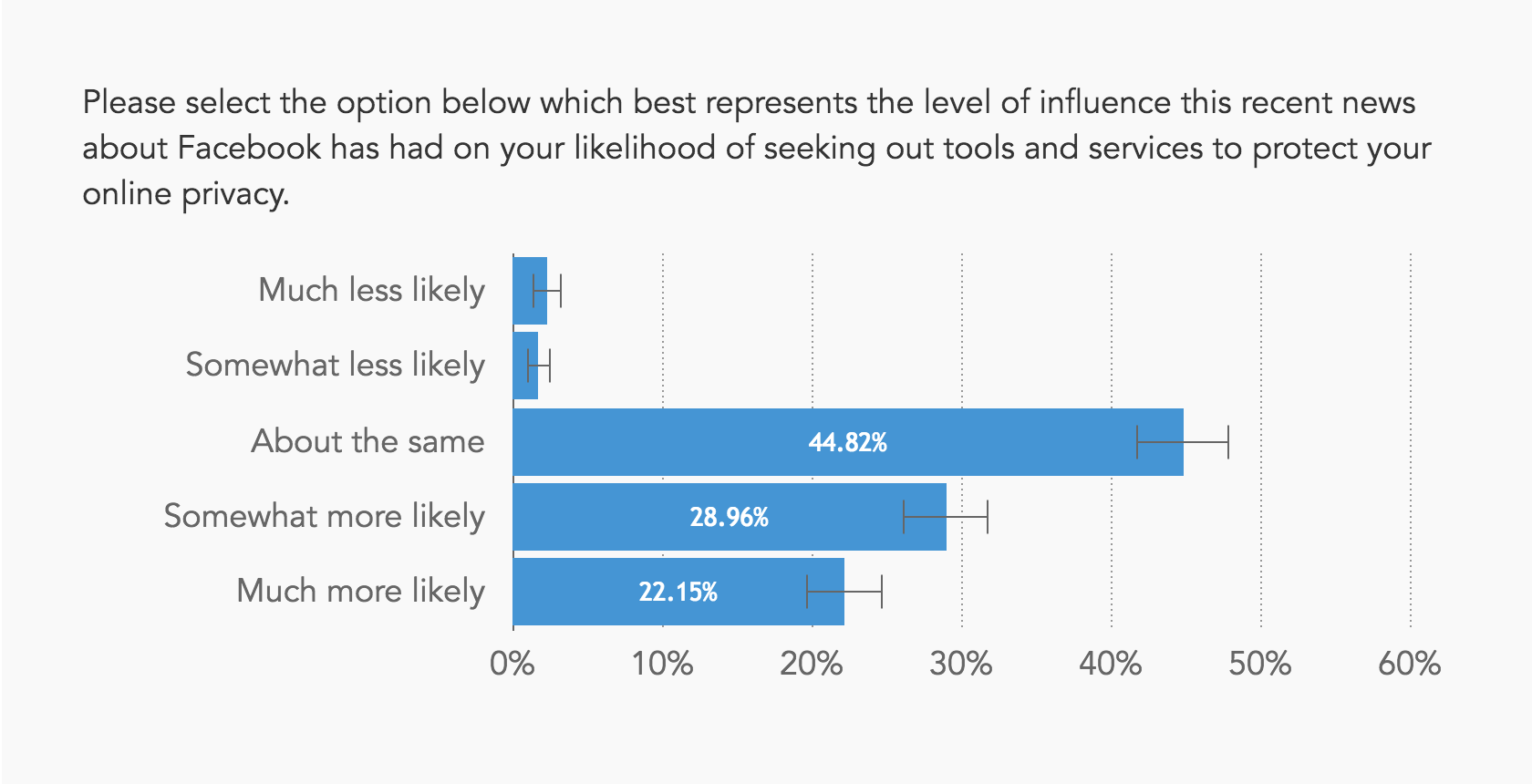
In the wake of news about Cambridge Analytica obtaining the personal data Facebook kept on 50 million Americans, #DeleteFacebook went viral. And, as our recent survey revealed, about 60 percent of Americans plan to share less information with Facebook and nearly 40 percent are now more likely to delete their Facebook accounts. But there’s one big problem: a majority of Americans don’t know that Facebook also owns Instagram.

We surveyed 1,153 random U.S. adults (not just DuckDuckGo users), who collectively are demographically similar to the general population of U.S. adults. Surveys were taken on Mar 26th and 27th, 2018.

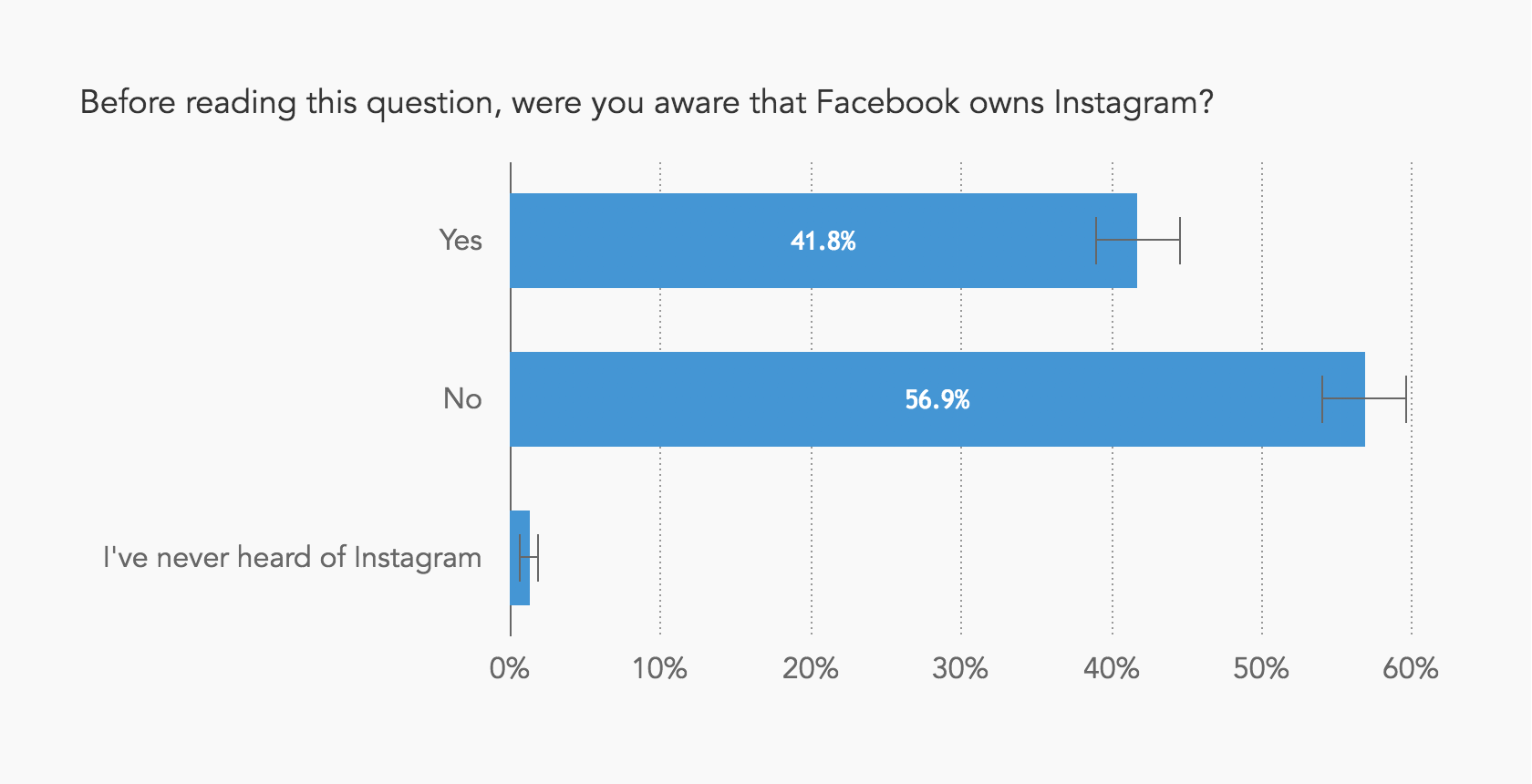
We found that 56.90 percent (± 2.86%) of respondents were unaware that Facebook owns Instagram.

A Majority of Americans Don't Know That Facebook Owns Instagram

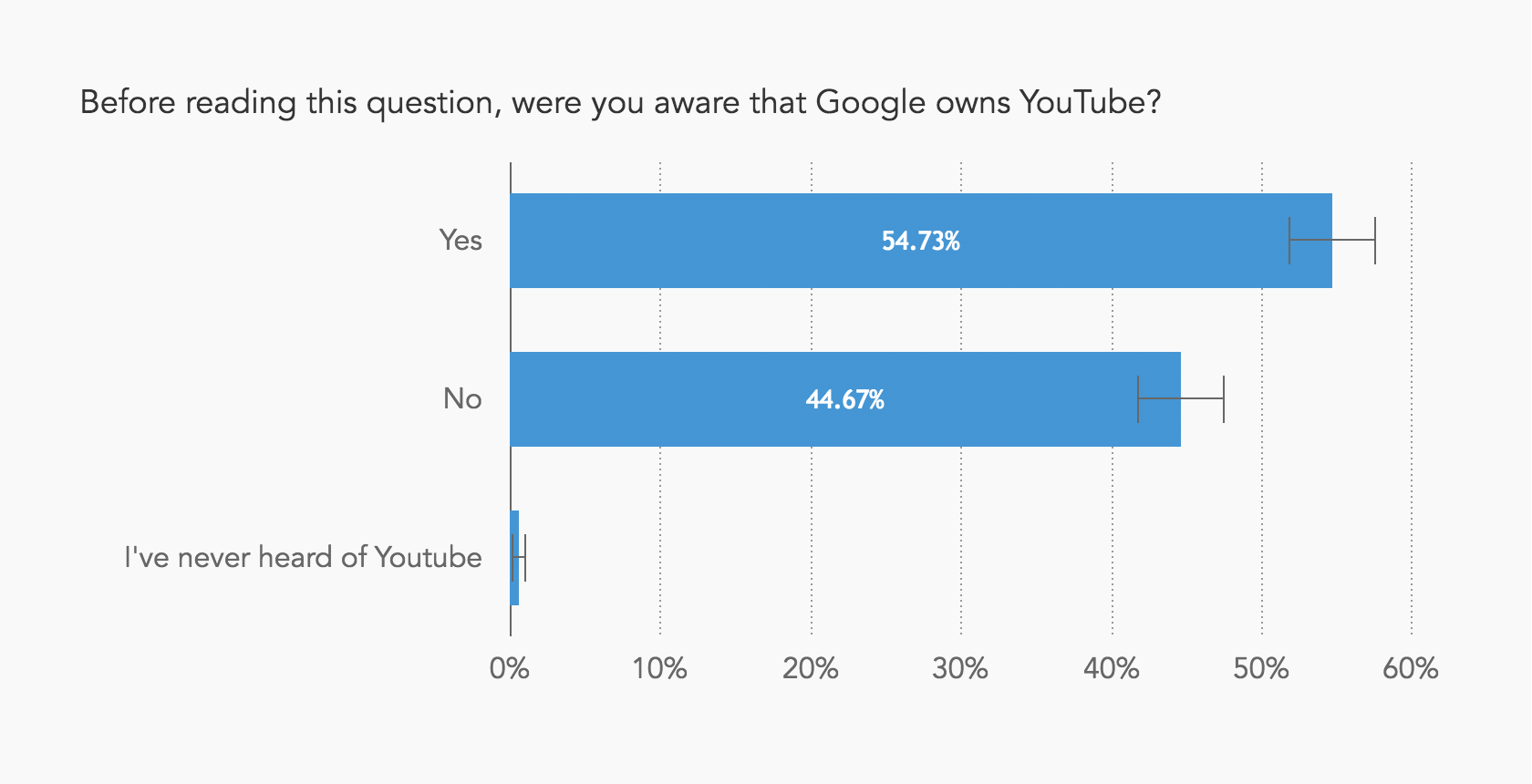
And the problem isn’t just limited to Facebook/Instagram. We also found that almost half of the American population (44.67 ± 2.87%) did not know that Google owns YouTube.

A Majority of Americans Don't Know That Facebook Owns Instagram

Why is this a problem? Case in point:

A Majority of Americans Don't Know That Facebook Owns Instagram

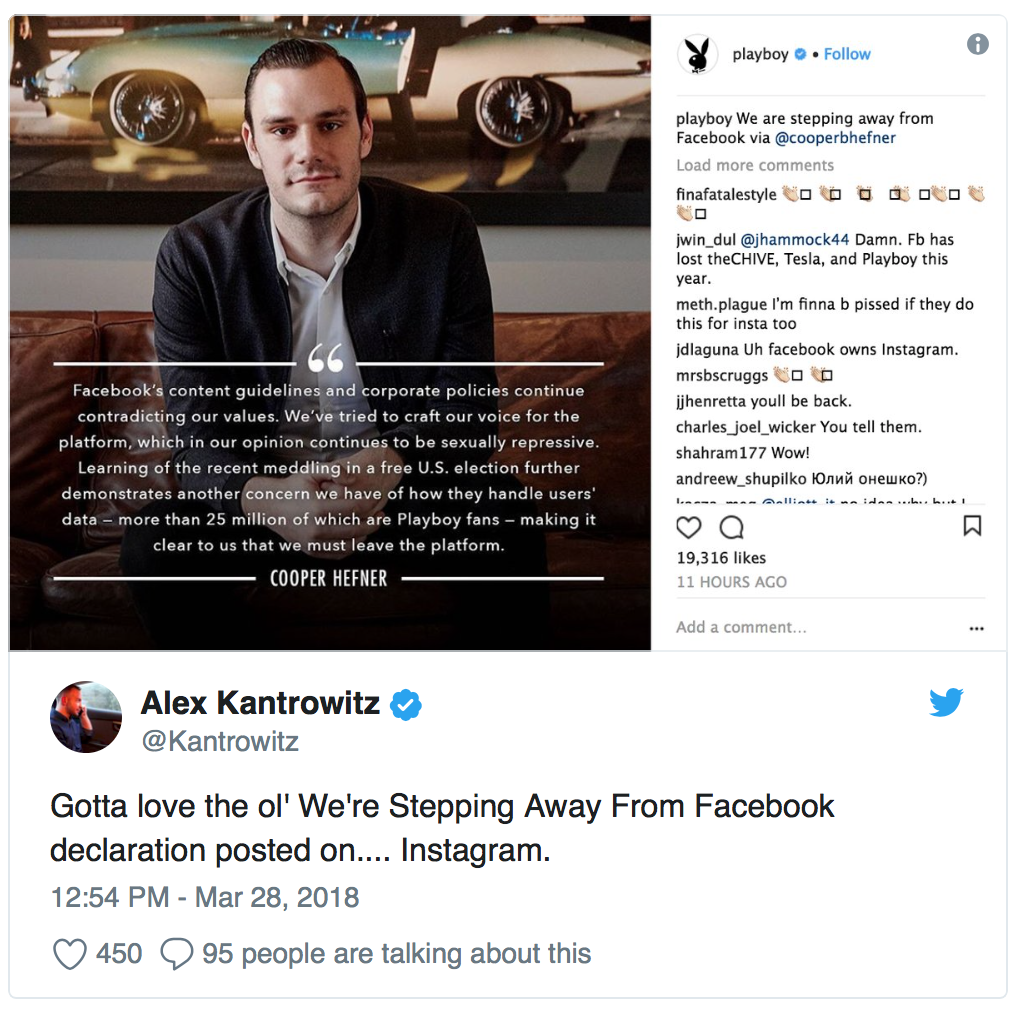
In reaction to #DeleteFacebook, we’ve seen many disengage with Facebook in favor of Instagram, seemingly without realizing that the same company would be handling their personal data.

Quite simply, people who are unaware of the corporate parent ownership of Instagram and YouTube cannot make informed privacy decisions about using them. Facebook and Google amass huge data profiles about people, and can each combine Instagram or YouTube data into these profiles, respectively, further enabling hyper-targeting on their ad platforms.

Add to that the troves of data they’re already collecting on you through their massive tracker networks lurking behind most of the sites you visit, and the question then becomes what don’t they know about you instead of what do they know.
Bottom line: if you want to disengage fully with Facebook, you also need to disengage with Instagram, and also block Facebook's web trackers.

Methodology

These results are based on the polling of a random sample of 1,153 American adults (18+) on March 26th and 27th, 2018 via SurveyMonkey's Audience platform, which ensures the demographic make-up of respondents is representative of the U.S. population. Survey respondents were paid and a confidence level of 95% was used for calculating the values above.


from DuckDuckGo Blog https://spreadprivacy.com/facebook-instagram/
via Middlesbrough